Peter Paul Rubens (1577-1640),’Diana and her Nymphs Spied upon by Satyrs, c.1616, Oil on canvas, 203 x 309.6 cm, Hampton Court Palace, Richmond upon Thames, Greater London
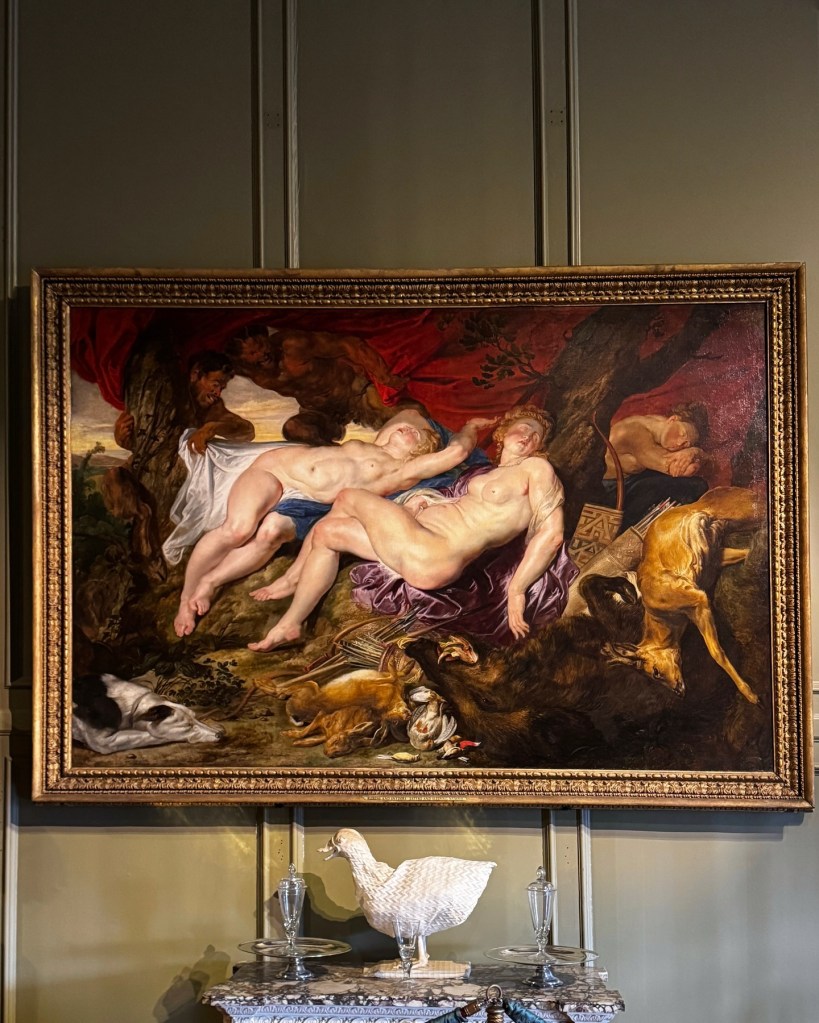
Frans Snyders and Rubens had known each other since childhood, both having grown up in Antwerp before their respective careers took them abroad. Snyders had trained under Pieter Brueghel the Younger (1564–1638) and Jan Brueghel the Elder (1568–1625), and by the time Rubens returned from Italy in 1608 Snyders had established himself as the most accomplished animal and still-life painter in the city. The working arrangement between them was unusually precise. For this canvas, Rubens painted the figures of Diana and her nymphs first, leaving a deliberate blank reserve in the foreground where the accumulated spoils of the hunt would eventually sit. Snyders filled that reserve with the foodstuffs and game that now occupy the lower left of the composition; Rubens then returned to add finishing touches across the picture as a whole. The result is one of two paintings in the Royal Collection produced through this specific division of labour, and the method itself is worth noting: it required both painters to understand the other’s contribution in advance, to plan across each other’s absence from the canvas, and to trust that the final passage of Rubens’s hand would hold the two parts together.
The scene is set at the midpoint of a long hunting day. Diana and her nymphs have been out since dawn and by the heat of the afternoon have taken shelter under a temporary canopy, the morning’s quarry piled around them. The goddess of chastity and the hunt rests with her women, unaware of the satyrs who have crept close to observe them. The subject encodes a specific tension: Diana’s world is exclusively female, governed by the vow of chastity that bound her nymphs to her service, and the satyr represented everything that world refused. He was a creature of woodland appetite, half-bestial, constitutionally unable to observe the boundary between desire and action. That Rubens chose to show him only watching, and not yet intruding, keeps the scene at the moment before the boundary is crossed. The tension is anticipatory rather than dramatic, and the large canvas gives it room to breathe across the full expanse of the composition.
By 1616 Rubens had been back in Antwerp for eight years and his studio at the Wapper was producing large-scale mythological canvases at a pace that no other European workshop could match. His formation in Italy, and particularly his close study of Titian’s (c.1488–1576) handling of female figures in mythological settings, including the poesie series painted for Philip II of Spain, had given him both a compositional vocabulary and a technical approach that northern European painting did not otherwise possess. The warm, luminous handling of flesh against dark wooded settings, the frieze-like organisation of figures moving across a wide horizontal canvas, the use of rich colour accents in the drapery to punctuate and direct the eye: all of these connect this canvas to the Venetian tradition Rubens had absorbed and made his own. The specific precedent for the Diana and satyrs subject is harder to pin down to a single source; the subject appears across ancient poetry and was available through multiple channels, but the pictorial energy of the encounter between ordered female beauty and lurking male disorder belongs to Rubens rather than to any single model.
Rubens returned to this subject in the last decade of his life, producing a later version now in the Museo Nacional del Prado, Madrid, again with Snyders contributing the animals and Jan Wildens (1584–1653) the landscape. The Prado version is more dynamically charged: the satyrs no longer merely watch but have begun to intrude, the nymphs scatter and resist, and the composition opens into a running frieze of flight and pursuit that the Hampton Court version, with its atmosphere of suspended quiet, does not attempt. Comparing the two across the span of roughly two decades tells us something about the direction of Rubens’s mythological work: the earlier treatment holds its drama in reserve, and the later one releases it.


References
Belkin, K.L. (1998) Rubens. London: Phaidon Press
Büttner, N. (2022) ‘Nymphs’ in Mythological Subjects: Hercules to Olympus. Corpus Rubenianum Ludwig Burchard, Part XI, 2. London and Turnhout: Harvey Miller/Brepols
RKD – Netherlands Institute for Art History (n.d.) Rubens and Snyders, Diana and her Nymphs Spied upon by Satyrs, c.1616. RKDimages, image no. 238612. The Hague: RKD – Netherlands Institute for Art History. Available at: https://rkd.nl/en/explore/images/238612 (Accessed: 16 November 2024).
Robels, H. (1989) Frans Snyders: Stilleben- und Tiermaler 1579–1657 [Frans Snyders: Still-Life and Animal Painter 1579–1657]. Munich: Deutscher Kunstverlag.
Royal Collection Trust (n.d.) Rubens and Snyders, Diana and her Nymphs Spied upon by Satyrs, c.1616 (RCIN 405553). Available at: https://www.rct.uk/collection/405553/diana-and-her-nymphs-spied-upon-by-satyrs (Accessed: 16 November 2024).
Vergara, A. (1999) Rubens and his Spanish Patrons. Cambridge: Cambridge University Press
White, C. (1987) Peter Paul Rubens: Man and Artist. New Haven and London: Yale University Press
Other sources
Yubero Hierro, S. (2025) ‘A Collaboration between Rubens and Snyders on the Pictorial Representation of Ophidians’, Eikón Imago, 14, Imago Universidad Complutense de Madrid, Available at: https://www.academia.edu/127516441/A_collaboration_between_Rubens_and_Snyders_on_the_pictorial_representation_of_ophidians_Three_works_with_snakes_by_Snyders_displayed_in_museums_in_Madrid Accessed 12 December 2025)