Chiesa di San Nicola alla Carità (Church of Saint Nicholas of Myra), Naples
The plague that swept Naples in 1656 killed around half the city’s population, including almost all of the Pii Operai congregation who had been tending the sick, and the architect they had hired nine years earlier to build their new church on Via Toledo. Onofrio Antonio Gisolfi (died 1656) had been chief royal engineer to the Kingdom of Naples, a serious if not celebrated figure, succeeding Bartolomeo Picchiatti (1571–1643) in that role and occupied with the Regi Lagni reclamation works and the Palazzo Reale alongside his ecclesiastical commissions. He had begun work on the church in 1647. By the time he died, the left aisle and the hypogeum (the underground burial chamber) had been built. The painter Bernardo Cavallino (1616–1656), one of the most refined Neapolitan colourists of his generation, also died in the contagion, and his body was placed in that same hypogeum.
The site sat dormant for twelve years. Work resumed on 18 March 1668 under Cosimo Fanzago (1591–1678), who modified the earlier scheme, and the church was finally blessed on 5 July 1682 under the patronage of Cardinal Diego Innico Caracciolo di Martina. There is an irony worth noting here: in 1645, while Gisolfi was briefly absent from Naples, Fanzago had attempted to take his post as chief royal engineer. The commission of the man he had once tried to displace passed, by way of the plague, into his hands.
The Pii Operai themselves are often confused with the Theatines, and it is a confusion that travels easily into popular guidebooks. The two orders are entirely distinct. The Theatines were founded in 1524 by St Cajetan (1480–1547) and Gian Pietro Carafa (1476–1559), the future Pope Paul IV. The Pii Operai (formally the Congregation of Pious Workers, in Latin Congregatio Piorum Operariorum) were founded in Naples around 1600 by a different Carafa: Carlo Carafa (1561–1633), of a junior branch of the Neapolitan noble family, who had been educated at the Jesuit college in Nola, had been forced out of the Society of Jesus by ill health, and then spent more than a decade as a soldier before returning to religious life in his thirties. His pastoral work attached itself to the most exposed parts of Neapolitan society: the inmates of the Ospedale degli Incurabili, the dying and the condemned (through the Compagnia dei Bianchi), reformed prostitutes (for whom he founded a conservatorio in 1602), and from around 1605 the rural villages around the city. Pontifical recognition came in 1606, formal approval as the Pii Operai followed in 1621 under Pope Gregory XV.
The funding of the church carries its own legend. According to the tradition the congregation preserved, a beggar whom they had been nursing for a long time died in their care, and the rags in which he had been wrapped were found to contain six thousand ducats. A second donation of six thousand ducats followed from another patient, Giovan Battista Burgo, in similar gratitude. Whether the beggar story is exact or polished in the retelling, the property on Via Toledo was bought in 1647 with that capital, and Gisolfi began work. The relics of St Nicholas of Bari, specifically a phalanx of the saint’s index finger, were translated from Scala in the Amalfi peninsula when the new church was blessed, and gave it its dedication.
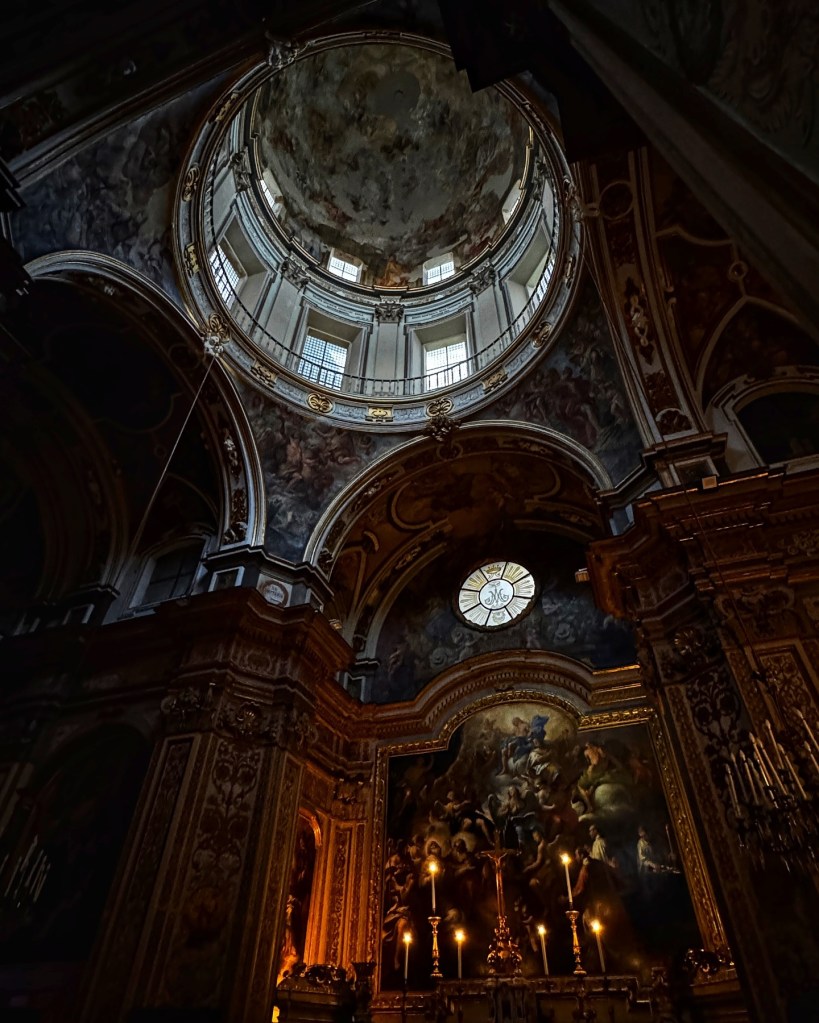
What the visitor sees today is essentially eighteenth-century decoration within a seventeenth-century shell. The architecture is sober, a Latin-cross plan with three aisles, in keeping with Counter-Reformation preaching practice rather than the more inventive geometries that Fanzago and his peers were testing in other Neapolitan commissions. The interior matters because of what was done to its surfaces over the following century, by three painters in succession.
The principal campaign was Francesco Solimena’s (1657–1747). Between 1696 and 1701, Solimena, then in his late thirties and rising into the position he would hold for the next fifty years as the dominant figure in Neapolitan painting, frescoed the vault of the central nave with three scenes from the Life of St Nicholas: the Birth of the Saint, the Liberation, and the Abduction of the Boy Basilio. The lateral spandrels near the windows hold figures of the Apostles and the Virtues. He added two large transept altarpieces, the Sermon of St John the Baptist and the Sermon of St Paul (both 1697), and painted lunettes on the counter-façade. A protracted dispute with the Pii Operai (resolved only in 1708) led him to abandon the worksite for some years, although he later returned to design the lower order of the façade, begun in 1723 and finished only in 1776 by Salvatore Gandolfo, who completed the upper order to his own design. The two marble angels above the central portal were begun by Francesco Pagano in 1725 and completed by Paolo Persico in 1775; the bronze bust of St Nicholas between them is by Bartolomeo Granucci.
The apse and dome were finished by two painters who together represent the next generation. Paolo De Matteis (1662–1728), the favourite pupil of Luca Giordano (1634–1705) and Solimena’s principal rival, frescoed the vault of the apse, the wall above the choir and the pendentives of the dome between 1700 and 1702, and in 1707 added the large canvas of the Death of St Nicholas behind the high altar together with the lateral apse paintings. The fresco of St Nicholas Driving Demons from a Tree above the entrance was completed in 1712. Francesco De Mura (1696–1782), Solimena’s principal follower in the next generation, frescoed the dome itself (the Healing of the Sick by St Nicholas and the Paradise) and contributed the Visitation, the Nativity, the Doctors of the Church and several individual saints. The high altar itself, an inlaid polychrome marble construction, was designed by Mario Gioffredo (1718–1785), the architect later given the epithet ‘the Neapolitan Vitruvius’, and executed by Antonio Troccola in 1743.
The altarpiece behind the high altar, Paolo De Matteis’s Transito di San Nicola [the Passing, or Death, of St Nicholas], was painted in 1707, and its commission cannot be separated from the breakdown that had just occurred between the Pii Operai and Francesco Solimena. The order had quarrelled with Solimena badly enough that he had abandoned the worksite, in a rupture only patched up in 1708, and they needed a painter capable of finishing the apse with credibility. De Matteis (1662–1728) was the obvious successor. He was Solimena’s principal rival in the city, the pupil whom the historiographer Luigi Lanzi (1732–1810) would later describe as Luca Giordano’s (1634–1705) best, and he had already worked inside the building between 1700 and 1702, on the apse vault, the wall above the choir and the pendentives of the dome. He was, in other words, neither a stranger to the site nor an unknown quantity to the order. There was also a particular circumstantial advantage. Between 1702 and 1705, De Matteis had been at the French court, invited by Victor-Marie, Comte d’Estrées (1660–1737), where he worked for Louis the Grand Dauphin (1661–1711), for the financier Antoine Crozat (1655–1738) and for the Marquis de Clérambault, decorating Crozat’s hôtel particulier on the Place Vendôme. Both Giordano and Solimena had declined invitations to Paris; De Matteis went, becoming the first Neapolitan of his generation to take a major foreign court commission and setting a precedent that would later be followed by the Venetian painters Sebastiano Ricci (1659–1734), Rosalba Carriera (1675–1757) and Giovanni Antonio Pellegrini (1675–1741). By the time the Pii Operai needed him back in Naples for the Transito, he had returned with a European visibility that no Neapolitan painter of his generation could match. Born in Piano Vetrale in the Cilento hills in 1662, trained first under Francesco di Maria (1623–1690) (a small but telling biographical overlap, since di Maria had also been Solimena’s early teacher) and then in Giordano’s studio, he was by temperament more cosmopolitan than the Neapolitan school usually permits, working subsequently in Rome for Popes Clement XI, Clement XII and Benedict XIII, and in Genoa, at Monte Cassino, and at Bisceglie. The Transito itself is a deliberately legible piece of work, a death-bed scene of the bishop of Myra organised on a clear axis, painted in the warm diffused light he had taken from Giordano and softened with the classicising restraint he absorbed from the Roman example of Carlo Maratta (1625–1713). It reads quickly, which mattered in a church whose congregation was the urban poor whom the order served. The choice of subject is also intelligent for the setting: the Transito of St Nicholas is the moment when the patron of givers becomes the recipient of attention, a reversal that cannot have been lost on a congregation whose founding act of mercy had been the nursing of dying paupers. As for De Matteis’s place in the Neapolitan school, his reputation has been hard to fix because his first biographer, Bernardo de’ Dominici (1683–1759), was openly hostile to him, presenting him as vain and over-productive. It is worth pausing on this. De’ Dominici was himself a pupil of Solimena, which means that the canonical account of Neapolitan painting that was inherited was effectively written from the studio of De Matteis’s principal rival; one might reasonably ask how much of De Matteis’s two-hundred-year eclipse was earned and how much was simply the consequence of being on the losing side of an in-house quarrel. It was Livio Pestilli’s monograph of 2013 that finally set out the case for the defence, arguing that what de’ Dominici read as facility was in fact a genuine responsiveness to patrons’ iconographic programmes, sustained at a high technical level across an unusually wide geography. De Matteis is most naturally understood as the painter who carried Giordano’s manner forward at the moment Solimena was pulling Neapolitan painting in the opposite direction, towards the older example of Mattia Preti (1613–1699) and the darker drama of Giovanni Lanfranco (1582–1647). The Transito in San Nicola alla Carità is one of the points where that divergence is visible inside a single building: Solimena’s nave above, the rivalrous pupil of his rival below.
Some popular guides in English still credit Luca Giordano with an altarpiece in the church, often described as a St Nicholas Distributing Alms of 1695. The high altar canvas is firmly attributed to De Matteis. What does exist is a Guardian Angel altarpiece in the third left chapel by Giovan Battista Lama (1673–c. 1748), a pupil of Giordano, which may be the source of the confusion in tourist literature. The attribution of stucco work to Dionisio Lazzari (1617–1689) often repeated in guides is likewise absent from the standard catalogues of Lazzari’s documented Neapolitan commissions; the stucco of the presbytery was in fact executed by Pietro Scarola under Solimena’s direction.
Two later burials still anchor the building’s history. Cavallino’s grave has never been located precisely within the hypogeum, which is fitting for a painter only one of whose surviving works is dated and most of whose chronology has had to be reconstructed from style alone. The body of Carlo Carafa, the founder of the order, was translated here from San Giorgio Maggiore in 1969, three centuries after his death. The painter killed by the plague and the founder whose congregation was almost extinguished by it now lie under the same roof, beneath ceilings neither of them lived to see.


References
Barker, S. (2007) ‘Art, Architecture and the Roman Plague of 1656–1657’, in I. Fosi (ed.) La peste a Roma (1656–57) [The Plague at Rome (1656–57)]. Rome: Università Roma Tre-Croma, pp. 243–262. Available at :https://www.academia.edu/7620955/Art_Architecture_and_the_Roman_Plague_of_1656 (Accessed 16 December 2024)
Blunt, A. (1975) Neapolitan Baroque and Rococo Architecture. London: A. Zwemmer.
Galante, G.A. (1985) Guida sacra della città di Napoli [Sacred Guide to the City of Naples]. Edited by N. Spinosa. Naples: Società Editrice Napoletana
Hansen, M.S. (2024) ‘Trinitarian Theology, Neapolitan Painting: Paolo De Matteis, Francesco Solimena, and Sebastiano Conca’, Zeitschrift für Kunstgeschichte [Journal of Art History], 87(2), pp. 234–261. Available at: https://doi.org/10.1515/zkg-2024-2005. (Accessed 16 December 2024)
Hills, H. (2004) Invisible City: The Architecture of Devotion in Seventeenth-Century Neapolitan Convents. Oxford: Oxford University Press.
Hills, H. (2016) The Matter of Miracles: Neapolitan Baroque Architecture and Sanctity. Manchester: Manchester University Press.
Marshall, C.R. (2000) “‘Senza il minimo scrupolo’: Artists as Dealers in Seventeenth-Century Naples” [‘Without the slightest scruple’: Artists as Dealers in Seventeenth-Century Naples], Journal of the History of Collections, 12(1), pp. 15–34. Available at: https://www.academia.edu/18483439/Senza_il_minimo_scrupolo_Artists_as_Dealers_in_Seventeenth_Century_Naples (Accessed 16 December 2024)
Marshall, C.R. (2016) Baroque Naples and the Industry of Painting: The World in the Workbench. New Haven: Yale University Press.
Mormando, F. and Worcester, T. (eds.) (2007) Piety and Plague: From Byzantium to the Baroque. Kirksville, MO: Truman State University Press
Percy, A. and Mahon, D. (1984) Bernardo Cavallino of Naples, 1616–1656. Exhibition catalogue. Cleveland: Cleveland Museum of Art
Pestilli, L. (2013) Paolo de Matteis: Neapolitan Painting and Cultural History in Baroque Europe. Farnham: Ashgate
Sallmann, J.-N., Carmichael, A.G., Alfani, G. et al. (2012) ‘Plague Epidemic in the Kingdom of Naples, 1656–1658’, Emerging Infectious Diseases, 18(1), pp. 186–188. Available at: https://doi.org/10.3201/eid1801.110597. (Accessed 16 December 2024)