
The Royal Palace of Naples stands as a remarkable testament to a layered architectural heritage. The fusion of late Renaissance, Baroque, and Neoclassical styles, shaped by the Spanish Habsburgs, Austrian Habsburgs, and Bourbon monarchs, reflects both the finest achievements of past generations and the evolving tastes of successive rulers.

Palazzo Reale di Napoli
The Royal Palace of Naples, commissioned in 1600 by the Spanish viceroy Fernando Ruiz de Castro, was designed by Domenico Fontana (1543–1607) in the late Renaissance style. Fontana’s design emphasised symmetry, classical proportions, and monumental elegance.
In the mid-17th century, under the rule of the Spanish viceroys, Francesco Antonio Picchiatti (1619–1694) expanded the palace, incorporating Baroque features. His contributions included the grand staircase and the Palatine Chapel, where dramatic spatial effects and intricate decoration exemplified the opulence of the Baroque period.
After the War of the Spanish Succession (1701–1714), the Kingdom of Naples came under the rule of the Austrian Habsburgs and, later, the Bourbon dynasty in 1734 with the accession of Charles VII of Naples (later Charles III of Spain). Under Bourbon rule, the palace became a royal residence. Following a fire in 1837, Gaetano Genovese (1795–1875) oversaw renovations that introduced many Neoclassical elements. His work included porticos, balanced façades, and simplified ornamentation, reflecting the taste of 19th-century Bourbon monarchs.
The Palatine Chapel (Cappella Reale) was closely associated with prominent composers who served as maestros di cappella, including Diego Ortiz (c. 1510–c. 1570), Giovanni de Macque (c. 1548–1614), Giovanni Maria Trabaci (c. 1575–1647), Alessandro Scarlatti (1660–1725), and Giovanni Paisiello (1740–1816). These composers reflect the chapel’s importance as a centre of sacred music.

The Palatine Chapel (Cappella Palatina or Cappella Reale dell’Assunta), Royal Palace of Naples. Designed by Francesco Antonio Picchiatti (1600–1670), begun c. 1643–1644, consecrated 1646, later decorated by Jusepe de Ribera (1591–1652), Giovanni Lanfranco (1582–1647), Charles Mellin (1597–1649), Giacomo del Pò (1654–1726), Domenico Morelli (1823–1901), and Giuseppe Cammarano (1766–1850); high altar by Dionisio Lazzari (1617–1689, executed 1674).

Palazzo Reale di Napoli
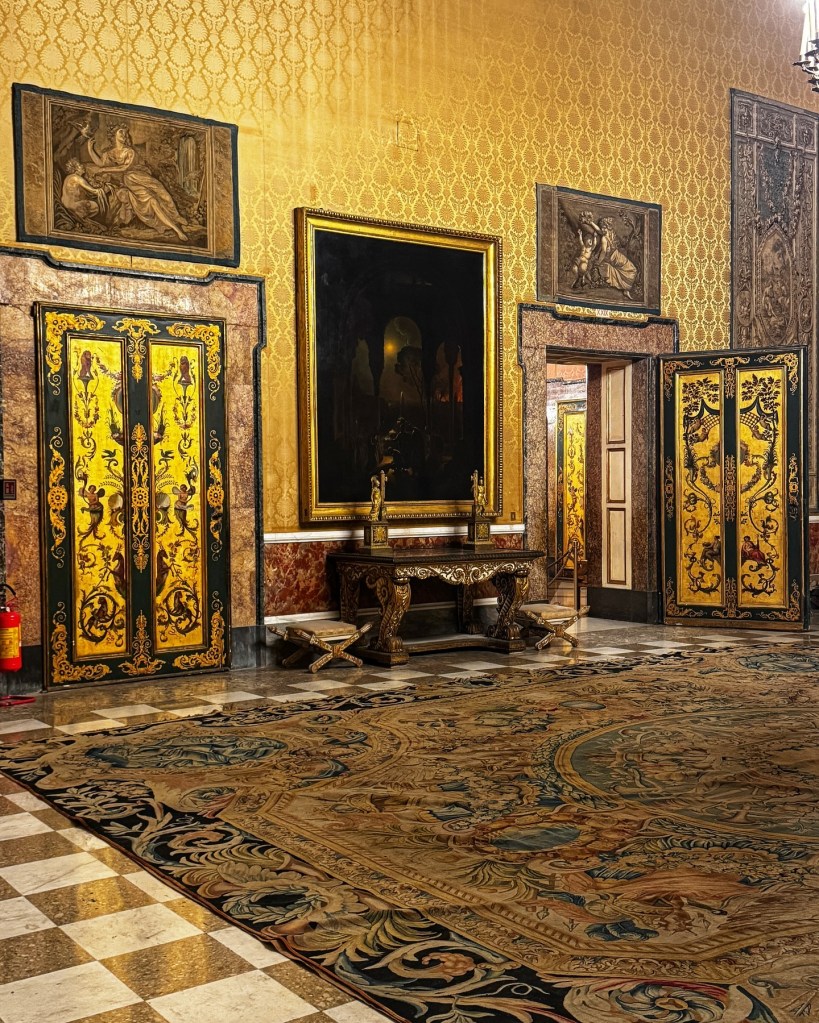
Palazzo Reale di Napoli

Palazzo Reale di Napoli
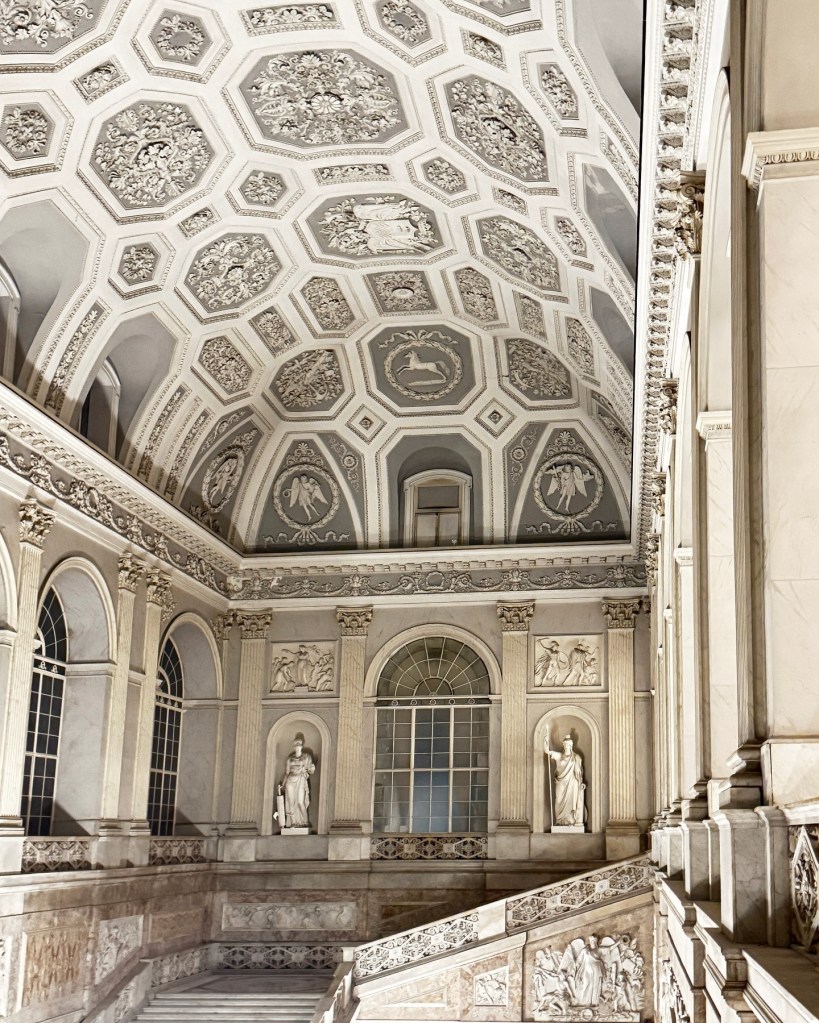
Palazzo Reale di Napoli

Palazzo Reale di Napoli