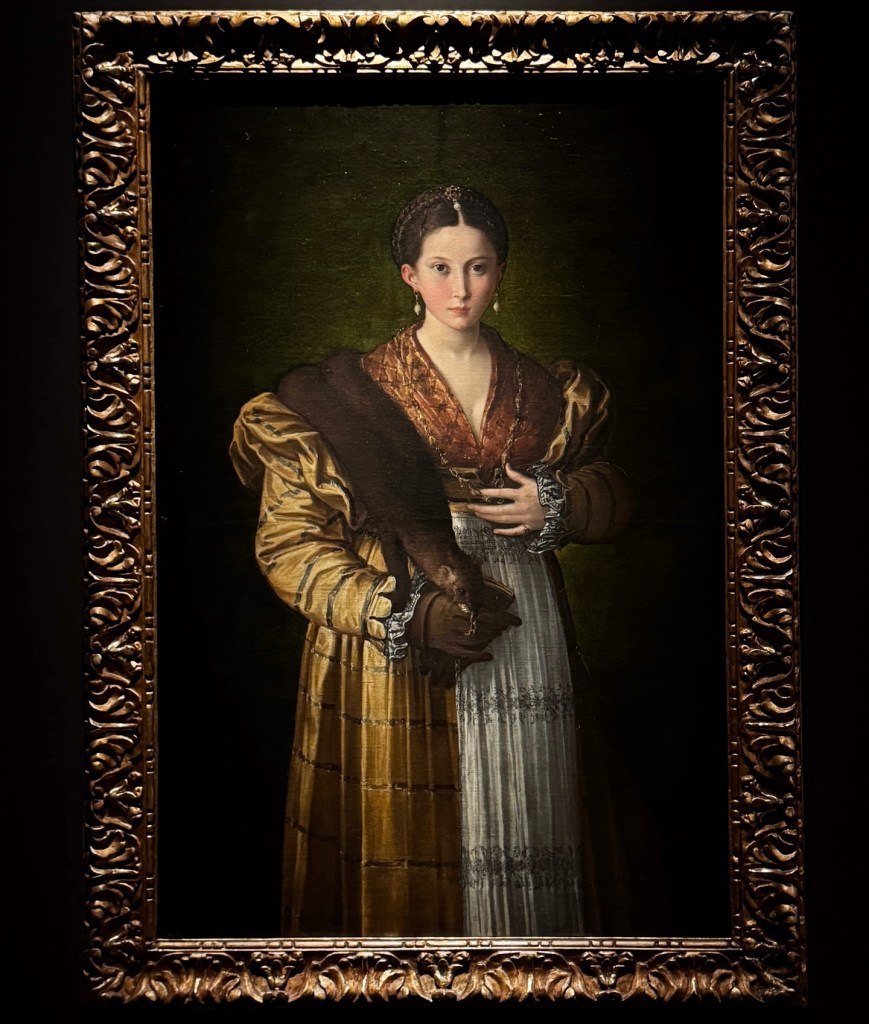
Parmigianino (1503–1540), Antea, c.1531–34, Oil on canvas,. 136 x 86 cm, Museo di Capodimonte, Naples

The fact that this painting survives at all is remarkable.It had been moved to the Monte Cassino monastery for protection during the war, but when the Hermann Göring Division occupied the area, the work was seized along with other holdings from the Museo di Capodimonte and taken first to Berlin, then deeper into occupied territory, ending up in the Altaussee salt mines near Salzburg. There it sat in a network of tunnels alongside thousands of looted works, the Ghent Altarpiece and Michelangelo’s Bruges Madonna among them, while the local Gauleiter tried to have the whole cache destroyed. It was recovered by Allied forces in the summer of 1945 and eventually returned to Naples. The Monte Cassino monastery had been flattened by Allied bombing in February 1944, and a great deal that had been stored there was lost.
The name ‘Antea’ is part of the painting’s mythology. It was first attached to the portrait in 1671 by the writer Giacomo Barri, who claimed the sitter was a celebrated Roman courtesan and the artist’s lover. There is no evidence for either claim, and for its first hundred and thirty-five years the picture was known simply as Ritratto di giovane donna. But the story stuck, and it is telling that it did. From the Baroque period onwards, people liked to furnish Renaissance portraits with romantic backstories, and Parmigianino’s picture, with its frankly confrontational gaze and its air of unresolved intimacy, practically invited that kind of invention. The various candidates proposed since then (the artist’s daughter, a servant, the Parmese noblewoman Pellegrina Rossi di San Secondo, a woman named Antea Smeraldi found in local baptismal records) only confirm how powerfully the painting generates the feeling that this must be a real person, someone whose name ought to be recoverable.
Whether it is recoverable is another question. An influential reading of Parmigianino’s female figures has placed them within the Renaissance discourse of ideal beauty and the Petrarchan literary tradition, where the sitter’s individual identity mattered far less than her conformity to a set of visual and poetic conventions (Cropper, 1976). The oval face, the blonde hair, the composed expression: these are the features of Petrarch’s Laura translated into paint, filtered through the treatise literature on beauty that circulated in sixteenth-century Italy. On this reading, asking who she ‘really’ was may be the wrong question altogether. The portrait belongs to a genre in which beauty and virtue are the subject, and the woman who embodies them need not have existed at all.
And yet the painting resists sitting comfortably in that category. The near full-length standing format was unusual for female portraits of this period. The body is broad-shouldered and ample, the proportions deliberately exaggerated in the Mannerist manner, but the face has a directness that feels like observation rather than formula. Her clothing mixes luxury with specificity: the gold satin dress with its silver bands, the blackwork embroidery on her apron and cuffs, the marten fur draped over one shoulder, the gold chain and brooch. These are not generic markers of wealth. The white apron, or zinale, was traditionally worn by brides in northern Italy as a sign of virginity, which, if that reading holds, would narrow the possibilities considerably. It has been suggested by scholars that several of the accessories she wears, the marten fur, the chain, the ring, the earrings, were of a kind conventionally given as courtship gifts, and that a woman shown wearing them would have been understood as having accepted a lover’s advances. Parmigianino seems to have been aware of these codes and to have used them with purpose, even if we cannot now say exactly what that purpose was.
Parmigianino appears to have used this same face, or something very close to it, in other works, including his unfinished Madonna of the Long Neck. If the same model sat for both a devotional image and a portrait loaded with erotic suggestion, then the boundary between observed person and invented type was one Parmigianino was happy to blur. That may be the most honest conclusion available: that the painting sits on the line between portraiture and ideal, between a woman who might have walked into the studio and one who was assembled from conventions, desires, and paint.
References
Cropper, E. (1976) ‘On Beautiful Women, Parmigianino, Petrarchismo, and the Vernacular Style’, The Art Bulletin, 58(3), pp. 374–394.Available at, https://www.jstor.org/stable/i354283 ( Accessed 19 December 2024)
Cropper, E. (1986) ‘The Beauty of Woman: Problems in the Rhetoric of Renaissance Portraiture’, in Ferguson, M.W., Quilligan, M. and Vickers, N. (eds.) Rewriting the Renaissance: The Discourses of Sexual Difference in Early Modern Europe. Chicago: Chicago University Press, pp. 175–190.
Vaccaro, M. (2001) ‘Parmigianino and Andrea Baiardi: Figuring Petrarchan Beauty in Renaissance Parma’, Word and Image, 17(3), Availabel at , https://www.academia.edu/24362705/Parmigianino_and_Andrea_Baiardi_figuring_Petrarchan_beauty_in_Renaissance_Parma (Accessed 19 December 2024)