In 1734, after two centuries of alliance with Spain and three decades under the Austrian Habsburgs, Charles of Bourbon ascended the throne, re-establishing Naples as the capital of an independent kingdom. The new king initiated an urban renewal of the city, including plans for a palace to house the Farnese collection—a renowned assemblage of artworks begun in the 16th century by Pope Paul III and expanded by his descendants. This collection, inherited by Charles through his mother, Elisabetta Farnese (1692 – 1766), became the foundation for the palace’s artistic significance.
Over time, the Reggia di Capodimonte underwent numerous alterations, each leaving a distinct imprint on its architecture and interiors. Its rooms reflect various styles, from the Baroque and Rococo opulence of the Bourbon court to the Neoclassical refinement of the Napoleonic era and, later, the modernising efforts of the Savoy dynasty.
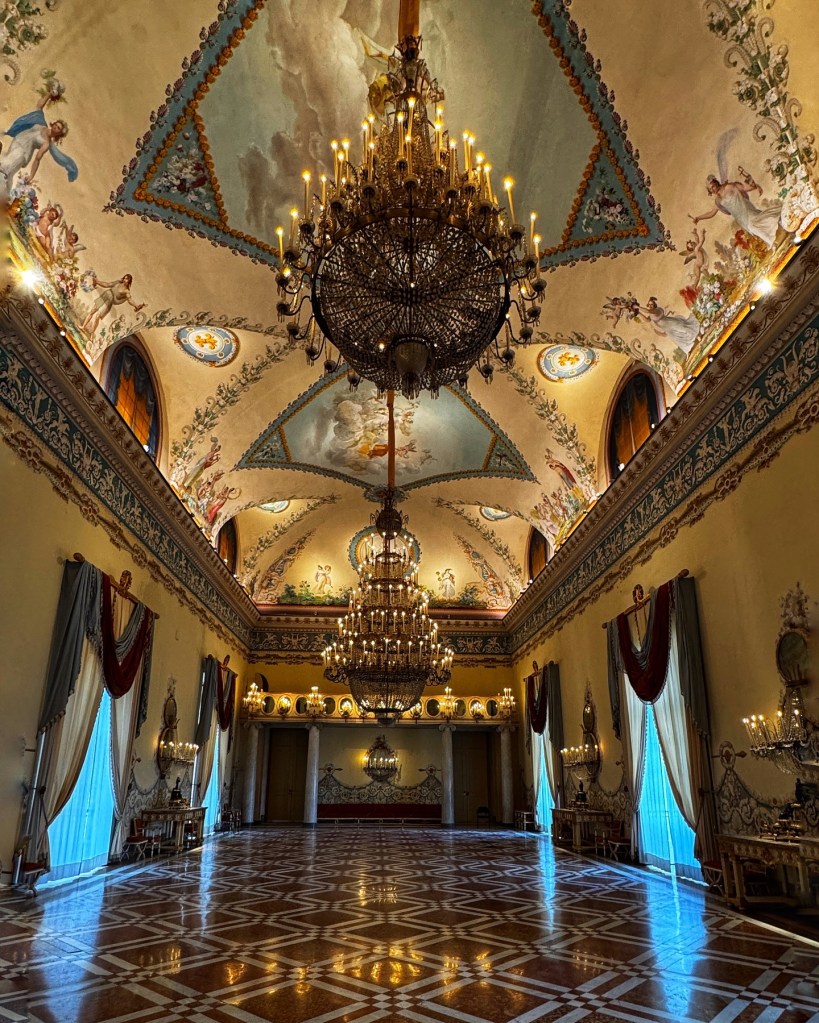
One of the most distinctly Napoleonic spaces in the palace is the Salone delle Feste. This grand rectangular hall, spanning the entire width of one wing, was designed for court celebrations and enhanced during the reign of Joachim Murat (1767–1815), Napoleon’s brother-in-law and King of Naples. The hall’s Neoclassical elements include frescoed walls, a vaulted ceiling, three balconies adorned with painted glass windows, and orchestra platforms supported by marble columns at either end. Murat commissioned Salvatore Giusti (1773–1851) to refine the hall’s decor, infusing it with the majestic and modern aesthetic of the Napoleonic court.