Isaac Oliver (1565-1617), A Man Consumed by Flames (c.1600–10), Watercolour and bodycolour with gold on vellum, 5.2 x 4.4 cm, Ham House, Surrey
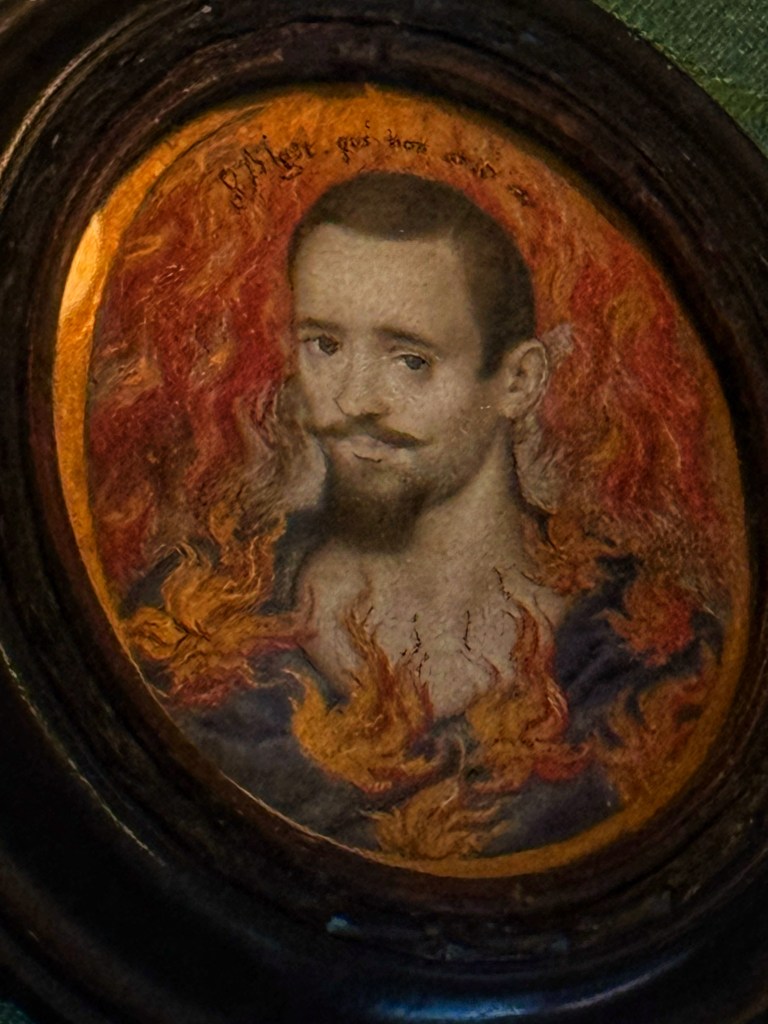
Renaissance allegorical portraits often preserve more mysteries than certainties: the identities of sitters, the circumstances of commission, and even the intended meaning are often uncertain, yet such ambiguity only intensifies their allure. Isaac Oliver’s A Man Consumed by Flames (c.1600–10) is a Jacobean miniature in the English Renaissance tradition, remarkable for its fusion of portraiture and allegory. The sitter, engulfed by fire and accompanied by the motto Alget, qui non ardet (‘He grows cold, who does not burn’), epitomises the central intrigue: do the flames signify Petrarchan love passion or Protestant zeal? The work hovers between amatory token and religious device, and its fascination lies in this ambivalence.
The imagery belongs to a broad European allegorical language in which fire carried multiple meanings. Andrea Alciato’s (1492–1550) Emblematum liber (first ed. 1531), the text that inaugurated the emblem tradition, codified flame as a symbol of both ardour and trial, pairing images with mottoes and epigrams. Alciato’s successors elaborated these themes: Joachim Camerarius (1500–1574), in his Symbola et Emblemata (1590–1604), repeatedly depicted the heart consumed by fire as an emblem of fidelity tested by suffering, while Hadrianus Junius (1511–1575), in his Emblemata (1565), presented the burning heart as a purifying ordeal of virtue. Such devices were deliberately double-edged: in an amorous context they signified constancy, while in a devotional frame they symbolised the soul inflamed by divine grace.
Literary traditions reinforced this iconography. Francesco Petrarca (1304–1374), in the Canzoniere, had made fire and the burning heart central metaphors of desire, at once destructive, refining, and transcendent. Neoplatonic philosophy gave these images further depth: Marsilio Ficino (1433–1499), in De amore (1469) and the Theologia Platonica (1469–74), described love as a divine fire (ignis divinus) binding mortal and eternal, while Giovanni Pico della Mirandola (1463–1494), in the Oration on the Dignity of Man (1486), extended the theme of ardour as the means of ascent to God. Religious discourse added a sharper edge, as in Revelation 3:15–16, which condemned the ‘lukewarm’ soul that failed to burn with zeal. Thus the same image of fire within a portrait could represent steadfast Petrarchan love, the ascent of the soul in Neoplatonic thought, or the fervour of evangelical faith, depending on context.
Scholars have proposed the identity of the sitter as William Strachey (1572–1621), secretary of the Virginia Company, and connected the miniature’s commission to the circumstances of his Virginia voyage. Both remain uncertain, but the association provides further intrigue. Strachey repeatedly employed the rare motto Alget, qui non ardet in his Lawes Divine, Morall & Martiall (1612) and the Historie of Travaile into Virginia-Britania (c.1612). His celebrated account of the Sea Venture shipwreck of 1609, which describes fiery storm phenomena later echoed in Shakespeare’s Tempest, gave the phrase the weight of Protestant zeal and colonial endurance. If linked to these circumstances, the miniature functions not as a Petrarchan love token but as a Protestant impresa announcing constancy and evangelical mission.
This portrait ultimately reflects a Renaissance culture that prized ambiguity. Its flames may be read as amorous passion, Protestant constancy, or Neoplatonic ascent, and all these readings were available to a cultivated audience. Oliver’s miniature collapses the boundaries between sacred and profane, private and public, earthly and divine. Its enigma lies not in the resolution of the allegory but in recognising that its very ambivalence was the point: for Renaissance beholders, trained in the logic of emblems and Neoplatonic metaphor, the consuming fire was not a matter of choosing between meanings, but a single image in which fervour, passion, and trial coincided, holding faith, love, and truth together rather than apart.
References
MacLeod, C. (ed.) (2019) Elizabethan Treasures: Miniatures by Hilliard and Oliver. London: National Portrait Gallery Publications
Marr, A. (2020) ‘A mystery in miniature: Isaac Oliver, the Virginia colonists and The Tempest’, Apollo, September 2020. Available online at: https://apollo-magazine.com/isaac-oliver-man-consumed-by-flames/ (Accessed: 3 September 2025)
National Trust Collections (n.d.) A Man Consumed by Flames, by Isaac Oliver, c.1610. Ham House. Available at: https://www.nationaltrustcollections.org.uk/object/1139627 (Accessed: 3 September 2025)