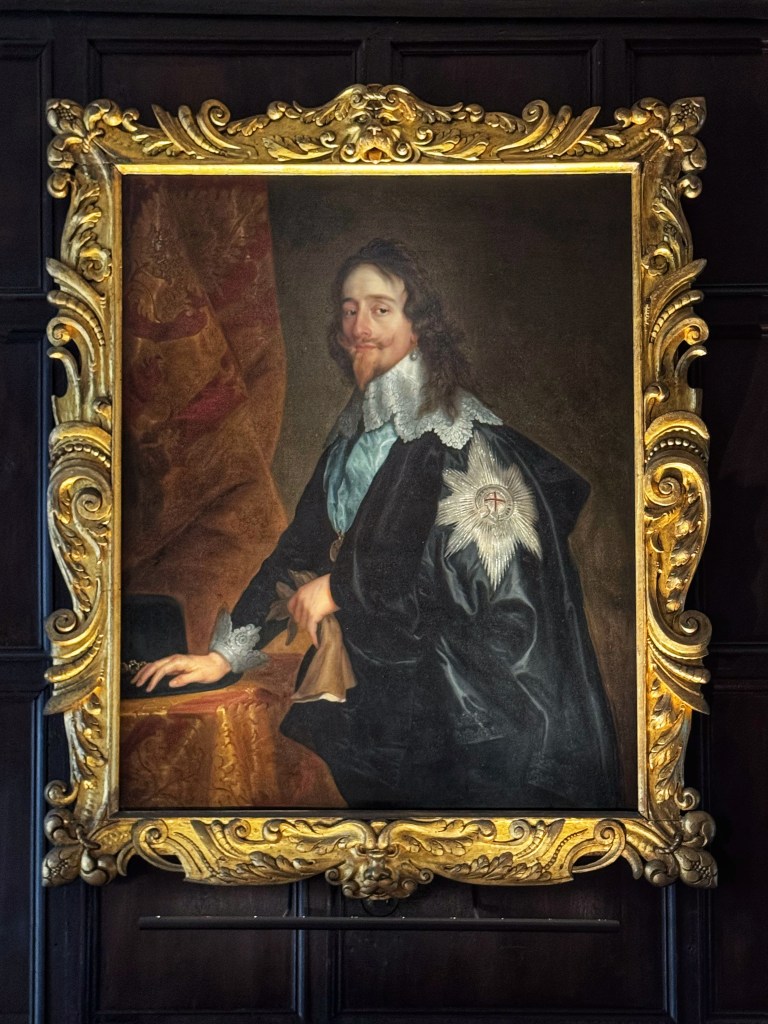
Antoon Van Dyck (1599 – 1641) and Studio, Portrait of King Charles I (1600–1649), circa 1635–1637, Oil on canvas, 121 x 94.6 cm, Ham House, Surrey

Of the surviving versions of Van Dyck’s three-quarter-length portrait of Charles I in black, the painting at Ham House is particularly interesting because of the context of its commission. Its recipient, William Murray, future 1st Earl of Dysart, had been brought to court as a child to be educated alongside Prince Charles and, by the convention of the day, to serve as his ‘whipping boy’, absorbing in his place the corporal punishments that no tutor could lawfully administer to a future monarch. The portrait, given perhaps thirty years after that first encounter, is in this sense a gift from one childhood companion to another, dressed in the formal language of Caroline kingship.
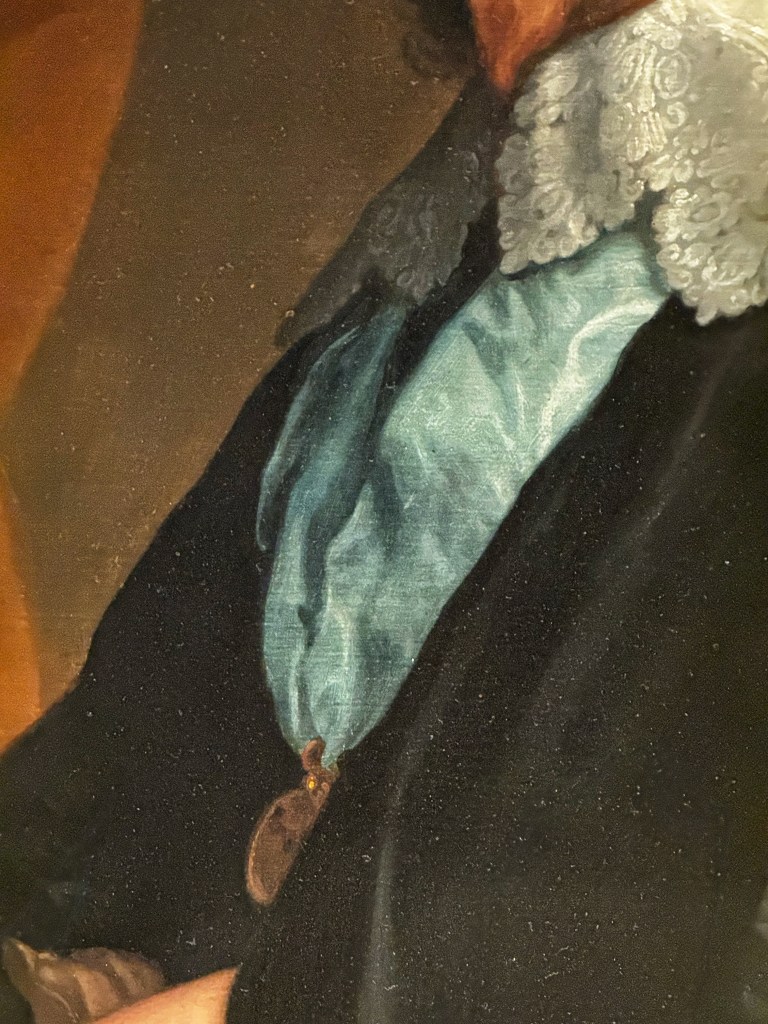
The composition itself was developed in London between 1635 and 1637, during the most productive years of Van Dyck’s English period. Charles is shown three-quarter length, turned slightly to the left, his head pivoting back over the shoulder to meet the spectator. He wears plain black, relieved only by the white linen collar at his throat and the blue ribbon and Lesser George of the Order of the Garter. His right hand rests lightly on a table at his side; his left holds a glove. There is no allegory, no military attribute, no architectural setting. The image works through reduction, an idiom that recent scholarship has read as central to Van Dyck’s redefinition of English royal portraiture, in which authority is established through stillness, costume and a sustained meeting of the eyes rather than through emblematic apparatus.
The prototype Van Dyck devised for this design no longer exists. It is generally believed to have been the version recorded in the Royal Collection and lost when fire broke out at Whitehall Palace on the afternoon of 4 January 1698 and burned, with brief interruption, for some fifteen hours, leaving little more than Inigo Jones’s Banqueting House standing. What does survive is the design itself, in repetitions ranging from substantially autograph to substantially studio-produced. The most polished is the canvas now in the Gemäldegalerie at Dresden, dated 1637 and painted for the king’s nephew Charles Louis, Elector Palatine, who at that moment was attempting to recover his territories from his exile in England. Its precision of finish, particularly in the costume and insignia, is consistent with its function as a dynastic gift intended for display abroad. Other versions, including those at the National Portrait Gallery and at Kedleston Hall, are more economical in handling, with softer faces and drier passages of drapery. The variation reflects the practical economy of a workshop operating at considerable pressure: assistants laid in the costume, drapery and ground, while Van Dyck reserved for himself the passages where likeness and decorum had to be earned.
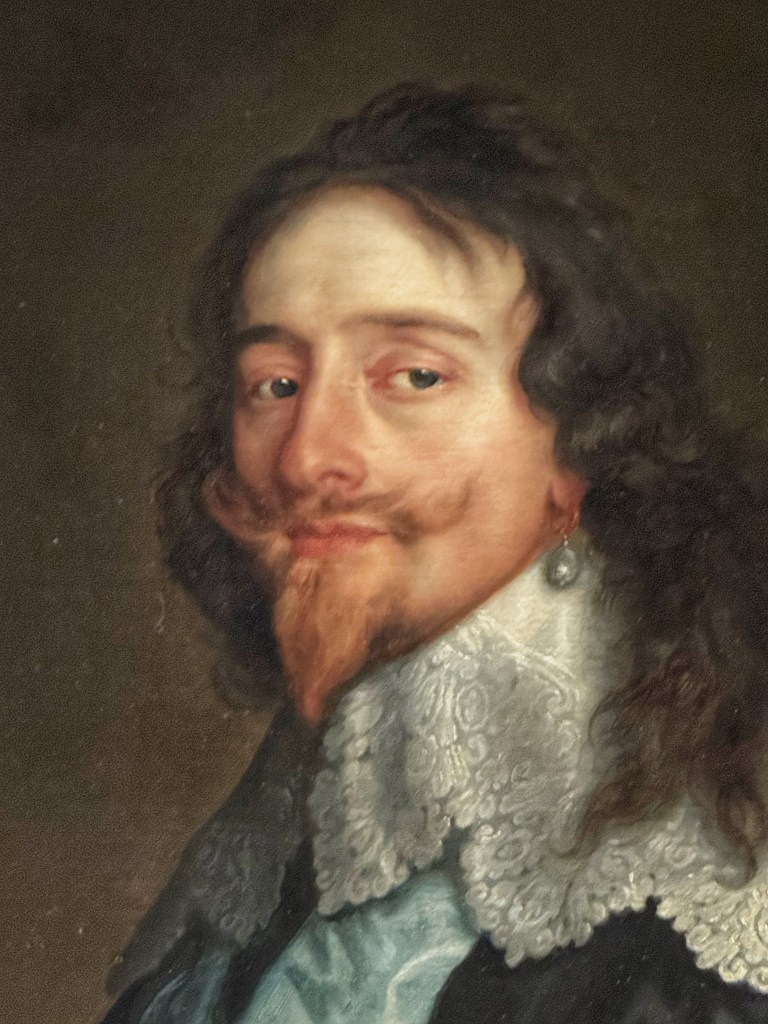
Recent technical scholarship, examining a series of unfinished and partially finished Van Dycks, has identified a faint “rough halo” of underpainting around the head of many sitters, marking the boundary between the master’s brushwork and that of the studio. The same logic of selective intervention can be observed in the hands. Where assistants could plausibly produce a passage of black satin or a neutral background, the slow accumulation of light over the joints of a finger, or the sense of weight registered in a wrist, lay beyond their fluency. In Van Dyck’s hierarchy of authorship, the head and the hands were the master’s territory.
The Ham House version belongs to this category of personal investment. Its provenance is unusually well documented. It corresponds, almost certainly, to the entry “Le Roi vestu de noir … avec sa mollure” in the bill, written in French, that Van Dyck submitted to Charles I in the autumn of 1638, listing pictures supplied with their frames and approved by the king himself, who reduced some of the prices in his own hand. The phrasing places the painting in the king’s possession at that moment, in its present frame, before passing to Murray. Murray’s career gives the gift unusual weight. He had been brought to court by his uncle Thomas Murray, tutor and later secretary to the prince. Following Charles’s accession in 1625, he became a Groom of the Bedchamber, an office that required daily personal attendance on the monarch and gave him a degree of intimate access matched by few at court. The royal grant of the manors of Ham and Petersham in 1636/7, around the time the Van Dyck design was being formulated, was already understood as a mark of singular favour; the picture followed soon after.
In the Ham canvas, the face is built up in Van Dyck’s characteristic thin glazes, the flesh luminous, the gaze quietly melancholy. The lace collar is laid in with shimmering delicacy. But it is the hands that carry the painting, and they deserve the closest attention.
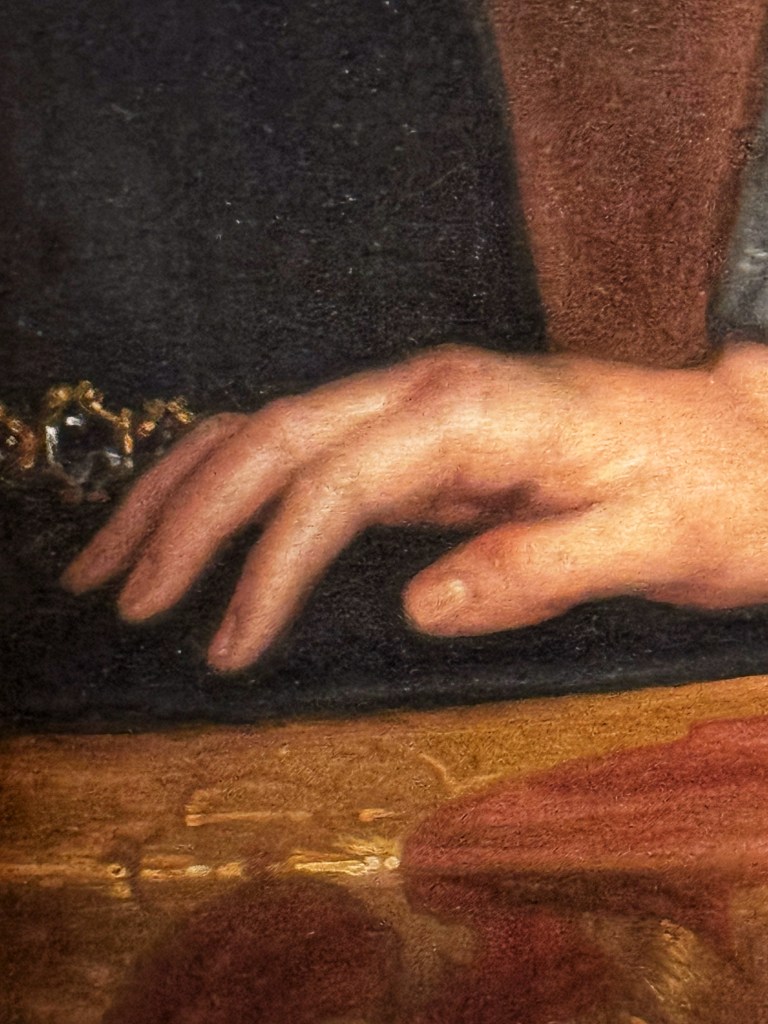
Van Dyck’s hands are not anatomical records. They are, on every aristocratic sitter who passed through his English studio, slightly elongated beyond nature, the fingers tapered, the wrists narrow, the palms pale and lightly veined. The fashion for what came to be called the ‘Van Dyck hand’ entered English portraiture as a quiet manifesto: long fingers signalled a body unmarked by labour, a person whose authority was inherited rather than earned through exertion. Contemporary observers commented on the elegance of his hands, and his successors, from Lely to Reynolds, retained the formula long after the costumes around them had changed. Technically the hands are constructed in much the same way as the face, by a slow layering of translucent glazes over a paler underlayer, allowing the warm tone of the flesh to emerge through cooler shadows in the knuckles and along the tendons. Opaque highlights are reserved for the upper edge of a finger or the small ridge of a nail; the rest is built up in a graduated half-light. This is exactly the kind of work that resists delegation. An assistant copying the master’s design could match a contour, but not the rhythm by which one passage of glaze is allowed to settle before the next is laid over it.
In the Ham portrait both hands carry this rhythm. The right rests on the table with a poised half-pressure, the index finger slightly lifted, the others barely resting on the surface, as if the king’s weight were carried elsewhere. It is a hand that touches without leaning. The left, meanwhile, holds the glove with the slightly mannered ease that became Van Dyck’s signature: the glove falls between thumb and forefinger, the remaining fingers curve loosely below it, and the wrist turns inward in a gesture closer to handling a bird than gripping an object. Veins are faintly indicated along the back of the hand, and the knuckles are softly modelled rather than outlined.
The contrast with the related versions sharpens the observation. In the Dresden canvas the hands are elegant, but firmer in outline and cooler in colour, the modelling more uniform, suited to the picture’s role as a diplomatic object. In the National Portrait Gallery and Kedleston versions the hands are correctly placed and decorously held but feel set down rather than discovered, the fingers more even in length, the lighting flatter across the knuckles. In the Ham picture the hands are something else: lyrical, supple, conversational. They give the portrait a quietly private quality at odds with the austere pose, as if the king were addressing not a foreign court but a man who had known him since boyhood.
Read this way, the Ham House Charles I is more than a competent variant of a successful design. It records a particular friendship, fixed in paint, between a king who governed in large part through image and a courtier who had once stood in for him under the rod. The framework is the official idiom of Caroline kingship: black silk, Garter ribbon, the studied half-turn of the head. The interior is private, and it is in the hands, more than anywhere else, that Van Dyck makes the distinction visible.


References
Barnes, S.J., De Poorter, N., Millar, O. and Vey, H. (2004) Van Dyck: A Complete Catalogue of the Paintings. New Haven and London: Yale University Press
Hearn, K. (ed.) (2009) Van Dyck and Britain. London: Tate Publishing
Sharpe, K. (2009) ‘Van Dyck, the Royal Image and the Caroline Court’, in Hearn, K. (ed.) Van Dyck and Britain. London: Tate Publishing.
Peacock, J. (1995) ‘The Politics of Portraiture’, in Sharpe, K. and Lake, P. (eds.) Culture and Politics in Early Stuart England. Stanford: Stanford University Press
National Trust Collections (n.d.) King Charles I (1600–1649), by Sir Anthony Van Dyck and Studio, c.1635/7, Ham House, The Dysart Collection. Available at: https://www.nationaltrustcollections.org.uk/object/1139944 (Accessed: 3 September 2025)