Mary of Burgundy (1457–1482), last Valois Duchess of Burgundy and heir to the Burgundian Netherlands

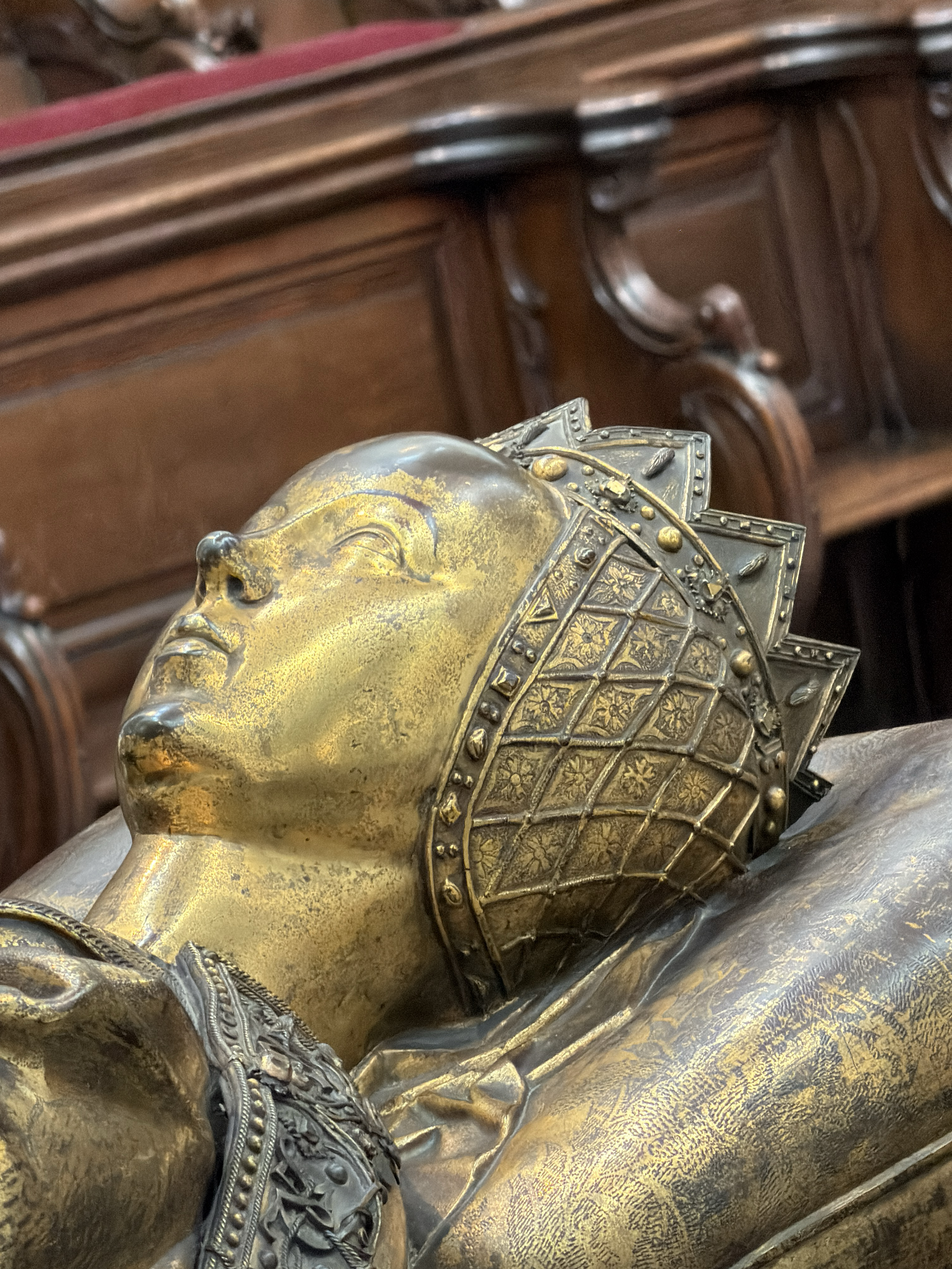
Renier van Thienen (active c.1470–1495), Jan Borman II (c.1460–1520), Pieter de Backere (active late fifteenth century) and Jehan Hervy (active late fifteenth century), Tomb of Mary of Burgundy, c.1488–1502, Brass, copper, bronze and enamel effigy on black stone sarcophagus, 260 × 135 × 135 cm, Church of Our Lady, Bruges
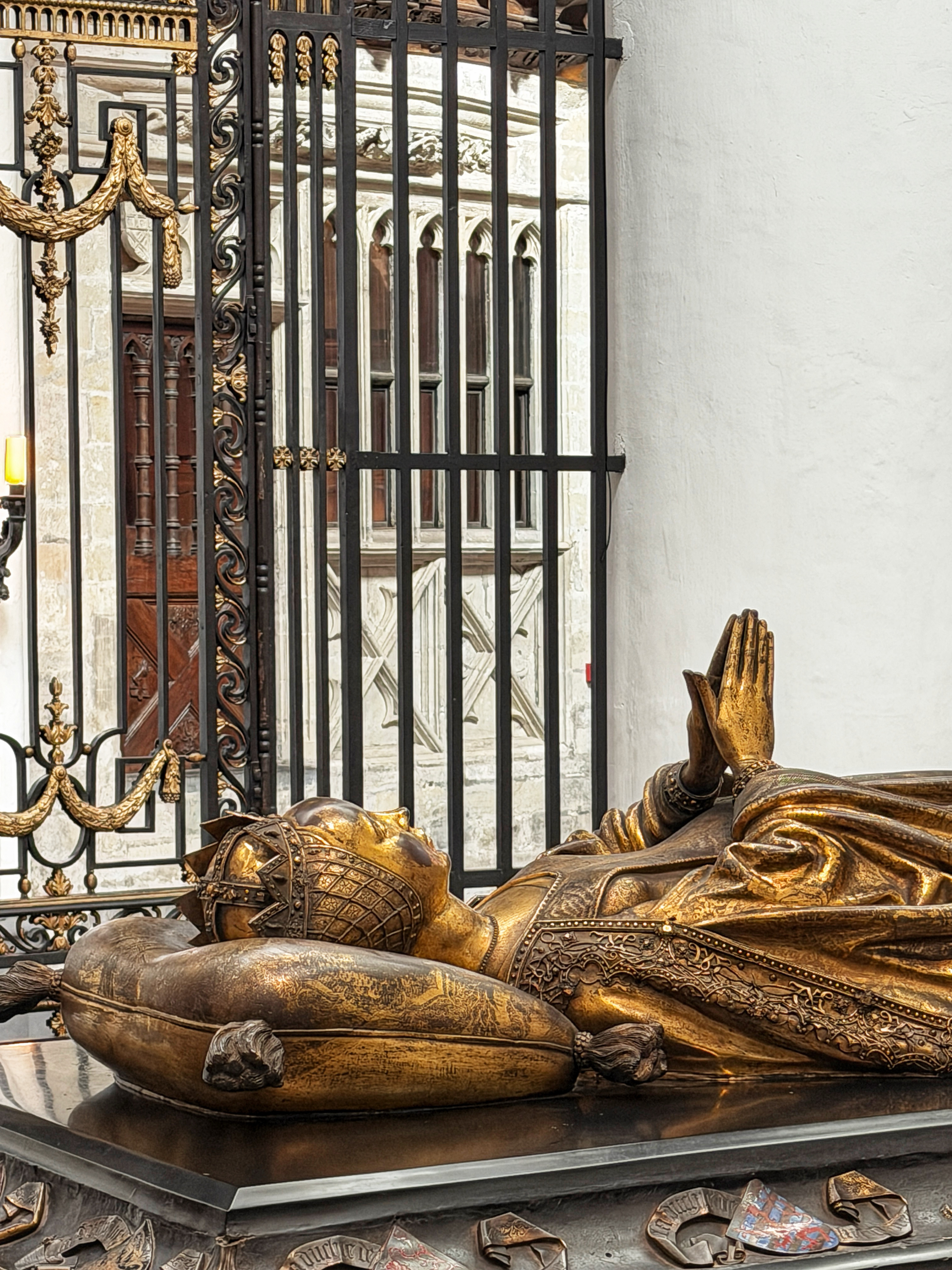
Renier van Thienen (active c.1470–1495), Jan Borman II (c.1460–1520), Pieter de Backere (active late fifteenth century) and Jehan Hervy (active late fifteenth century), Tomb of Mary of Burgundy, c.1488–1502, Brass, copper, bronze and enamel effigy on black stone sarcophagus, 260 × 135 × 135 cm, Church of Our Lady, Bruges

Renier van Thienen (active c.1470–1495), Jan Borman II (c.1460–1520), Pieter de Backere (active late fifteenth century) and Jehan Hervy (active late fifteenth century), Tomb of Mary of Burgundy, c.1488–1502, Brass, copper, bronze and enamel effigy on black stone sarcophagus, 260 × 135 × 135 cm, Church of Our Lady, Bruges

Renier van Thienen (active c.1470–1495), Jan Borman II (c.1460–1520), Pieter de Backere (active late fifteenth century) and Jehan Hervy (active late fifteenth century), Tomb of Mary of Burgundy, c.1488–1502, Brass, copper, bronze and enamel effigy on black stone sarcophagus, 260 × 135 × 135 cm, Church of Our Lady, Bruges

A young ruler lies in still metal, surrounded by the heraldry of a vanished political world.

The tomb erected in Bruges some years after Mary of Burgundy’s death gathers into sculptural form the inheritance that had briefly converged in her person. The gilded effigy shows the duchess resting in composed stillness, crowned and wrapped in the mantle of Burgundian sovereignty. Along the sides of the sarcophagus a dense sequence of heraldic shields borne by lions unfolds in measured succession.

These arms evoke dynastic lineage and the territories of the Burgundian house, so that the monument begins to resemble a visual genealogy as much as a funerary image, metal and stone quietly assembling the web of lands and claims once held together under Burgundian rule.

That political configuration had taken shape during the long reign of Philip the Good (1396–1467), whose government consolidated the territories of the Low Countries into one of the most powerful princely formations of late medieval Europe. When his son Charles the Bold (1433–1477) was killed at Nancy in 1477, the inheritance passed to his only child, Mary of Burgundy.

Her short rule unfolded at a fragile historical threshold between the Burgundian structure fashioned under Philip and the Habsburg order that would soon emerge. After 1477 the French king Louis XI (1423–1483) sought to dismantle Burgundian power, while the cities of the Low Countries compelled the young ruler to confirm their liberties in the Great Privilege of 1477.

Her marriage that same year to Maximilian I (1459–1519) brought military support but also drew the Burgundian inheritance into the orbit of the Habsburg dynasty. Through their son Philip the Handsome (1478–1506) and grandson Charles V (1500–1558), these territories would become the political core of the Habsburg Netherlands.

Renier van Thienen (active c.1470–1495), Jan Borman II (c.1460–1520), Pieter de Backere (active late fifteenth century) and Jehan Hervy (active late fifteenth century), Tomb of Mary of Burgundy, c.1488–1502, Brass, copper, bronze and enamel effigy on black stone sarcophagus, 260 × 135 × 135 cm, Church of Our Lady, Bruges

References

Van Loo, B. (2021) The Burgundians: A Vanished Empire: A History of 1111 Years and One Day. Translated by N. Forest-Flier. London: Head of Zeus.


More posts