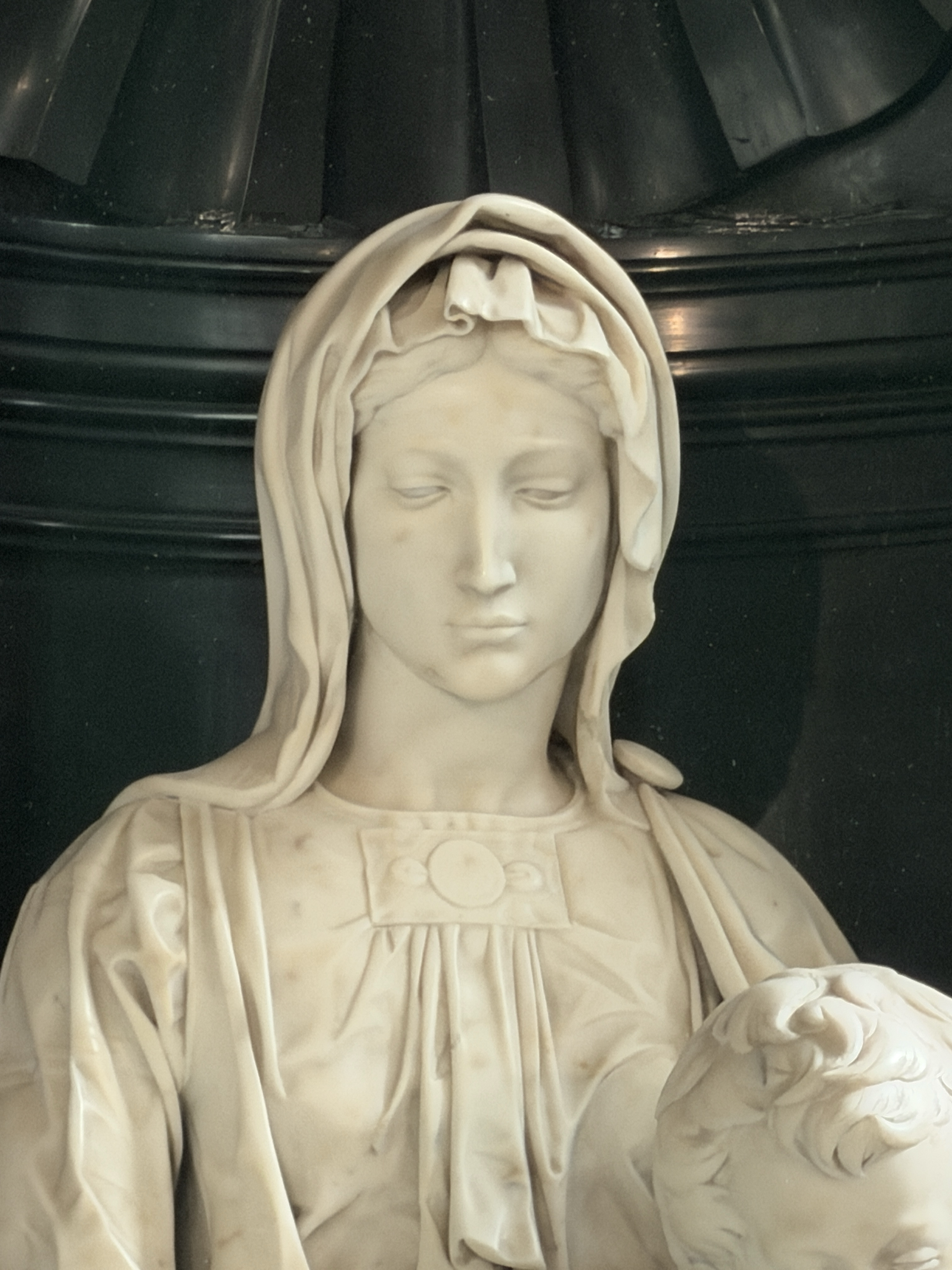
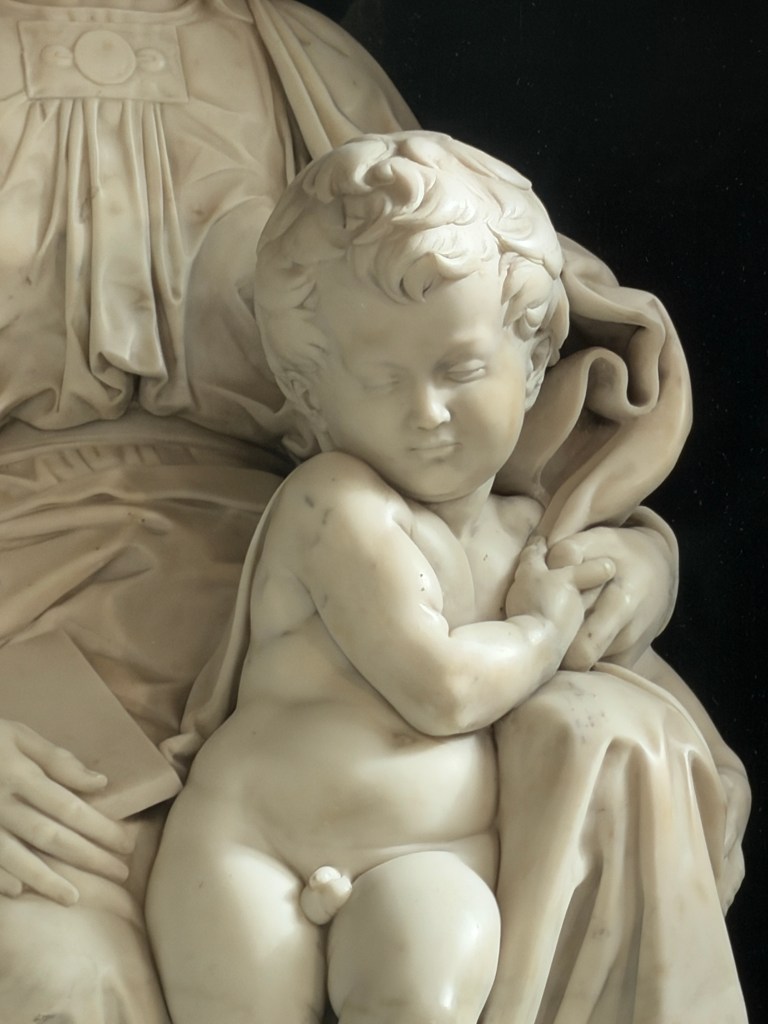
Michelangelo Buonarroti (1475–1564), Madonna and Child (known as the Bruges Madonna), c. 1503–1505, Marble, 128 cm, Church of Our Lady, Bruges

Marian devotion shaped the religious life of Bruges at the beginning of the sixteenth century. The city moved under the presence of the Virgin: chapels dedicated to her, confraternities, processions through the streets, and small painted panels used in private prayer.
In the painting of the Low Countries—particularly in works by Jan van Eyck (c. 1390–1441), Rogier van der Weyden (c. 1399–1464), and Hans Memling (c. 1430–1494)—the Virgin often bends toward the child with quiet intimacy. Hands meet, veils are touched, bodies lean toward one another. A language of tenderness slowly formed across generations of devotional images.
Into this environment arrived Michelangelo’s sculpture.
Carved in Florence around 1503–1505, it belongs to the early years of the artist’s career. The Roman Pietà had already revealed his command of marble, while the colossal David was being carved almost simultaneously. Michelangelo was still in his twenties, still testing what a figure in stone might contain: calm surfaces, compact strength, bodies poised between stillness and movement.
The Bruges Madonna carries that early gravity. The Virgin sits upright, composed, her gaze lowered into a quiet interior space. The child stands between her knees rather than clinging to her arms, though her hand still lightly holds his.
The marble was purchased in Florence by the Bruges merchants Jan and Alexander Mouscron and brought north by 1506, later installed in their chapel in the Church of Our Lady in 1514. It is often described as the only finished sculpture by Michelangelo to reach the Low Countries during his lifetime.
In a city steeped in Marian devotion, the Virgin does not gather the child fully toward her. A small bond remains in the hand she holds, yet a subtle distance persists. The child steadies himself on the ground, as if already aware of the world beyond the mother’s lap.
How might such calm Italian reserve have been received in Bruges—strange, dignified, or another way of imagining the quiet emotional weight carried by motherhood?
The sculpture was twice removed from Bruges by occupying forces. In 1794, French Revolutionary troops seized it along with other works and sent it to Paris, where it remained until its return after Napoleon’s defeat in 1815. A century and a half later, in 1944, retreating German soldiers smuggled it out of the city wrapped in mattresses inside a Red Cross truck. It was discovered the following year in the Altaussee salt mine in Austria and recovered by the Allied ‘Monuments Men’ team charged with retrieving looted art across Europe. That a marble carved quietly in Florence for a merchant family’s chapel should have attracted the attention of two successive waves of military plunder says something about the weight it had acquired, well beyond the devotional purpose for which it was made.

References
Edsel, R.M. and Witter, B. (2009) The Monuments Men: Allied Heroes, Nazi Thieves, and the Greatest Treasure Hunt in History. New York: Center Street
Hirst, M. (2012) Michelangelo, Volume I: The Achievement of Fame, 1475–1534. New Haven and London: Yale University Press.
Wallace, W.E. (2010) Michelangelo: The Artist, the Man, and His Times. Cambridge: Cambridge University Press.
Ridderbos, B., Van Buren, A. and Van Veen, H. (eds.) (2005) Early Netherlandish Paintings: Rediscovery, Reception and Research. Amsterdam: Amsterdam University Press
Sheedy, L.R.E. (2016) Marble Made Flesh: Michelangelo’s Bruges Madonna in the Service of Devotion. MA thesis. Washington University in St. Louis. Available at,https://openscholarship.wustl.edu/cgi/viewcontent.cgi?article=1706&context=art_sci_etds (Accessed 10 March 2026)
Van Loo, B. (2021) The Burgundians: A Vanished Empire: A History of 1111 Years and One Day. Translated by N. Forest-Flier. London: Head of Zeus