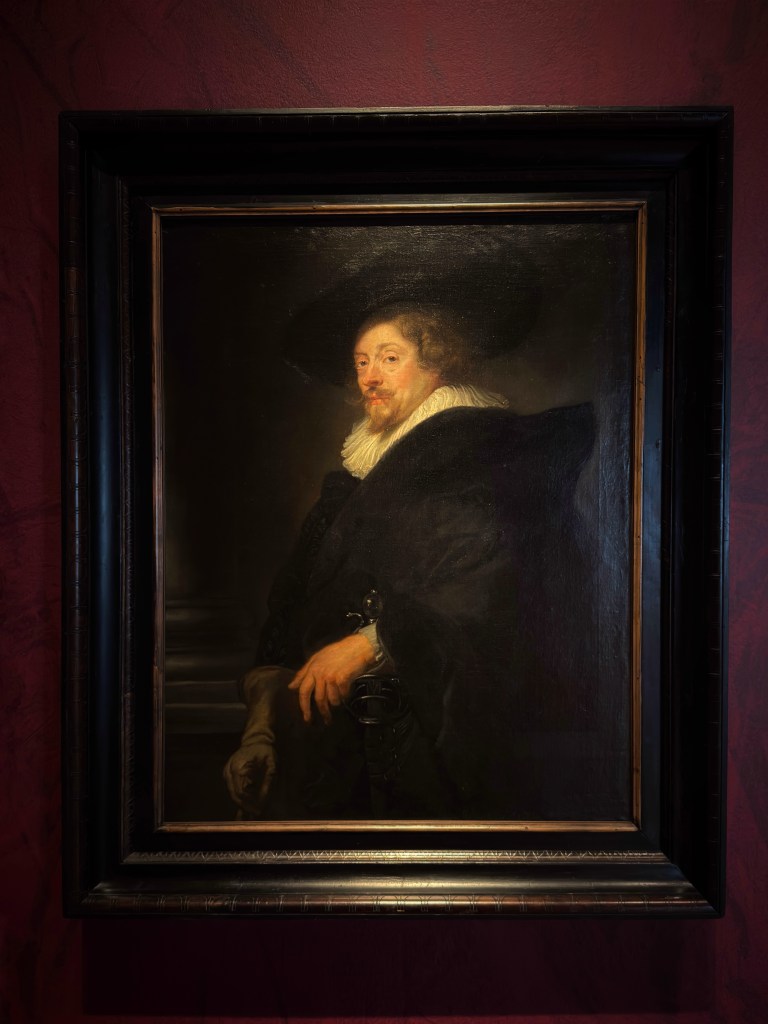
Peter Paul Rubens (1577–1640), Self-portrait, c. 1638–1640, Oil on canvas, 110 × 85.5 cm, Royal Academy of Arts, London, on short-term loan from the Kunsthistorisches Museum, Vienna

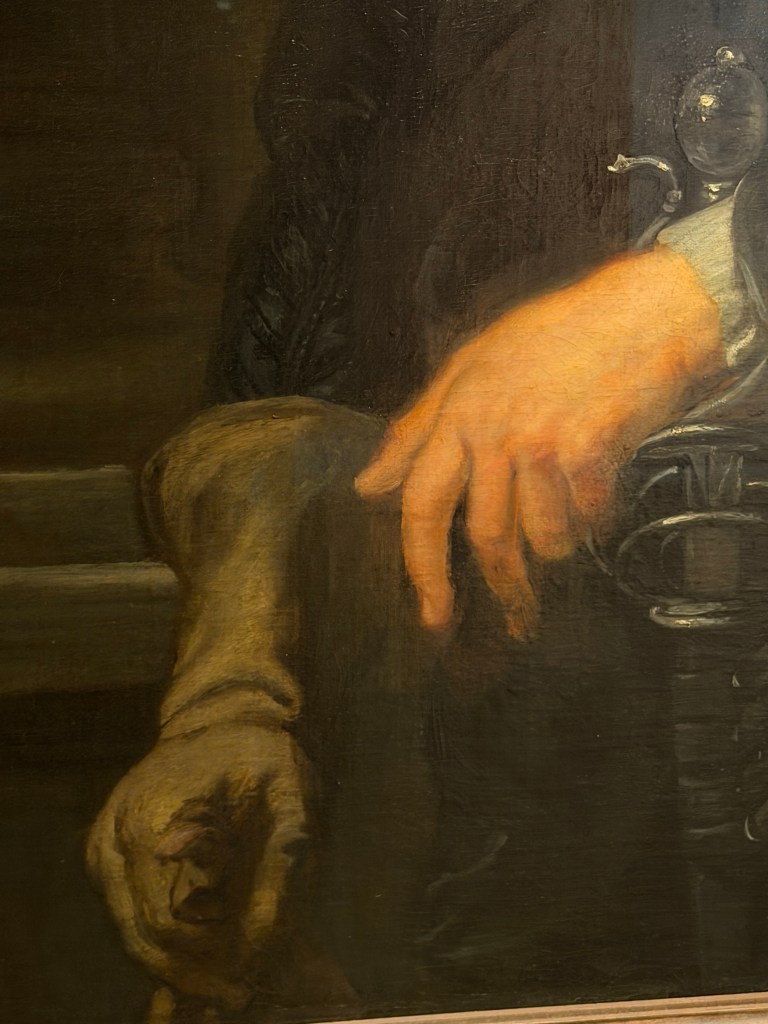
Painted in the last years of his life, when chronic gout had begun to restrict his hands and large commissions were increasingly realised through his workshop. There is no known commission, no clear occasion, no securely documented destination; its early function remains uncertain. Rubens was living between Antwerp and his estate at Het Steen. By this point he had largely withdrawn from diplomatic missions, but the status he had gained — court connections, a knighthood, a landed position — remained intact and continued to shape how he presented himself.
The image is carefully staged. The turn, the column: these point to arrangement rather than observation. Three-quarter length, with sword and gloves, it works within the conventions of aristocratic portraiture that Rubens had used in earlier self-representations. The column suggests permanence; the gloves and sword mark gentility and composure. At the same time, everything that would identify him as a working painter is excluded.
Already in the 1620s and early 1630s Rubens had cast himself in this elevated register. The engraving by Paulus Pontius in 1630, after a self-portrait of his mid-forties, circulated that version of him widely: poised, courtly, at some distance from the workshop.
This late painting does not simply repeat it. The body holds the pose, yet the face softens and the contours loosen; the expression loses its earlier declaration. It does not displace the earlier type so much as return to it with less certainty. No engraving was made after this portrait, and the public image remained the earlier one.
That gap matters. Rather than constructing a new identity, the painting re-enacts an established one — the same structure, but now carried by a man older, physically diminished, and further removed from direct making. The theatre holds; what has changed is the ease with which it is worn.

References
RKD – Netherlands Institute for Art History (n.d.), Peter Paul Rubens (1577–1640), Self-portrait, c. 1638–1640. RKDimages database entry no. 28131. Available at: https://rkd.nl/images/28131 (Accessed: 6 April 2026)
White, C. (1987) Peter Paul Rubens: Man and Artist. New Haven, CT: Yale University Press