Antoon van Dyck (1599-1641), Abraham and Isaac, c. 1617, Oil on canvas, 119 x 178 cm, Schwarzenberg Palace, Prague

Sometime around 1617, in a rented house in Antwerp’s Lange Minderbroedersstraat known as the Dom van Keulen, two teenagers were running their own painters’ workshop. Antoon van Dyck, then seventeen, and his slightly younger friend Jan Brueghel the Younger had set up an independent practice well before either had been formally admitted to the Guild of Saint Luke, an arrangement the city’s regulators tolerated rather than sanctioned. Van Dyck would not be received as a free master until 11 February 1618, at the age of eighteen, a precocity almost without parallel in seventeenth-century Antwerp, where most painters of his age were still apprentices or journeymen in another master’s workshop. Abraham and Isaac belongs to this brief, anomalous moment of self-directed early production.
Antwerp at this date was still adjusting to the religious and political reordering that had followed the Spanish reconquest of 1585. Catholic devotional painting had been re-established as the dominant idiom of public commission, and altarpieces, large narrative biblical scenes and meditational images circulated continuously through the workshops of Rubens, of Hendrick van Balen (Van Dyck’s first teacher), and of the network of figures around them. The young Van Dyck’s religious works belong squarely within this milieu and bear its marks: tight diagonal compositions, concentrated light falling on faces and exposed flesh, and an inherited Rubensian appetite for physical scale.
What distinguishes the Prague picture, and what tends to occupy its commentators, is its emotional register. Abraham and Isaac do not gesture, plead or struggle. The patriarch’s face turns inward in something closer to private grief than to dramatic horror, and the boy submits in silence, his throat exposed without resistance. The pathos is carried by stillness rather than action, a choice that already separates Van Dyck from the more rhetorical mode of much Antwerp narrative painting around 1617.
The face given to Isaac has long attracted attention. Several writers have noted its resemblance to Van Dyck’s earliest known self-portrait, the panel in the Gemäldegalerie der Akademie der bildenden Künste in Vienna, datable c. 1613–15, which shows a long-faced youth with comparable hair and features. A related Head Study of a Youth of c. 1615–17 in the National Gallery of Art, Washington, generally regarded as a tronie based on Van Dyck’s own face and reused in his history paintings, makes the practice of importing his own features into narrative figures more than hypothetical for this period. The identification of Isaac as a self-image nonetheless remains conjectural. No document supports it, and any reading of authorial self-projection into the figure of the bound son must be advanced as interpretation rather than fact. If the resemblance is intended, it places the picture within a wider seventeenth-century practice of using one’s own face as a convenient model, a habit shared with Rubens, Rembrandt and many others. To read it instead as an act of devotional self-implication, of the painter writing himself into the akedah (the Binding of Isaac), is a further interpretive step, suggestive but unverifiable.
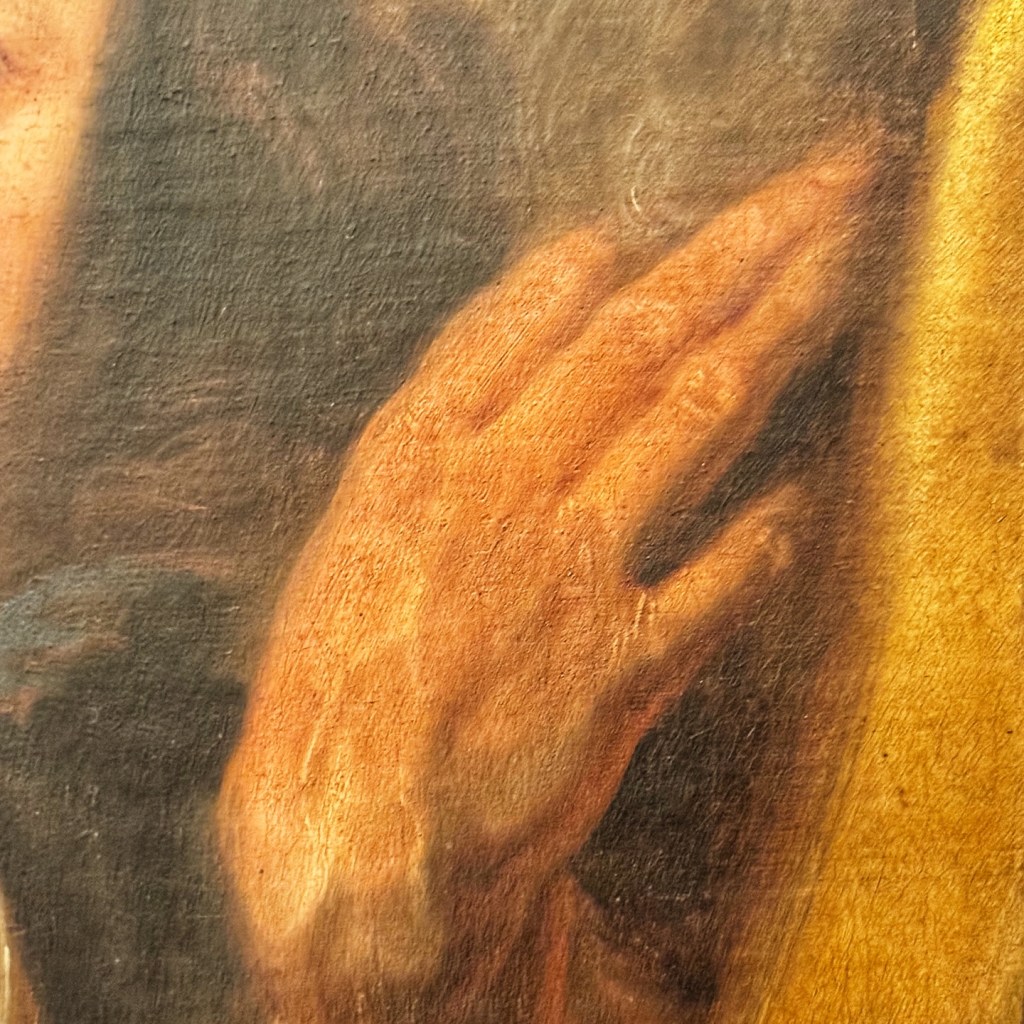
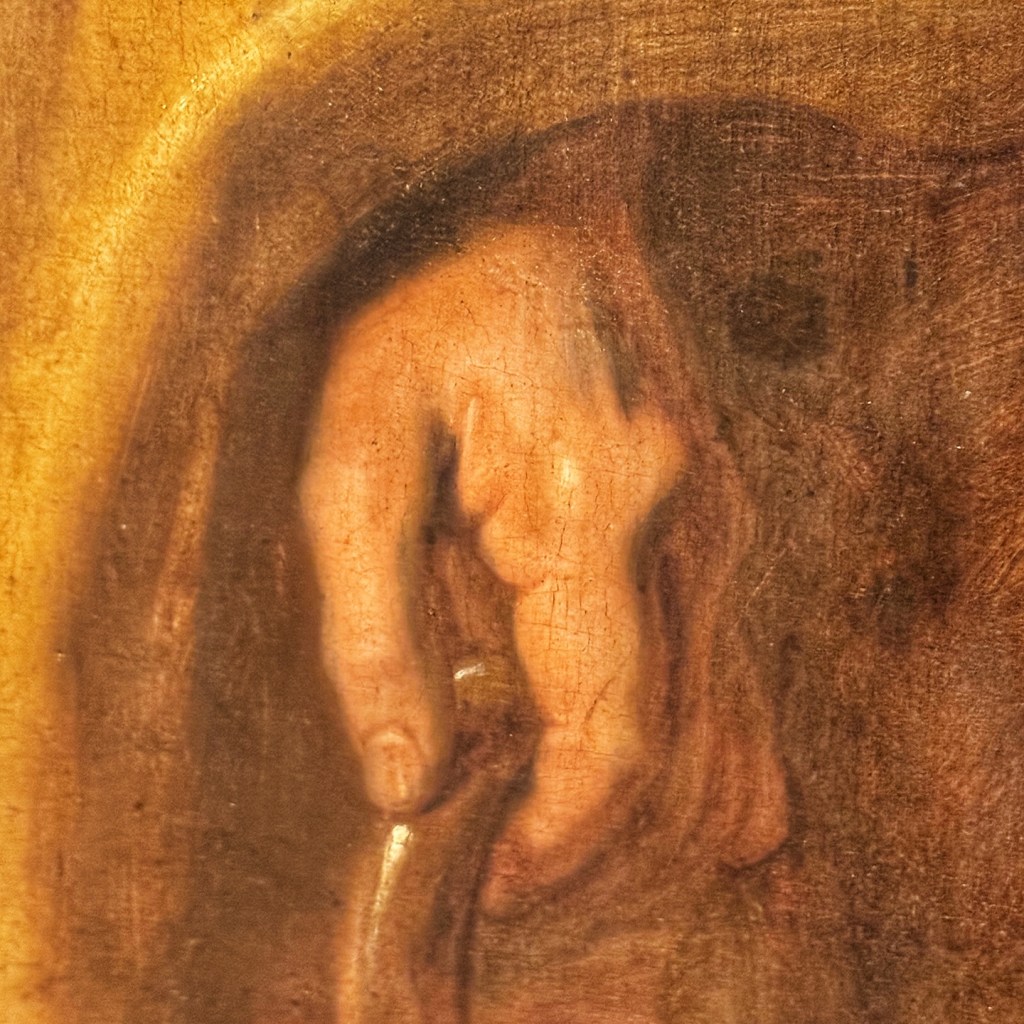
The painting’s present condition somehow complicates aesthetic judgement. The greens have darkened considerably through the oxidation of copper-based pigments, a problem widely documented in seventeenth-century Flemish paintings using verdigris and copper resinate glazes, and the modulation of landscape and drapery has flattened as a result. Final-stage glazes and surface refinements, characteristic of Van Dyck’s early Antwerp practice more generally, are likely to have been compromised by historical cleaning, though without a published technical examination of this specific canvas the precise extent of loss cannot be stated with confidence. What remains is a picture whose compositional architecture and psychological calibration survive intact, even where the chromatic relationships originally intended by a painter still in his late teens have been substantially altered by time.

References
Barnes, S.J., De Poorter, N., Millar, O. and Vey, H. (2004) Van Dyck: A Complete Catalogue of the Paintings. New Haven and London: Yale University Press / Paul Mellon Centre for Studies in British Art
Vlieghe, H. (1998) Flemish Art and Architecture, 1585–1700. New Haven and London: Yale University Press