The reformation that came close to destroying the medieval interior of the Pühavaimu kirik had arrived in Tallinn in 1523, a year before the riot that nearly carried it off. The former monk Johann Lange (active in Tallinn from 1523) had begun preaching at Niguliste church in that year, and the chaplain Zacharias Hasse (active in Tallinn also from 1523,) at St Olaf’s church in the same year, both without formal permission and against the resistance of the Dominican community at St Catherine’s church. What lit the fuse was a letter of admonishment from Wolter von Plettenberg (c. 1450 to 1535), Master of the Livonian Order, written in defence of the Dominicans.
On 14 September 1524, the feast of the Exaltation of the Holy Cross, a crowd loyal to the new Lutheran preachers stormed first St Catherine’s and then the the Pühavaimu (Holy Spirit) church , dragging out images and liturgical silver in a brief but fierce outburst of iconoclasm; the wave reached St Olaf’s church the same day. Niguliste church alone was spared, its warden having had the foresight to seal the church doors with molten lead before the rioters arrived. The tumult lasted barely a day. By the morning of 15 September the Tallinn city council, itself sympathetic to reform but anxious to keep the city’s commercial life intact, ordered the looted objects to be returned to the churches from which they had been seized. That the Holy Spirit retained its famous Notke masterpice, and indeed the bulk of its medieval furnishings, owes more to that swift restorative gesture than to any miraculous immunity, and to the fact that the Tallinn reformation took its theology from Wittenberg rather than from Zürich or Geneva. Lutheran practice, unlike its Reformed counterpart, tolerated images so long as they were not made the object of cult, and the Pühavaimu’s medieval interior was therefore reabsorbed into Protestant use with relatively limited losses, and was extended rather than stripped over the following century.
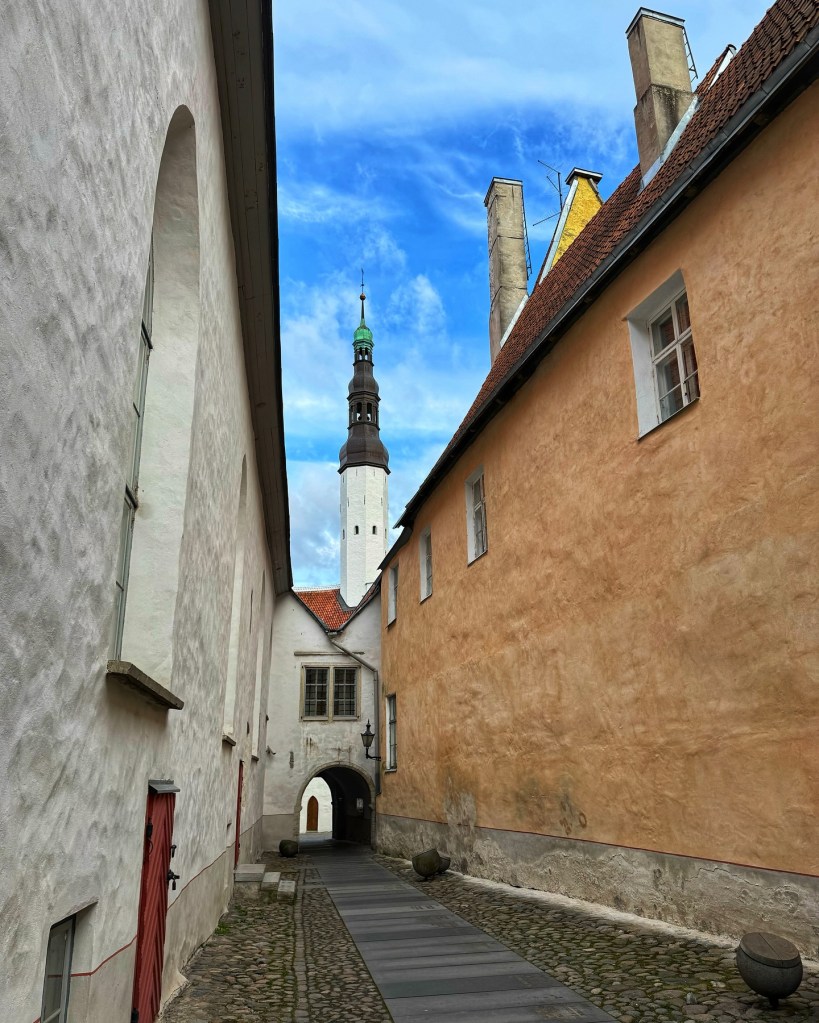
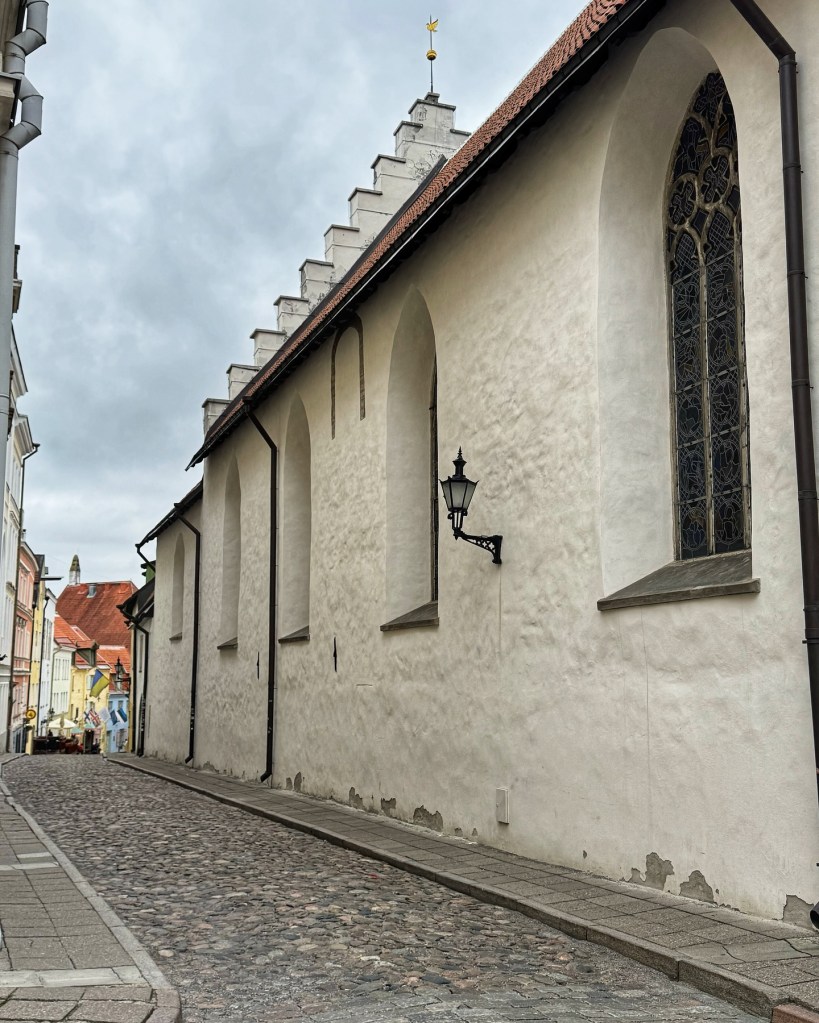
The church was already old when the rioters arrived. A priest of the Holy Spirit is mentioned in 1316, and the building itself appears in written sources in 1319 as the chapel of the Holy Spirit Hospital and Almshouse, an institution serving the sick poor, retired clergy and those who could not be cared for elsewhere. The church does not face due east, an irregularity that has been read as evidence that it was inserted into an already crowded streetscape and had to negotiate with neighbouring plots. Its original entrance arrangement reflects its dual function: a north door opening onto Pühavaimu Street for the city’s parishioners, and a south door opening onto the hospital yard for the residents of the almshouse complex. Constructed of local limestone in a single-nave Gothic plan, the church was enlarged at the end of the thirteenth century with a chancel, and the choir is the oldest surviving part of the structure, with the aisle added in the late thirteenth or early fourteenth century.
In 1360 the original wooden ceiling was replaced by stone vaulting, the present tower was raised, and the larger Gothic windows with their tracery were inserted. The first record of the tower itself in the city books dates from 1498, when a certain Didrick was paid for gilding and painting its spire. After the catastrophic fire of 1684 the tower was rebuilt with the octagonal stage and Baroque spire that have since become a signature of the lower town’s silhouette, and which, after the further fire of 2002, were restored once more. The Pühavaimu sometimes housed sessions of the Tallinn city council itself, and is for this reason occasionally referred to in seventeenth-century sources as the Town Hall Chapel, a sign of how closely its civic and ecclesiastical functions were bound together.
By the fifteenth century the church had become a central parish for the lower town, valued for its accessibility to townspeople of all ranks. Throughout that century it accumulated the kind of devotional furnishing typical of a prosperous Hanseatic parish. Side altars dedicated to the Holy Cross, the Virgin, Saints Matthias, Bartholomew, Gangulf, Simon and Jude, Anthony, and others were endowed by burghers and confraternities, and pre-Reformation account books record thefts of statuary, silver and vestments significant enough to suggest a richly equipped interior. The bell cast for the church in 1433, still in situ and among the oldest in Estonia, carries a Low German inscription that reads in translation as the boast of a young woman who has woken servant, mistress and master alike and faces no rebuke for it, a rare touch of vernacular humour set into liturgical bronze.
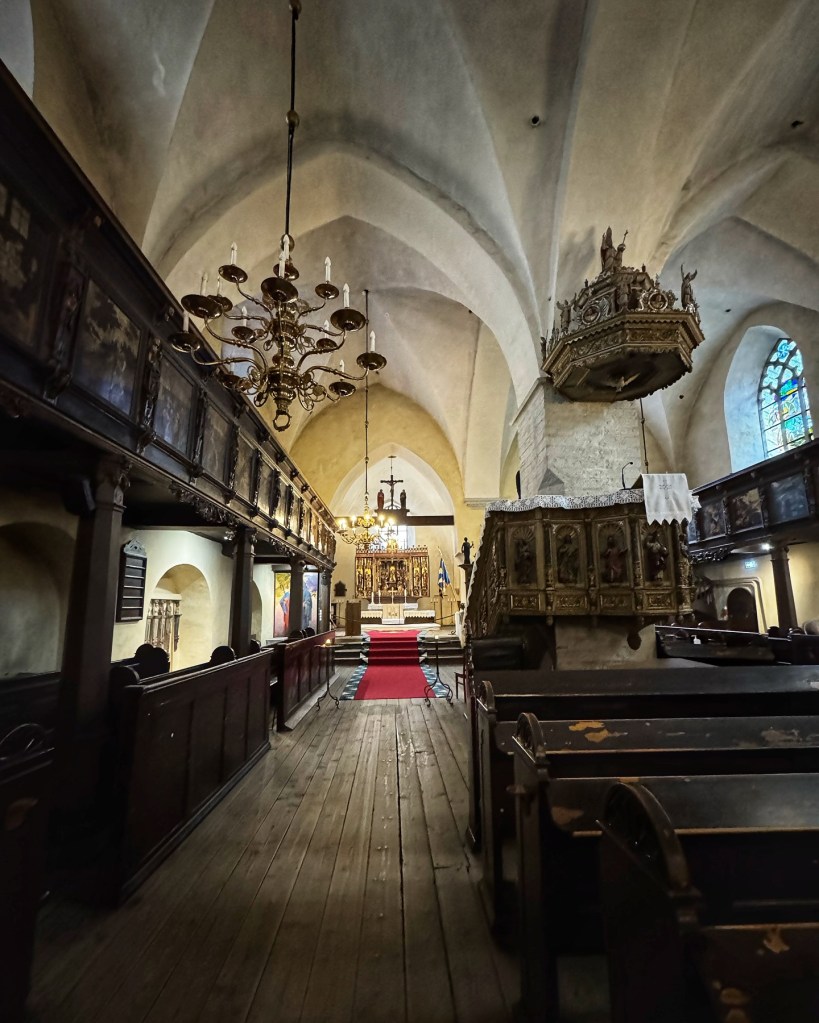
The dominant work of the medieval interior is the high-altar retable produced in 1483 in the Lübeck workshop of Bernt Notke (c. 1440 to before May 1509), the same master whose worksop’s Danse Macabre survives in fragmentary form at Niguliste church. The Tallinn city council appears to have commissioned the work in the early 1480s, and a letter of 1484 from Notke himself, in which the master reminds the council that he has not yet been paid for one “panel”, places its completion firmly within the documentary record. The retable bears the coats of arms of Tallinn rather than those of any individual donor, marking it as a corporate civic commission. Its iconography is precisely tuned to the church’s double identity as a hospital chapel and as a sanctuary dedicated to the Holy Spirit. The opened sculpted corpus shows the Pentecost, where the Virgin and the apostles receive the descent of the Spirit, while the painted wings carry scenes from the life of Saint Elisabeth of Thuringia, the thirteenth-century landgravine canonised for her care of lepers and her renunciation of dynastic wealth in favour of hospital foundation. Recent interdisciplinary research conducted by the Estonian scholars, has clarified the workshop technique, identified later overpainting, and confirmed that healing, here understood as one of the gifts of the Spirit invoked in 1 Corinthians 12, was the theological pivot on which donor, patron saint and architectural setting were aligned.
The Pühavaimu’s distinctive contribution to Estonian cultural memory is linguistic as much as architectural. From 1531, under Johann Koell (active from the 1530s), regular services in the Estonian language began to be held within its walls, the first such provision in any Tallinn church. In 1535 Koell, working with his colleague Simon Wanradt (also active in Tallinn from the 1530s) of Niguliste, produced the bilingual Low German and Estonian catechism that has since been recognised as the earliest known printed text in Estonian. It was set in Wittenberg, almost certainly by Hans Lufft (1495 -1584), the press that had also produced Luther’s German Bible. Its history, however, is a cautionary one. The Tallinn city council, finding the Estonian theology in places at odds with strict Lutheran formulations, ordered the run to be destroyed. Eleven damaged leaves survived only because they had been used as binding scrap inside a later seventeenth-century volume, where they were identified in 1929 by the Baltic-German historian Hellmuth Weiss (1900 -1992). Those eleven leaves now remain in the Tallinn City Archives.
The sixteenth-century pastorate of the Pühavaimu produced a second figure of comparable cultural weight. Balthasar Russow (c. 1536 – 1600), who served the church from 1566 until his death in 1600, composed the Chronica der Provintz Lyfflandt, the most vivid contemporary narrative of the Livonian War and one of the earliest sustained vernacular histories of the region, written by a man who appears to have been of partly Estonian descent. A generation later, between 1600 and 1606, the Pühavaimu’s dean Georg Müller (c. 1570- 1608) delivered and recorded a body of Estonian-language sermons that constitute, by some margin, the largest surviving corpus of handwritten Estonian from before the eighteenth century, now likewise preserved in the Tallinn City Archives. The church was not merely a venue for the first Estonian liturgy; it housed and helped to produce the texts on which the historical study of the language now substantially depends.
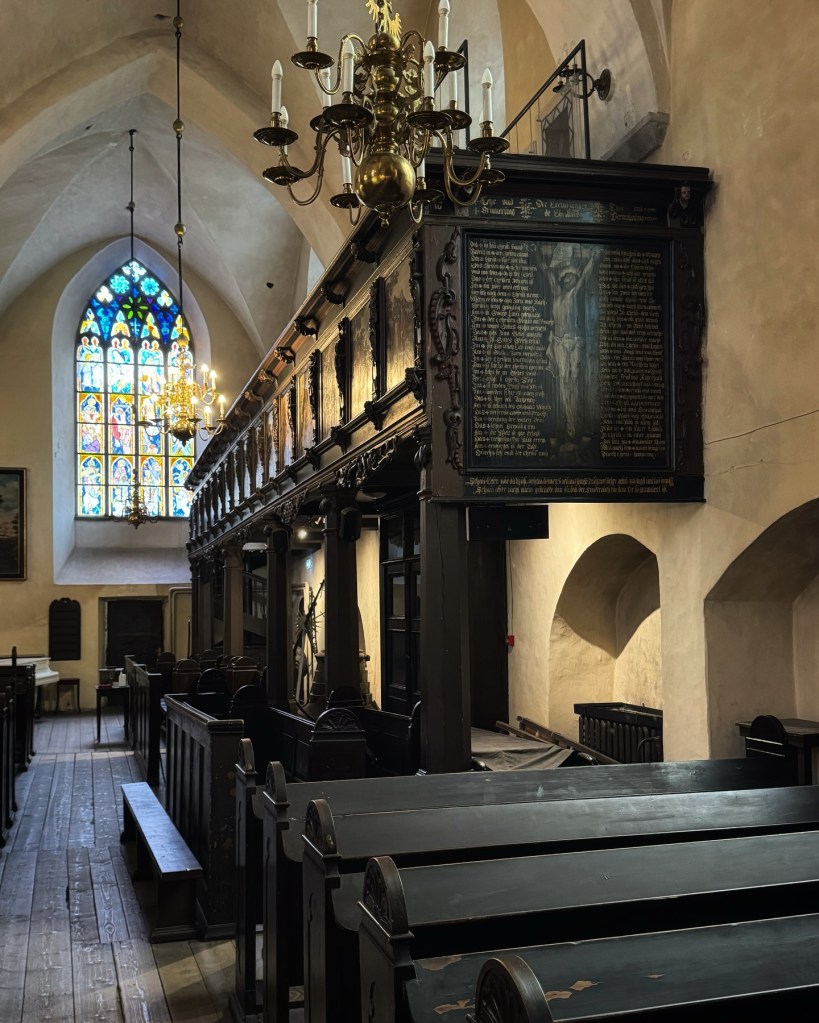
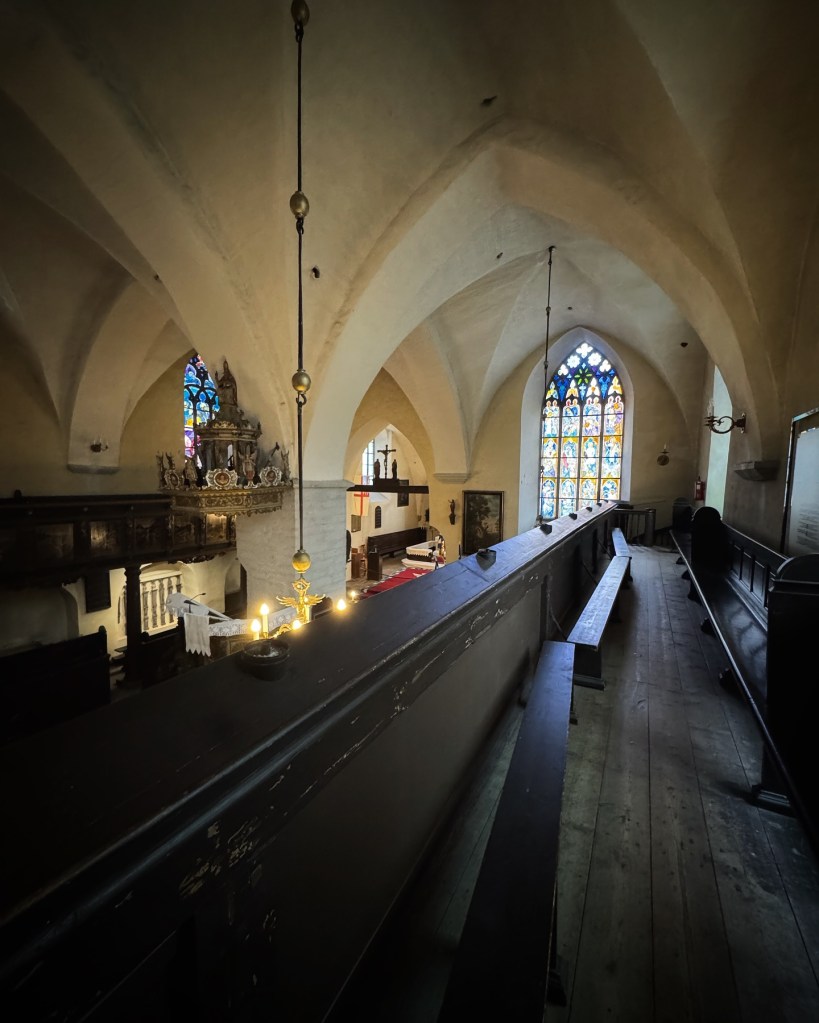
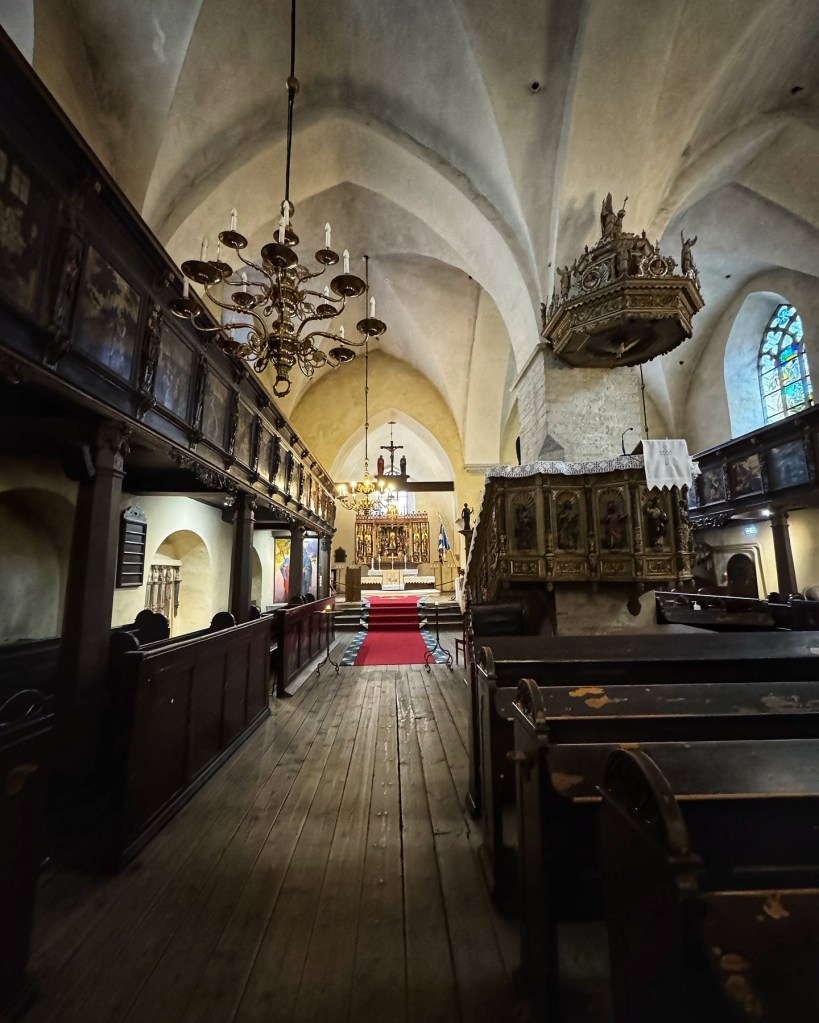
The seventeenth-century enrichments visible to a modern visitor accumulated steadily across that century and the next. The carved late-Renaissance pulpit of 1597 is the oldest in Tallinn. The painted galleries, with their biblical cycles executed by several different hands in the mid-seventeenth century, line three sides of the nave, and a sequence of painted epitaphs commemorate the city’s wealthy burgher families across the seventeenth and eighteenth centuries. A double portrait of Luther and Melanchthon, dated to the end of the sixteenth century, hangs in the church and offers an unusually direct memorial of the Wittenberg connection. Taken together, these accumulations make the interior one of the most artistically intact of any Protestant church in Tallinn.
The most interesting of these post-medieval additions is the elaborately carved wooden surround of the public clock on the church’s exterior, a work of the Königsberg-trained sculptor Christian Ackermann (c. 1670-after 1710 ). The clock face dates from 1684, and its surround was carved in the years that followed. The corrected biographical record, established by the Estonian Academy of Arts and the Art Museum of Estonia in their 2016 to 2020 research project, places Ackermann’s arrival in Tallinn in 1674. He had trained in Königsberg and worked in Danzig, Stockholm and Riga before settling in the city, where he found employment first in the Olevimägi workshop of the recently deceased master Elert Thiele. He married Thiele’s young widow Anna Martens, fathered a child by her in conspicuous breach of the prevailing moral norms, and in March 1677 was granted by the city council the unusual right to operate as an independent master without joining the woodcarvers’ guild, becoming the first freelance sculptor in Estonian history. The guild’s complaint that he behaved as if he were Phidias of Athens has given the modern research project its slightly mischievous title, Tallinna Pheidias. Ackermann probably died of plague during the epidemic of 1710, which carried off four-fifths of Tallinn’s population. The clock surround at the Pühavaimu, with its acanthus ornament and its small access door inserted, according to local tradition, so that the keeper could adjust the mechanism without raising a ladder daily, is among the works on which his attribution rests most securely.



References
Estonian Academy of Arts and Art Museum of Estonia (n.d.) The Investigation of the Works by Bernt Notke. Available at: https://notke.eu/en/ (Accessed: 14 May 2025)
Kodres, K., Kangropool, R. and Mänd, A. (eds.) (2005) Eesti kunsti ajalugu, 2: 1520–1770. Tallinn: Eesti Kunstiakadeemia.
Kreem, T.-M., Hiiop, H., Randla, A., Kröönström, T. and Aaso-Zahradnikova, I. (2020) Christian Ackermann. Tallinna Pheidias, ülbe ja andekas / Christian Ackermann. Phidias of Tallinn, Arrogant and Talented. Tallinn: Eesti Kunstimuuseum and Eesti Kunstiakadeemi
Pinkus, A. and Räsänen, E. (2019) ‘Si grant ardor: Transgression and Transformation in the Pühavaimu Altarpiece’, Different Visions: New Perspectives on Medieval Art, 5. Available at: https://differentvisions.org/issue-five/2019/07/si-grant-ardor/ (Accessed: 25 April 2026).
Niguliste Museum (2025) Estonian Book 500: Relics. Exhibition catalogue. Tallinn: Eesti Kunstimuuseum