
The painting and sculpture that filled Genoa’s churches and palaces during the seventeenth century developed along lines quite different from those of Rome, Naples, or Bologna. The reasons begin with the city itself and with the artistic culture that preceded the Baroque, which did not arrive as a sudden break around 1600 but grew out of conditions specific to Genoa’s geography, wealth, and habits of patronage. Genoa’s banking families could afford to hire whoever they wanted, and they did, long before the seventeenth century. The arrival of Perino del Vaga (1501–1547), one of Raphael’s most accomplished pupils, in 1528, fleeing the Sack of Rome, transformed what had been a modest artistic scene. Andrea Doria (1466–1560), the Republic’s effective ruler, immediately installed Perino as his artistic director at the Villa del Principe, where the decorative scheme he produced became for a generation of Genoese painters what Raphael’s loggias had been in Rome: a training ground and a standard. Lombard architects and craftsmen from the neighbouring lake regions, the traditional maestri antelami [master masons] who had formed a guild presence in Genoa since the Middle Ages, were a constant feature of the city’s building culture. Giovanni Battista Castello (c.1500–1579), known as il Bergamasco, worked on major decorative programmes in partnership with local painters. Galeazzo Alessi (1512–1572), who arrived from Perugia in 1548, redesigned the city’s palace architecture, establishing the monumental residential typology that Lombard builders like Bernardino Cantone and the Ponzello brothers then carried forward. The threshold of expectation was always high. These were patrons who bankrolled the Spanish empire and could commission any artist in Europe; their standard was set not by what the local market could supply but by what their wealth could attract.
What Genoa lacked, until the later sixteenth century, was a self-sustaining local school of painting with sufficient depth and coherence to rival what it imported. Luca Cambiaso (1527–1585), the native Genoese painter who dominated the second half of the sixteenth century, came closest to founding one. His extraordinary facility, his geometric drawing style, and his absorption of Correggio, Titian, and Veronese produced a body of fresco work across Genoese palaces and churches that set the terms for the generations that followed. He was summoned by Philip II to the Escorial in 1583, where he died two years later, but his followers, including Giovanni Andrea Ansaldo (1584–1638), Battista Castello, and Lazzaro Tavarone (1556–1641), perpetuated his idiom into the new century. Sofonisba Anguissola (c.1532–1625), one of the most celebrated portraitists of the Renaissance, spent some thirty-five years in Genoa with her second husband, the merchant captain Orazio Lomellini, establishing herself as the leading portrait painter in the city before moving in her final decade to Palermo. There, in July 1624, Van Dyck visited her when she was already at the age of ninety-two, recording in his Italian sketchbook that their conversation had taught him more about the true principles of painting than anything else in his life. Rubens, who had copied her royal portraits in Madrid, is said to have urged the visit.
The emergence of a fully developed Genoese school in the early seventeenth century was catalysed, in part, by the presence of foreign painters whose work galvanised local talent into a new confidence. Peter Paul Rubens (1577–1640) worked in Genoa on several visits between 1600 and 1607, leaving major altarpieces, including the Circumcision and the Miracles of Saint Ignatius of Loyola, in the Chiesa del Gesù e dei Santi Ambrogio e Andrea [Church of Jesus and Saints Ambrose and Andrew]. Antoon van Dyck (1599–1641) spent extended periods in the city in the early 1620s, transforming Genoese aristocratic portraiture. Orazio Gentileschi (1563–1639), Giulio Cesare Procaccini (1574–1625), and the French sculptor Pierre Puget (1620–1694) all found employment in Genoa, drawn by the same wealth and the same exacting standards that had attracted Perino a century earlier. These encounters mattered, but the Genoese school was never merely derivative. What emerged was a local idiom shaped by Flemish colour, Parmese foreshortening (Correggio’s influence ran deep), Lombard craftsmanship, and the particular demands of an oligarchy that wanted its private spaces decorated with energy and invention. Giovanni Battista Gaulli (1639–1709), known as Baciccio, carried that Genoese formation to Rome, where he painted the great ceiling fresco of the church of the Gesù, the mother church of the Jesuit order. Jacopo Barozzi da Vignola’s (1507–1573) plan for the Gesù had become the single most influential ecclesiastical design of the Counter-Reformation, its formula of wide nave, shallow transept, and side chapels replicated in hundreds of Jesuit churches from Lima to Prague, from Munich to Manila. That the ceiling of this building, the architectural prototype for Catholic worship across four continents, was painted by a Genoese is a fact that says something about the school’s calibre.
Among those who stayed and worked in Genoa itself, the most important was Domenico Piola (1627–1703), whose family workshop, the Casa Piola, became the dominant institution of Genoese painting for the better part of half a century. As Mary Newcome-Schleier argued in her foundational study of the Genoese Baroque, from the mid-seventeenth century onwards painting in the city was virtually controlled by the Piola and De Ferrari families. The term casa is telling. This was not an academy on the Roman model or a court atelier on the Flemish one. It was a family enterprise, organised with a practicality that the banking oligarchs who employed it would have recognised from their own counting houses. Piola’s eldest son, Anton Maria (1654–1715), worked in the business, as did his younger sons Paolo Gerolamo (1666–1732) and Giovanni Battista. His son-in-law Gregorio de Ferrari (c.1647–1726), who married his daughter Margherita, became his most distinguished pupil. Piola’s early formation included close study of Giovanni Benedetto Castiglione and a working relationship with the precocious Valerio Castello (1624–1659) in the late 1640s and early 1650s, which pushed his style towards a fuller Baroque idiom. By 1670 his manner was mature, and Gregorio de Ferrari’s return from Parma around 1672, saturated in the influence of Correggio, reinforced Piola’s own predilection for diagonal movement, bright colours, and strongly foreshortened figures. The workshop maintained a large stock of preparatory drawings, figure studies, and compositional cartoons that could be adapted to new commissions without loss of refinement. Speed and consistency were both expected.
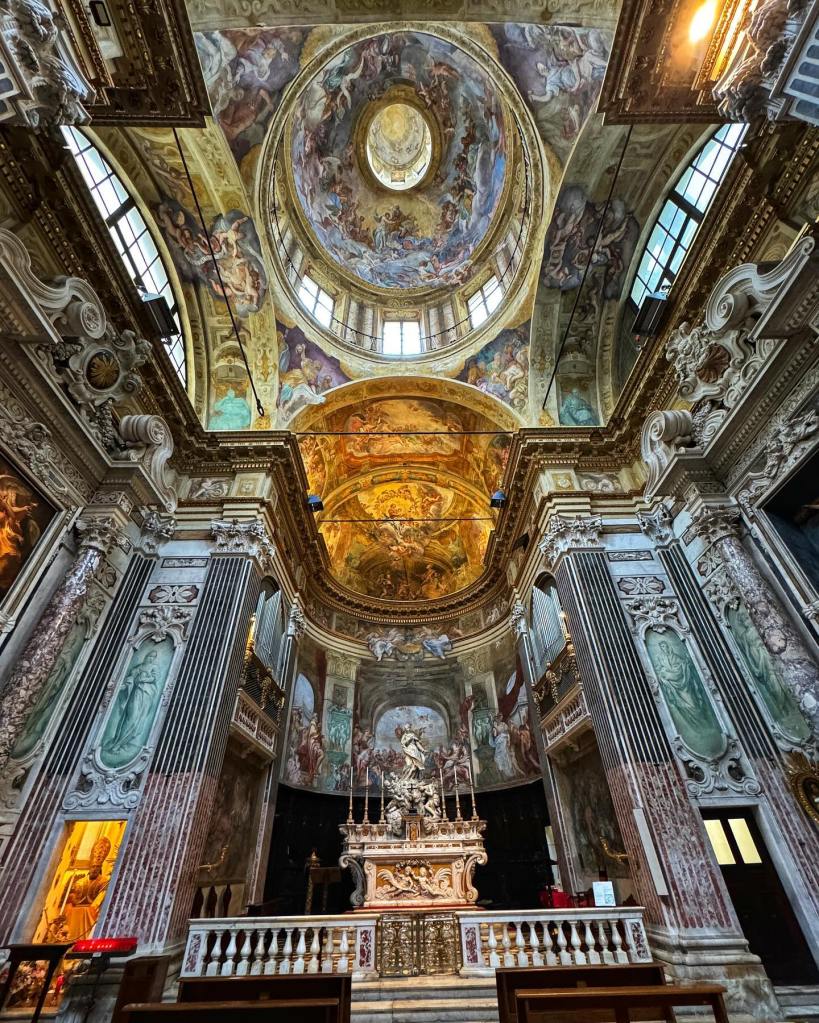
The Chiesa di San Luca [Church of Saint Luke], a small building in the Maddalena quarter a short walk from the Strada Nuova, is one of the finest surviving demonstrations of this workshop method put to work. It is also something rarer and more particular: a parrocchia gentilizia [noble parish church], a type of institution largely peculiar to Genoa, in which a church served not a geographical community but a single patrician family and its allied lineage, wherever in the city its members happened to live. San Luca has belonged to the Spinola and Grimaldi since its foundation. A Latin inscription above the entrance portal, the only surviving element of the original building, records that in October 1188, Oberto Spinola and his seven sons built the church on land owned by his son-in-law Oberto Grimaldi. Oberto Spinola (c.1130–1200) was a major figure in the Republic’s early history: he served eight times as consul, led the Genoese fleet alongside Richard I of England in the Third Crusade, and was honoured with the title padre della patria [father of the fatherland]. In 1485, Pope Innocent VIII (1432–1492) raised the church to a collegiata [collegiate church] and confirmed it as the giuspatronato [right of patronage] of both families. In 1589, Sixtus V (1521–1590) formally declared it a parrocchia gentilizia, extending its jurisdiction to members of both families regardless of where they resided in the city. It remains the Spinola family parish today.
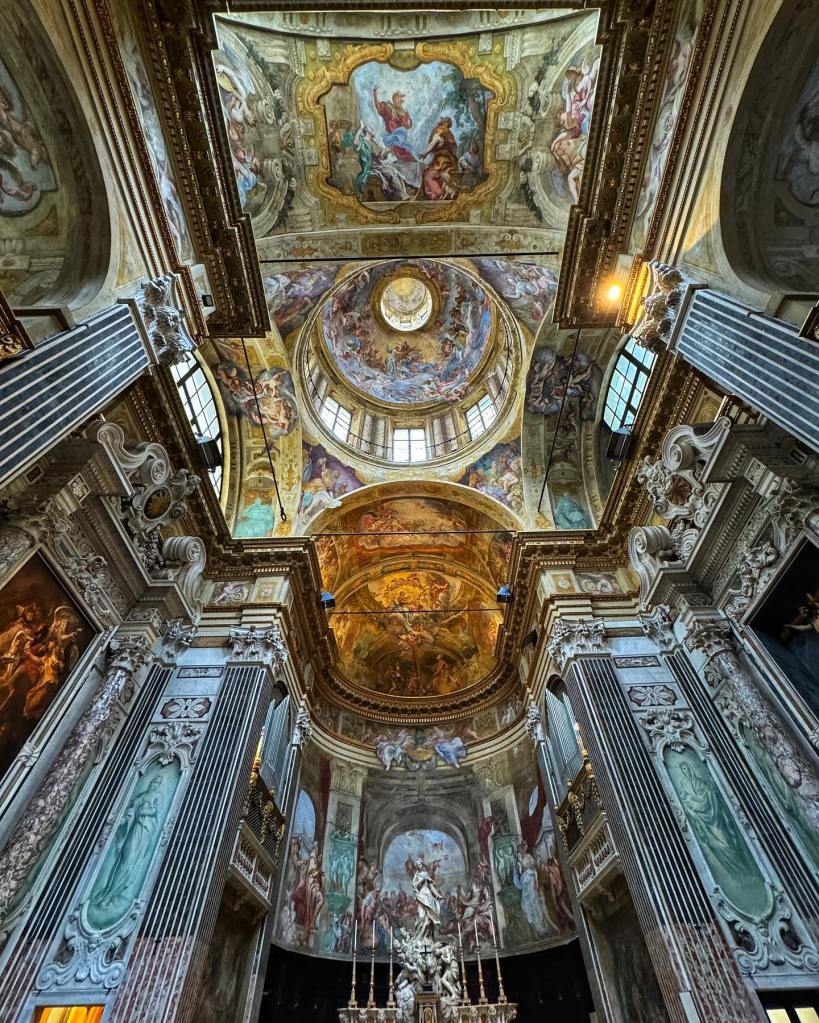
The church was rebuilt from 1626 in a comprehensive transformation. A contract dated February 1626, discovered in the State Archives of Genoa and witnessed by Luca Grimaldi and Leonardo Spinola, attributes the architectural project to Bartolomeo Bianco (c.1590–1657), the Como-born architect who also designed Via Balbi and the Jesuit college that now houses the University of Genoa. The facade stuccoes were the work of Carlo Mutone (active seventeenth century), a Lombard decorator to whom the entire design was once wrongly attributed. The church was reconsecrated in 1627 by Vincenzo Spinola, bishop of Brugnato. The interior has a Greek cross plan with a slightly elongated nave terminating in a semicircular apse. Daniello Solaro completed the marble high altar in 1649, together with the numerous marble ornaments throughout the building.
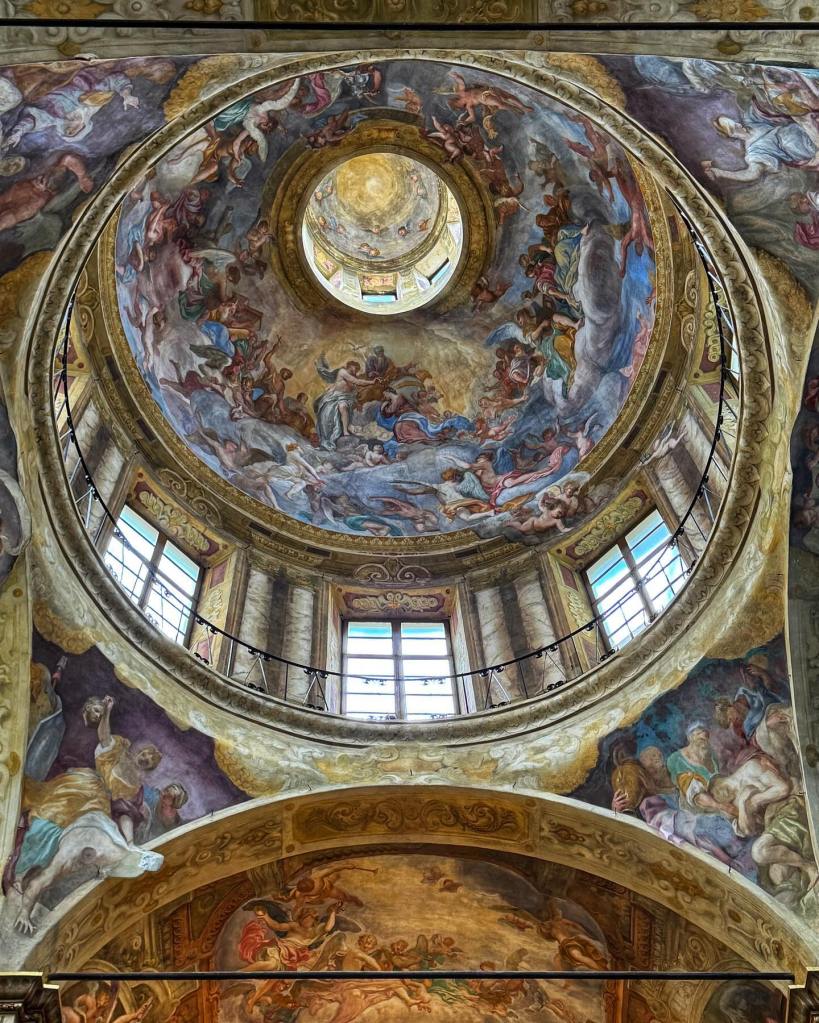
It was in 1695 that the decorative scheme that gives San Luca its present character was commissioned. Domenico Piola, by then sixty-eight years old and at the height of his reputation, was engaged to fresco the entire interior. Piola directed the overall programme, but the scale of the work required the full resources of the Casa Piola. His eldest son, Anton Maria, participated in both design and execution. Paolo Gerolamo, who had been working in Rome, was recalled by his father, almost certainly in anticipation of this specific commission. According to Newcome-Schleier, the Italian-Swiss painter Giovanni Andrea Carlone (1639–1697) may also have contributed.
The collaboration with Antonio Maria Haffner (1654–1732) was critical. Haffner, a Bolognese quadraturista [painter of illusionistic architectural frameworks], executed all the painted cornices and fictive architectural structures that frame Piola’s figurative scenes. This painter-quadraturist partnership was standard practice in Genoese Baroque decoration and reflects one of the school’s distinguishing features: Genoese workshops consistently brought in their architectural illusionists from Bologna, where the tradition of quadratura painting was strongest, and married that expertise to a local figurative style whose roots lay in Flemish colour, Parmese foreshortening, and a warmth of tone unlike the cooler classicism favoured in Roman or Bolognese fresco. In the cupola, Piola painted the Coronation of the Virgin surrounded by ranks of angels, saints, and patriarchs. In the pendentives, four Old Testament subjects serve as typological prefigurations of Marian virtue: Jael driving the nail into Sisera’s skull, Judith with the head of Holofernes, the Prodigal Son received by his father, and Job mocked by his wife. The apse frescoes depict scenes from the life of Saint Luke, including the evangelist painting the Virgin, a subject that carries a particular resonance in a church decorated by painters who conceived of their own work as a form of sacred service. Haffner’s fictive columns and cornices extend the architecture upward and outward, making the small Greek cross plan feel substantially larger than its actual dimensions. This was characteristic. Genoese Baroque was an art of compression: the palaces were tall and narrow because the city was squeezed between mountains and sea, and the churches were modest in footprint because they occupied caruggi [narrow alleys] that left no room for Roman-scale naves. The painters compensated with illusionistic expansion, and the Piola-Haffner partnership at San Luca is one of the most complete surviving demonstrations of that strategy.
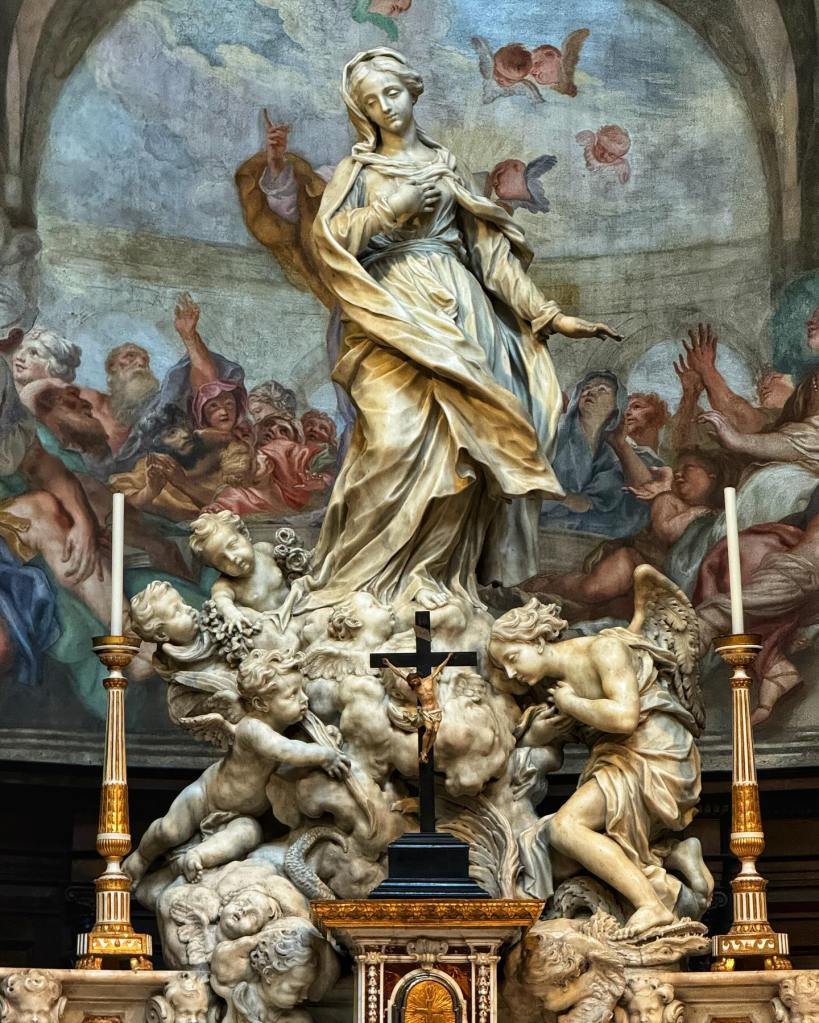
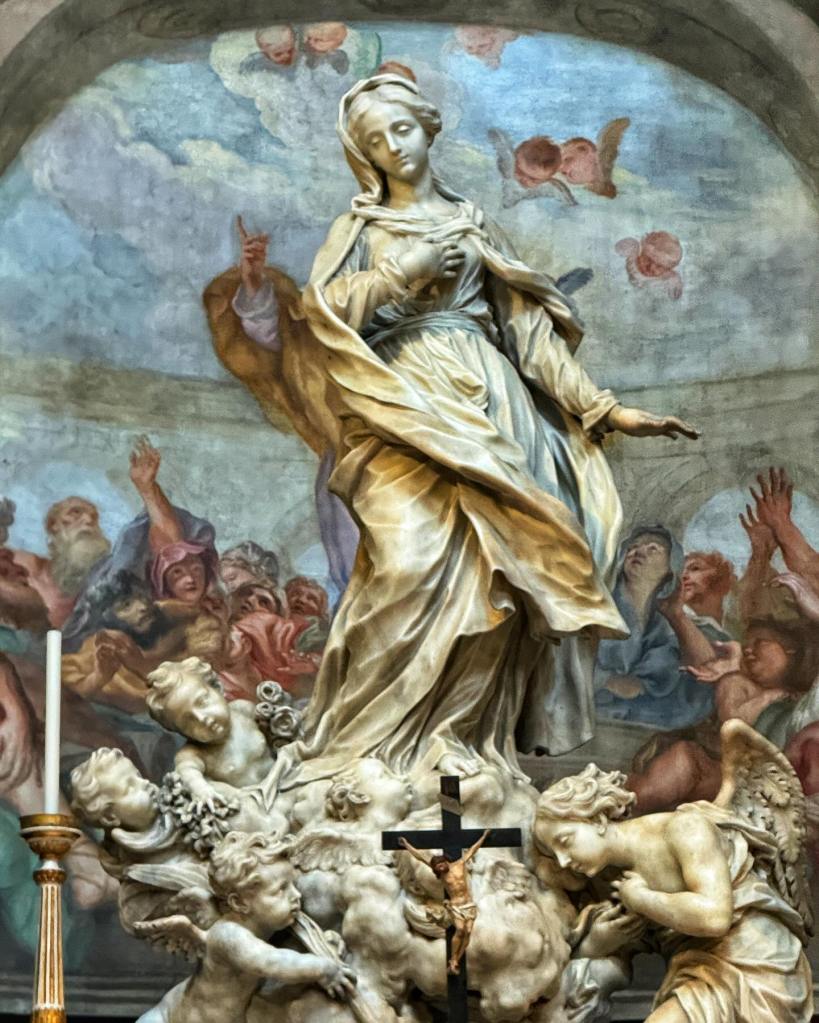
The furnishings confirm the density of talent available to Genoese patrons in this period. Filippo Parodi (1630–1702), who trained under Gian Lorenzo Bernini (1598–1680) in Rome between 1655 and 1661, and who has been called Genoa’s first and greatest native Baroque sculptor, contributed the marble Immacolata [Immaculate Conception] on the altar and the wooden Deposition of Christ, the latter given polychrome surface painting by Piola himself. Giovanni Benedetto Castiglione (1609–1664), known as il Grechetto, is represented by the Adoration of the Shepherds of 1645, the best preserved of his works. Castiglione’s handling blends naturalistic animal observation with atmospheric chiaroscuro and a richness of surface derived from his study of Rubens and Rembrandt; he stands apart, an eccentric genius whose influence passed to later Genoese painters largely through his prints and drawings rather than through workshop transmission.
The bombardments of August 1943 caused severe damage, destroying the dome’s timber armature, which was rebuilt in reinforced concrete in the post-war years. The frescoes were restored by Luigi Gerolamo Leggero (1892–1978). A more comprehensive restoration between 2000 and 2004 returned the decorative scheme to something closer to its original condition. What survives is sufficient to demonstrate why the Genoese Baroque deserves to be understood on its own terms rather than as a provincial echo of Rome. Its best painters were eclectic rather than doctrinaire, absorptive, and shaped by sources from across Europe in combinations that no other Italian city produced. San Luca, a small church built for a single family, decorated by a family workshop, and maintained by that family’s descendants more than eight centuries after its foundation, is as concentrated an example of that tradition as exists anywhere in the city.
Chiesa di San Luca (Church of Saint Luke), Genoa

Chiesa di San Luca (Church of Saint Luke), Genoa
Chiesa di San Luca (Church of Saint Luke), Genoa

Chiesa di San Luca (Church of Saint Luke), Genoa

Chiesa di San Luca (Church of Saint Luke), Genoa
References
FOSCA – Fondazione per lo Studio della Ceramica Antica e dell’Arte (n.d.) ‘Chiesa di S. Luca’. Università di Genova. Available at: https://fosca.unige.it/Chiesa%20di%20S.%20Luca (Accessed: 15 May 2026).
FOSCA – Fondazione per lo Studio della Ceramica Antica e dell’Arte (n.d.) ‘Domenico Piola, Affreschi (Chiesa di San Luca)’. Università di Genova. Available at: https://fosca.unige.it/Domenico%20Piola,%20Affreschi%20(Chiesa%20di%20San%20Luca) (Accessed: 30 September 2024).
Fondazione Spinola (n.d.) ‘The Church of San Luca’. Available at: https://www.spinola.it/en/the-church-of-san-luca/ (Accessed: 30 September 2024).
Fondazione Spinola (n.d.) ‘Chiesa di San Luca, gli affreschi’. Available at: https://www.spinola.it/en/archives/chiesa-di-san-luca-gli-affreschi/ (Accessed: 30 September 2024).
Magnani, L. (2006) ‘Cambiaso, Luca’, Grove Art Online. Oxford: Oxford University Press
Metropolitan Museum of Art (n.d.) Genoa: Drawings and Prints, 1530–1800. Exhibition text. Available at: https://www.metmuseum.org/met-publications/genoa-drawings-and-prints-1530-1800 (Accessed: 30 September 2024).
National Gallery of Art (2021) A Superb Baroque: Art in Genoa, 1600–1750. Exhibition catalogue. Washington, DC: National Gallery of Art. Available at: https://www.nga.gov/press/exhibitions/exhibitions-2021/5051/highlights.html (Accessed: 30 September 2024).
Newcome-Schleier, M. (1972) Genoese Baroque Painting. PhD thesis. Binghamton University. Available at: https://orb.binghamton.edu/dissertation_and_theses/285/ (Accessed: 29 September 2024).
Whitfield, P. (2020) Historic Churches of Genoa: A Brief Guide. Genoa: Peter Whitfield