
‘Baroque’ is rather an unstable term to use as a period name. Derived from barroco, Portuguese jewellers’ jargon for a misshapen pearl, it circulated for two centuries as a term of disparagement before Heinrich Wölfflin, in Renaissance und Barock (1888), reorganised it into a formal category defined by opposition to Renaissance proportion (Wellek, 1946). The reorganisation gave the term analytical purchase without resolving its ambiguity: applied across Europe as a category of style, it made its own inconsistencies more visible, since the same forms carried different histories and different political weights depending on where they landed.
‘Bohemian Baroque’ compounds that instability. As a period label it names the Catholic rebuilding campaign that reshaped churches, monasteries, and palaces acrossBohemia from the 1620s to the 1760s, and the chronology is the least disputed part; almost nobody quarrels with when this happened, only what it means. Whether what arrived from Rome and Vienna was adopted, adapted, or simply imposed is the question the style reading has been arguing for decades without settling. Nineteenth-century Czech nationalism bypassed the formal question and named the whole period as foreign darkness laid over a defeated land, turning the Baroque from a style into evidence of cultural dispossession, a verdict that outlasted the scholarship that eventually dismantled it. The most recent views is that imported form and local memory became so entangled in the actual practice of building that the two cannot be separated.
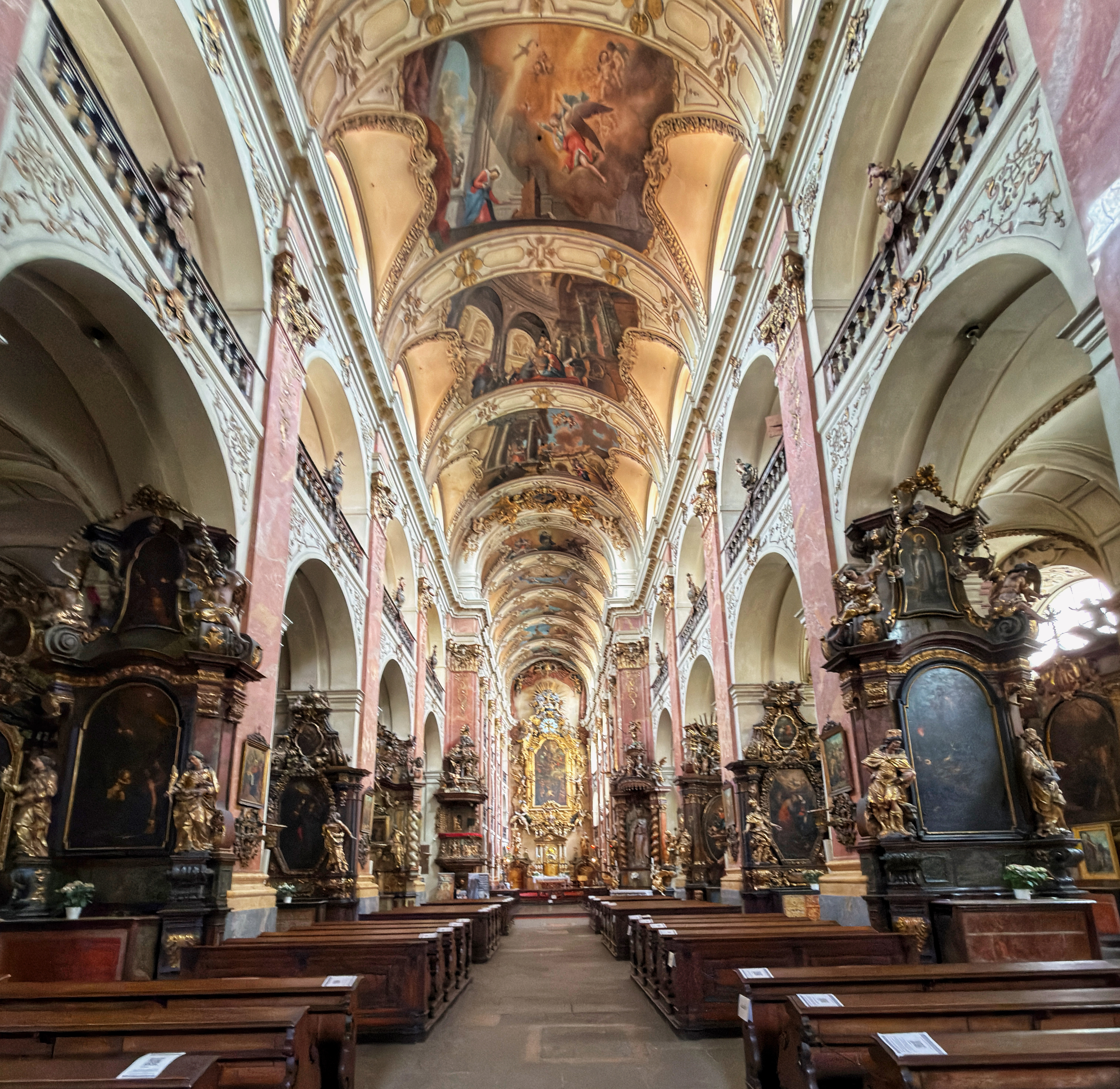
Prague preserves a large number of Gothic churches and monasteries recast in Bohemian Baroque form across the seventeenth and eighteenth centuries, the older structures settled within their new surfaces rather than erased by them, each carrying in its fabric the record of a transformation that was neither wholesale nor painless.Bazilika svatého Jakuba Většího (the Basilica of St James the Greater) in the Old Town is a particularly sharp case, and one with an unusually broad European reach. The clearest way to see what that means is to follow the building’s history rather than the term’s, starting with the fire that nearly destroyed it.
On the night of 21 June 1689 a blaze swept the Old Town and the Jewish quarter and destroyed several hundred houses, with the church among the worst affected (Vlček, 1996). Czech tradition calls it the francouzský požár (the French fire) and lays it at the door of arsonists working in the French interest during the Nine Years’ War of 1688 to 1697, when Louis XIV (r. 1643–1715) stood against the Grand Alliance led by the Emperor Leopold I (r. 1658–1705). The belief, unsubstantiated, took root at once and persisted for centuries, so that the rebuilding answered a fire and an accusation together.
The accusation drew its plausibility from a wider reputation. Louis XIV was the foremost architectural patron of his age, and the French Baroque he presided over was among the most ordered and classical versions, the manner of Versailles, the Louvre colonnade, and Les Invalides. The same reign carried out the most deliberate destruction of other cities’ architecture in the period. In 1684, during the War of the Reunions and with no formal declaration, a French fleet under Abraham Duquesne (c.1610–1688) bombarded Genoa for ten days, some fourteen thousand projectiles levelling roughly half the city, after which the Doge was made to travel to Versailles in 1685 and apologise in person, a humiliation the king had recorded in paint for the palace (Château de Versailles, 2018). In the winter of 1688 and 1689 the devastation of the Palatinate, planned as a deliberate policy of destruction within the cabinet strategy of Louis XIV, his war minister Louvois (1641–1691), and the strategist Chamlay (1650–1719), burned Heidelberg and more than twenty substantial towns, and the revulsion it provoked across the Empire helped consolidate the coalition it was meant to weaken (Cénat, 2005). In 1695, as a diversion from the siege of Namur, the artillery of Marshal Villeroi (1644–1730) destroyed a third of Brussels, the Grand-Place with it, in the most destructive single event of that city’s history. A reign that produced one of Europe’s most disciplined Baroques was at the same time erasing the urban fabric of its rivals, and it was that record, more than any evidence, which made Prague so willing to believe French agents had lit its fire.
The fire took a great deal. This Gothic church had been among the most ambitious in Prague. Founded in 1232 for the Conventual Franciscans, under Wenceslas I (r. 1230–1253), it was rebuilt as a long triple-naved basilica with an extended choir after the Old Town fire of 1291, the presbytery raised by the 1320s and the nave completed under Charles IV (r. 1346–1378), who saw it consecrated in 1374 by Archbishop Jan Očko of Vlašim (d. 1380). The building was also a recurring setting for royal ceremony. The coronation feast of John of Bohemia (r. 1310–1346) and Elisabeth of Bohemia (1292–1330) was held here in 1311, and the body of Charles IV lay in state beneath five hundred candles in December 1378 (Vlček, 1996). The fire destroyed a long sediment of dynastic and civic memory along with the stone that carried it, and the rebuilding would have to decide what to do with what was left.
The reason the church suffered worst was probably circumstantial. The building stood wrapped in scaffolding for repairs to its plaster, and the timber casing fed the flames and carried the fire into the body of the church. The frontal gable fell and the Gothic vault came down, and the interior was lost apart from three objects pulled clear: a Gothic Pietà, a painting of St Anthony, and a statue of the Suffering Christ (Vlček, 1996).
A surprising amount of the medieval church survived below the level of its furnishings. The eastern clock tower, the long choir, and the cross-vaulted Gothic sacristy remained, and the ground plan that still governs the interior is older than any surface laid over it (Vlček, 1996; Národní památkový ústav, n.d.). How much of this was kept by intention and how much by the plain economy of building on standing foundations is not clear, and the answer would change how the whole should be read.
The reconstruction began at the end of 1690 and was entrusted to Jan Šimon Pánek (also recorded as Pannetius, d. 1721), an architect of the New Town whose other work lay chiefly in fortification. The main fabric was finished by about 1702, with the decoration of the interior carried out between 1736 and 1739. Pánek kept the medieval disposition, though he shortened the choir to correct an axial deviation that Baroque symmetry could not tolerate, lowered the ceiling, and threw a barrel vault with lunettes across the nave, placing tribune galleries above the side aisles (Vlček, 1996). The exterior lost its Gothic character, but the interior kept the proportions of the older church, its unusual length most of all. Whether Pánek preserved the plan as a deliberate gesture of continuity or simply because rebuilding on the old foundations was the faster and cheaper course, the records do not say. More interesting is the observation that the rebuilt disposition has been read against the model of the main Jesuit church of Il Gesù in Rome, the type church of the Counter-Reformation, so that the same plan which conserves the medieval choir also leans toward a Roman confessional model, and continuity and a newer Catholic rhetoric inhabit the same walls. The dates of the rebuilding, 1690 to 1739, sit squarely inside the long Catholic century that gives ‘Bohemian Baroque’ its plainest meaning.
It is exactly this kind of rebuilding, a damaged Gothic church given a new, Rome-leaning skin by the same religious order that had occupied it for centuries, that nineteenth-century Czech nationalism would read as proof of its own case: the epoch after the defeat of the Bohemian estates at White Mountain in 1620 became, in that telling, the temno (the darkness), a period of foreign Catholic absolutism imposed on a subdued people. The temno reading has proved the most persistent of these, because it was built to be unforgettable. The image was fixed in the national imagination, for example, by Alois Jirásek (1851–1930), whose novel Temno [Darkness], serialised from 1913 and published in 1915, portrayed early eighteenth-century Bohemia under re-Catholicisation as spiritual and cultural suffocation; the book was extremely popular, went through several further editions, and partly influenced how generations understood this historical period (Jirásek, 1915; Vlnas, 2001). In that reading the Baroque was the visible instrument of oppression, and the native Gothic past its victim.
Part of what the temno image carried was true, and it should not be waved away. The Thirty Years’ War was a demographic catastrophe for the Bohemian lands, with heavy population loss, displacement, and the flight of the Protestant elites, and the first phase of re-Catholicisation after 1620 was coercive, marked by confiscation, the burning of Czech books, and the expulsion of those who would not convert. The temno reading described this much accurately. Its failure lay in freezing the whole following century and a half at its worst moment, treating an entire epoch as unbroken night. The evidence, however, resists it. The population of the Bohemian lands rose from roughly 959,000 in 1626 to some 2,777,000 by 1790, architectural treatises in Latin, German, and Italian had circulated in Czech libraries since the late fifteenth century, and the lands were neither sealed off nor in continuous decline (Kalina, 2010). The catastrophe was real, but the darkness that supposedly followed it was a literary and ideological construction, and a later one than the events it claimed to describe.
Dismantling the temno reading took the scholarship somewhere more complicated than a revised verdict on the period. By the later seventeenth century the methods of Catholic restoration had grown subtler than the harsh, largely foreign, Jesuit-led campaigns of the decades after the White Mountain. The older monastic orders, the Cistercians and Benedictines with their centuries of settled presence in Bohemia, took the lead, and their abbots promoted a Catholicism that drew on local memory, liturgical and architectural alike, so that the restored faith might appear rooted rather than freshly imposed (Salviucci Insolera, 2011). The architect whose work made this most visible in stone was Jan Blažej Santini-Aichel (1677–1723), the figure the scholarship returns to when it needs to show what entanglement actually looks like in practice. His fusions of Baroque geometry with Gothic vocabulary at the abbeys of Sedlec, Kladruby, and Žďár answered the abbots’ desire to resurrect the imagined greatness of medieval Bohemia, a greatness then being recovered in the patriotic histories of the Jesuit scholar Bohuslav Balbín (1621–1688). Even this resists a simple reading. The abbots who commissioned such work knew the word gotico chiefly from liturgical texts and antiquity rather than as a label for high medieval building, and Santini’s revived ribs were structurally calculated rather than decoratively quoted, reinforcing the vaults at their most loaded points (Kalina, 2010). The invocation of the Gothic past was a Catholic strategy carried out with imported learning, and the two things the temno reading had held apart were entangled in the practice of building from the start.
Sv. Jakub’s own rebuilders were doing something much less considered than this, and the gap between the two is where the building belongs in the larger argument, and where it should not be overclaimed. Sv. Jakub keeps its medieval plan and enshrines its rescued medieval image, and it does so in the same decades when the great abbeys were making the Bohemian past a deliberate instrument of Catholic renewal. Yet there is no sign that the Minorites and their architect were doing anything so considered. A fortification engineer rebuilding at speed on inherited foundations, retaining a choir and a tower because they stood and a Roman plan because it was the available idiom, is some distance from Santini calculating Gothic ribs for a Cistercian abbot steeped in Balbín. The conservatism of the church can be read as purposeful, a restraint fitting for a building understood to be recovering from an act of aggression, and the reading is attractive. It should be held loosely. The building shares the materials of the period’s most sophisticated argument about memory and faith without obviously sharing its intent, and that gap is the most honest thing to be said about it.

Ottavio Mosto (1659–1701), Glorification of St Francis Seraphic (Glorifikace Františka Serafínského), 1695, stucco relief. North relief, façade of the Basilica of St James the Greater (Bazilika svatého Jakuba Většího), Staré Město, Prague


Ottavio Mosto (1659–1701), Glorification of St James the Greater (Glorifikace svatého Jakuba Většího), 1695, stucco relief. Central relief, façade of the Basilica of St James the Greater (Bazilika svatého Jakuba Většího), Staré Město, Prague
The façade is where the rebuilding reaches highest, and where the imported-style reading becomes physical fact rather than argument. Its three tall stucco compositions, set around the windows above the portals, were made in 1695 by Ottavio Mosto (1659–1701), a sculptor and stuccoist from Padua who came to Prague by way of Salzburg and is generally regarded as the first to bring the manner of Gian Lorenzo Bernini (1598–1680) into Bohemian sculpture (Vlček, 1996). They show St James the Greater at the centre, with St Francis of Assisi and St Anthony of Padua to either side, and they are worked spatially rather than in flat relief, the central portions receding into the wall, the faces generalised, the detail given up in favour of a single upward movement. The handling is openly Roman and rare in Prague at this date, and it sets a small puzzle. The street is too narrow to allow the composition to be read whole, so an illusionism designed to be taken in from a distance is met instead at close and oblique range. Whether Mosto and his patrons misjudged the setting, or whether the prestige of a Roman manner counted for more than its legibility, cannot be settled here, though the mismatch is a real one.
Behind the façade the decoration grows quieter. The nave is articulated by pilasters of artificial marble, with stucco by Abondio Bolla, beneath the barrel vault and its lunettes. The ceiling frescoes by František Maximilián Vogel set out the life of the Virgin and the mystery of the Trinity (Vlček, 1996). The side altars, more than twenty in time, carry one of the larger bodies of Baroque painting in Bohemia, with work by Petr Brandl (1668–1735), Jan Jiří Heinsch (1647–1712), and Michael Václav Halbax (1661–1711). The church holds the third largest collection of Brandl’s paintings of any church, after Kostel Panny Marie Vítězné (the Church of Our Lady Victorious) and Bazilika svaté Markéty (the Basilica of St Margaret) at Břevnov (Encyklopedie českých klášterů, 1997). The high altarpiece, The Beheading and Glorification of St James, was painted in 1739 by Václav Vavřinec Reiner (1689–1743), four years before his death.
The treatment of the salvaged Pietà returns the building to the question of memory. The late fifteenth-century Gothic group, one of the three objects carried from the fire, was set within a later retable and kept at the devotional centre of the high altar, the medieval image held inside the Baroque frame (Vlček, 1996). A statue of the Virgin on the high altar had drawn pilgrimage as a miraculous image until the Josephine reforms closed the monastery’s public life. One reading places the gesture beside the period’s wider use of medieval relics and forms as proof of an unbroken Catholic devotion, the local past pressed into the service of the restored church. Another holds that a working shrine simply keeps its miraculous image where the faithful expect it, with no argument intended. The evidence at sv. Jakub does not force a choice, and the more deliberate programmes elsewhere should not be read back into a Minorite rebuilding that may have meant nothing so elaborate.
The organ on the west gallery, built in 1705 by Abraham Starck of Loket (1659–1709), is the largest instrument in the country by its number of pipes, and the length of the nave gives it an acoustic that has kept the church in use as a concert hall for three centuries (Encyklopedie českých klášterů, 1997).
One work in the building stands apart from all of this. The tomb of Count Johann Wenzel Wratislaw von Mitrovice (1670–1712), High Chancellor of Bohemia, in the left aisle, is usually called the finest Baroque sepulchre in Prague. The Count died in Vienna in December 1712, and his remains were brought to Prague and interred within the fortnight. What is actually visible today is not the burial itself but a cenotaph built over his grave years later, designed between 1714 and 1716 by Johann Bernhard Fischer von Erlach (1656–1723), the leading architect of the Viennese imperial court, in the same years he was building the Clam-Gallas Palace across the city, and carved by Ferdinand Maximilian Brokof (1688–1731) (Aurenhammer, 1973). A sandstone effigy of the Count is raised on a red marble base by a personification of Glory, with Kronos and his hourglass set alongside. Its subject is the one the rest of the church leaves alone: Glory lifting the dead Chancellor against devouring Time, the highest office in the kingdom set against the certainty of its ending. The tomb speaks an imperial court idiom imported whole from Vienna, just as the façade speaks a Roman one imported from Padua and beyond, while the body of the church speaks the plainer, conservative Baroque of a local rebuilding on a Gothic plan.
It is tempting to say that each century simply read the Baroque to suit itself, the nineteenth needing a foreign darkness against which to define a suppressed nation, later scholarship preferring a quieter story of accommodation. These conflicting readings arise from the nature of Bohemian Baroque itself, which was made out of rupture and recovery at once, defeat and endurance, the imported and the inherited. A church like sv. Jakub holds all of it in one fabric, so the darkness and the settlement are both there to be found, because both went into the building.


The high altarpiece of the Basilica of St James the Greater (Kostel svatého Jakuba Většího), The Beheading and Glorification of St James (Stětí a glorifikace svatého Jakuba), painted in 1739 by Václav Vavřinec Reiner (1689–1743). The martyrdom occupies the lower scene, the saint’s glorification the upper, within a frame whose angels were carved by Matyáš Schönherr (1701–1743) in 1738–1739.


References
Aurenhammer, H. (1973) J. B. Fischer von Erlach. London: Allen Lane.
Cénat, J.-P. (2005) ‘Le ravage du Palatinat: politique de destruction, stratégie de cabinet et propagande au début de la guerre de la Ligue d’Augsbourg’ [The devastation of the Palatinate: destruction policy, cabinet strategy and propaganda at the beginning of the War of the League of Augsburg], Revue historique, 633(1), pp. 97–132. Available at: https://shs.cairn.info/revue-historique-2005-1-page-97?lang=fr&tab=auteurs (Accessed 16 June 2026)
Château de Versailles (2018) Reception of the Doge of Genoa, 1685. Available at: https://en.chateauversailles.fr/discover/history/key-dates/reception-doge-genoa-1685 (Accessed: 14 June 2026).
Encyklopedie českých klášterů [Encyclopaedia of Czech Monasteries] (1997). Edited by P. Vlček, P. Sommer and D. Foltýn. Prague: Libri
Hempel, E. (1965) Baroque Art and Architecture in Central Europe. Harmondsworth: Penguin
Jirásek, A. (1915) Temno [Darkness]. Prague: J. Otto.
Kalina, P. (2010) ‘In opere gotico unicus: the hybrid architecture of Jan Blažej Santini-Aichel and patterns of memory in post-Reformation Bohemia’, Umění / Art, 58(3), pp. 198–217. Available at: https://www.academia.edu/4506255 (Accessed: 14 June 2026).
Národní památkový ústav (n.d.) Klášter minoritů u kostela sv. Jakuba [The Minorite monastery by the church of St James], Památkový katalog [Monument Catalogue]. Available at: https://pamatkovykatalog.cz/klaster-minoritu-u-kostela-sv-jakuba-15740529 (Accessed: 14 June 2026).
Opačić, Z. (ed.) (2009) Prague and Bohemia: Medieval Art, Architecture and Cultural Exchange in Central Europe. British Archaeological Association Conference Transactions 32. Leeds: Maney. Available at: https://www.academia.edu/73023473 (Accessed: 14 June 2026).
Poche, E. (1985) Prahou krok za krokem [Through Prague step by step]. Prague: Panorama, pp. 190–193.
Salviucci Insolera, L. (2011) ‘Bohemian Baroque culture and folk devotion: Johann Santini Aichel’s Nepomuk church in Žďár’. Available at: https://www.academia.edu/10621757 (Accessed: 14 June 2026).
Řezníková, L. (2016) ‘Beyond ideology: representations of the Baroque in socialist Czechoslovakia as seen through the media’, Journal of Art Historiography, 15, pp. 1–23. Available at: https://www.academia.edu/42293454 (Accessed: 22 June 2026).
Vlček, P. (ed.) (1996) Umělecké památky Prahy. Staré Město, Josefov [Artistic Monuments of Prague: The Old Town, Josefov]. Prague: Academia.
Vlnas, V. (2001) ‘Beyond ideology: representations of the Baroque in the Czech lands’, in The Glory of the Baroque in Bohemia. Prague: National Gallery.
Wellek, R. (1946) ‘The concept of Baroque in literary scholarship’, The Journal of Aesthetics and Art Criticism, 5(2), pp. 77–109. https://www.jstor.org/stable/425797 (Accessed 16 June 2026)