
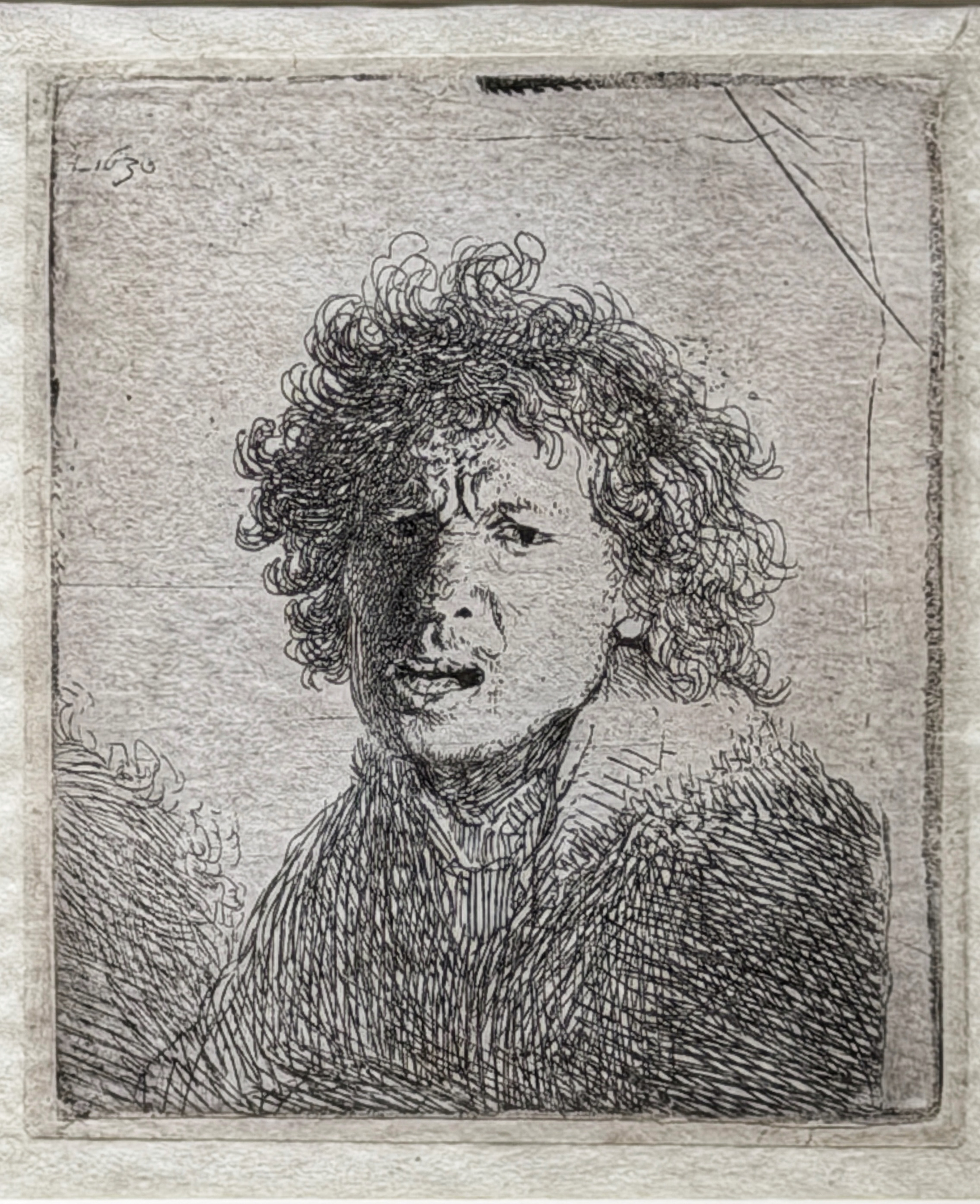
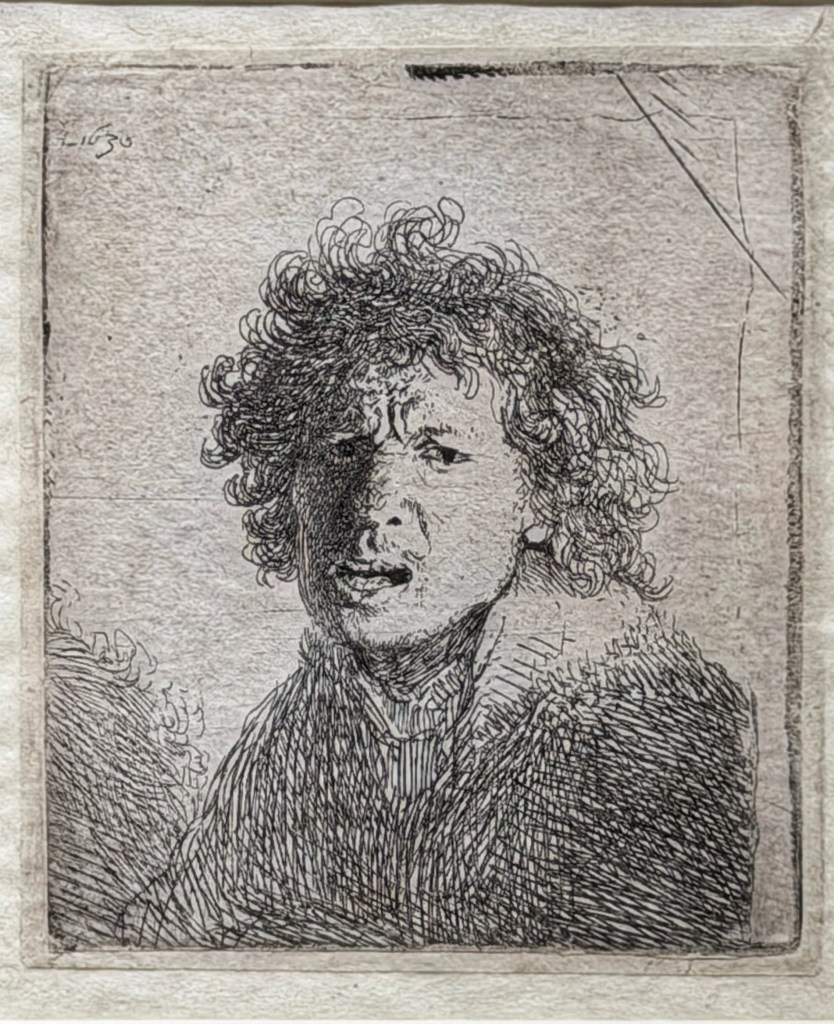
The tronie was an established genre long before Rembrandt, a head study built around a single emotional state or character type rather than the identity of any particular sitter. In Leiden, working alongside Jan Lievens (1607–1674), Rembrandt drew on the faces around him, family members, friends, neighbours, people from the street, as well as his own face studies, building a repertoire of human types across a range of emotional registers: surprise, grief, rage, laughter, suspicion, or, as in this sheet where the mouth falls open mid-shout and the features tighten around it, raw vocal urgency.
When Rembrandt used his own face within this practice the function was no different from any other available model, one more emotional state captured and held in reserve. Each sheet added another solved problem that could be recalled and repositioned when a history painting required a prophet crying out, a figure recoiling in fear, a crowd caught in the instant before it turns, an apostle overcome with grief, or a face registering the precise moment that doubt becomes certainty.
References
Hirschfelder, D. (2008) Tronie und Porträt in der niederländischen Malerei des 17. Jahrhunderts [Tronie and portrait in seventeenth-century Netherlandish painting]. Berlin: Gebr. Mann Verlag
Dickey, S.S. (2019) ‘Printmaking in Leiden c. 1630: Rembrandt, Lievens, and Van Vliet’, in Coutré, J. et al. Leiden circa 1630: Rembrandt Emerges. Kingston: Agnes Etherington Art Centre, Queen’s University, pp. 36–65.
Gottwald, F. (2011) Das Tronie: Muster, Studie und Meisterwerk. Die Genese einer Gattung der Malerei vom 15. Jahrhundert bis zu Rembrandt [The tronie: pattern, study and masterwork. The genesis of a genre of painting from the fifteenth century to Rembrandt]. Berlin: Deutscher Kunstverlag
Van de Wetering, E. (2005) ‘Rembrandt’s self-portraits: problems of authenticity and function’, in Van de Wetering, E. A Corpus of Rembrandt Paintings, vol. IV: The Self-Portraits. Stichting Foundation Rembrandt Research Project. Dordrecht: Springer. Available at: https://www.researchgate.net/publication/345247886_Rembrandt’s_self-portraits_problems_of_authenticity_and_function (Accessed: 26 June 2026).
Van de Wetering, E. (2005) A Corpus of Rembrandt Paintings, vol. IV: The Self-Portraits. Stichting Foundation Rembrandt Research Project. Dordrecht: Springer