The University Church of St Mary the Virgin, The High Street, Oxford
The tower of St Mary’s, begun around 1280 with its spire added in the early fourteenth century, is one of Oxford’s defining medieval landmarks. Its gargoyles, grotesques, and niches once gave the tower a vivid sculptural presence, but centuries of weathering reduced many to worn fragments. By the mid-nineteenth century restoration was unavoidable. George Gilbert Scott (1811–1878) directed work on the parapet and pinnacles in the 1850s and 1860s, Thomas Graham Jackson (1835–1924) supervised further repairs in 1894, and the sculptor George Frampton (1860–1928) carved new figures to replace those lost. Surviving medieval carvings were removed for protection to New College cloister.
The choices made at St Mary’s reflect the broader disputes of the Gothic Revival. John Ruskin (1819–1900), in The Seven Lamps of Architecture (1849), condemned restoration as a falsification of history, arguing that every stone should be left as it stood, however fragmentary. The French architect Eugène Viollet-le-Duc (1814–1879) took the opposite view, maintaining that restoration meant returning a building to a state of completeness that it may never have possessed in its past. The approach in Oxford occupied a middle ground. Scott and Jackson accepted reconstruction as necessary but tried to keep it sympathetic, avoiding invention and ensuring that original fragments were preserved even when replaced.
The tower that stands today therefore embodies two histories: that of its medieval masons, and that of the Victorian architects and sculptors who sought to secure its survival. It is both a thirteenth-century structure and a nineteenth-century monument, showing how Oxford has continually reinterpreted its Gothic past.
The University Church of St Mary the Virgin, The High Street, Oxford, OX1 4BJ The University Church of St Mary the Virgin, The High Street, Oxford, OX1 4BJ
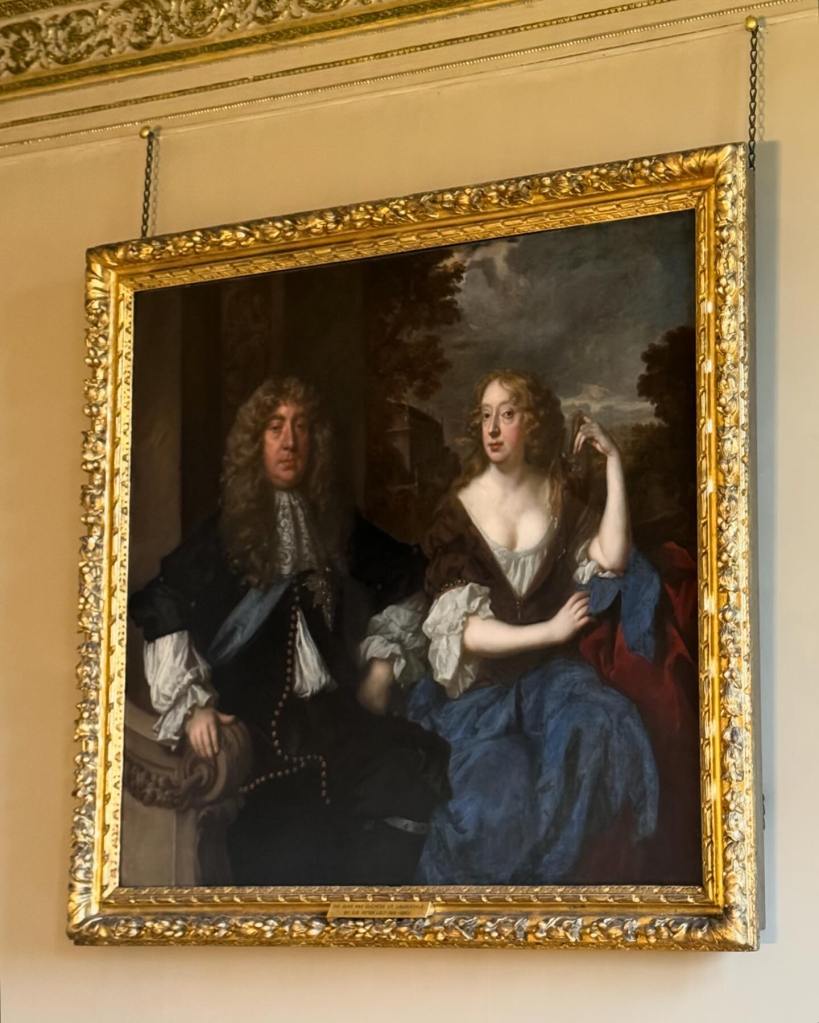
Peter Lely (1618 –1680) and Studio, Portrait of Elizabeth Murray, Countess of Dysart, later Duchess of Lauderdale (1626-1698), 1648, Oil on canvas, 122 x 98cm, Ham House, Richmond, Surrey
Peter Lely (1618 –1680) and Studio, Portrait of Elizabeth Murray, Countess of Dysart, later Duchess of Lauderdale (1626-1698), 1648, Oil on canvas, 122 x 98cm, Ham House, Richmond, Surrey
Few women in 17th-century England moved with such daring across the fault lines of politics, power, and intrigue as Elizabeth Murray, later Duchess of Lauderdale. Born in 1626 into a family close to the Stuart court, she became, during the upheavals of the Civil Wars and Interregnum, one of the most resourceful Royalist agents. Her ability to inhabit two worlds—socially engaged with Oliver Cromwell’s household, while secretly funnelling intelligence to Royalist exiles—made her indispensable to networks such as the Sealed Knot. It was a dangerous game of duplicity and coded correspondence, in which charm and social dexterity became weapons as sharp as any blade. By the time of the Restoration in 1660, Elizabeth had ensured her place as both survivor and power-broker, a woman whose wit and audacity were as legendary as her beauty.
Peter Lely’s earliest portrait of her, painted with the assistance of his studio in 1648, captures Elizabeth at just twenty, newly married to Sir Lionel Tollemache. The picture freezes a moment of youthful ascendancy, presenting a poised young woman at the threshold of the turbulent career that would define her. It is the first in a visual sequence that charts her evolution from ingénue to formidable duchess.
As the decades advanced, so too did the way Elizabeth was portrayed. Lely’s later images, painted in the 1660s at the height of her influence, show her transformed into the assured Countess of Dysart, draped in silks and jewels befitting her prominence in Charles II’s resplendent court. One later portrait even brings her together with her second husband, John Maitland, Duke of Lauderdale, one of the most powerful of the Restoration grandees. Here, the couple is presented as a political partnership, their likenesses embodying not only personal union but also their role as arbiters of courtly and cultural life.
Taken together, these portraits offer more than likenesses: they are fragments of a political biography in paint. Through Lely’s brush, we see Elizabeth Murray’s metamorphosis—an aristocratic daughter, a covert agent, a consummate courtier, and finally a duchess whose presence shaped the Restoration world.
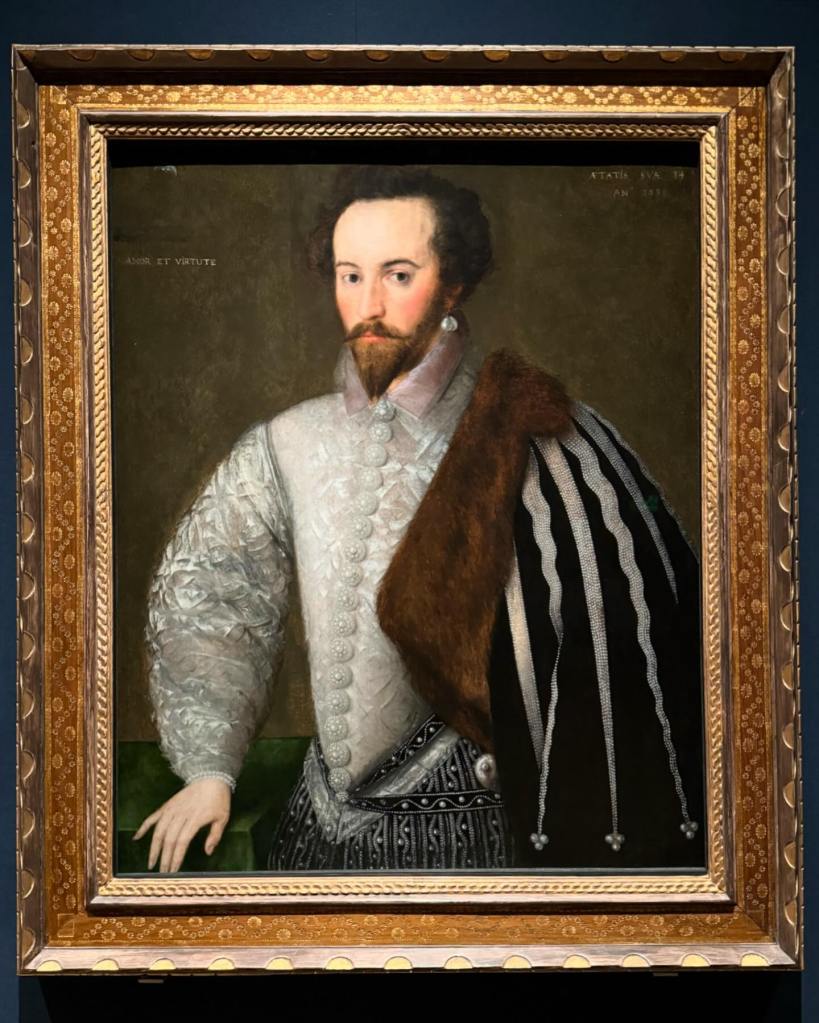
Unidentified English painter, Portrait of Sir Walter Ralegh, 1588, Oil on panel 91.4x 74.6cm , National Portrait Gallery, London
Pearls were among the most highly prized jewels of the sixteenth century, associated with wealth, purity, and refinement. Sir Walter Ralegh’s wearing of a single pearl earring signalled both his access to luxury goods derived from overseas trade and his self-fashioning as a courtier of distinctive style within Elizabeth I’s circle, where pearls also carried connotations of loyalty to the Queen, herself an avid wearer of them. The detail contributes to the image of Ralegh as a figure who combined martial ambition with cultivated taste. The Latin inscription to the left, Amor et Virtute (‘By love and virtue’), underscores the moral and chivalric framework of the portrait, while the legend to the right, Aetatis suae 34 / Anno 1588, records his age at the time of painting and situates the work within a moment of heightened national crisis, the year of the Armada.
Unidentified English painter, Portrait of Sir Walter Ralegh, 1588, Oil on panel 91.4x 74.6cm , National Portrait Gallery, LondonUnidentified English painter, Portrait of Sir Walter Ralegh, 1588, Oil on panel 91.4x 74.6cm , National Portrait Gallery, London
Hans Holbein the Younger (1497/8-1543), Portrait of Sir Nicholas Poyntz (c.1510-1556), 1535, Chalks snd inks on paper, 28.4 x 18.3 cm, The Royal Collection, on short-term loan to The Queen’s Gallery, Buckingham Palace, London
Hans Holbein the Younger (1497/8-1543), Portrait of Sir Nicholas Poyntz (c.1510-1556), 1535, Chalks snd inks on paper, 28.4 x 18.3 cm, The Royal Collection, on short-term loan to The Queen’s Gallery, Buckingham Palace, London
Hans Holbein the Younger (1497/8–1543) was born in Augsburg, the son of Hans Holbein the Elder (c. 1460–1524), a painter of altarpieces and portrait studies who gave his son both his first training and an unusually clear model of what it meant to work across media and across markets. The younger Holbein moved to Basel by 1515, entered the painters’ corporation there in 1519, and established himself through an exceptionally varied practice that included book illustrations, mural decorations, and portraiture, the last of these shaped early on by his close association with the humanist circle around Desiderius Erasmus (1466–1536), whose likeness he made internationally familiar and whose introductions opened the door to England. Holbein arrived in London for the first time in 1526, secured commissions through Sir Thomas More (1478–1535) and his circle, and returned to Basel in 1528. He came back to England permanently in 1532, by which point the religious disruptions of the Reformation had severely contracted the market for the kind of devotional painting he might otherwise have pursued. By 1535, when this drawing was made, he was working under the patronage of Anne Boleyn (c. 1501–1536) and Thomas Cromwell (c. 1485–1540), the two most powerful figures in the reforming court; his formal appointment as King’s Painter followed in September 1536.
The drawing of Sir Nicholas Poyntz (c. 1510–1556) belongs to the most productive and technically refined phase of Holbein’s English career. It is executed on paper primed with a pale pink ground, a practice Holbein adopted consistently from his return to England in 1532 and which served a specific technical purpose: the pink mid-tone approximated the flesh tones of his sitters, providing a ready foundation on which lighter highlights and darker shadows could be built up without first having to establish the colour range from scratch. Red chalk, black and coloured chalks, pen and ink, and white heightening were typically combined in these studies, with the face worked up in close, blended hatching and the clothing and accessories recorded more swiftly, sometimes with written colour notes added for reference. The eighty portrait drawings from Holbein’s English years that survive in the Royal Collection, of which this sheet is one, were at some point bound together into a volume described in the 1547 inventory of Whitehall Palace as one of three albums of Holbein drawings; the collection had very likely entered royal ownership before or shortly after the artist’s death. These drawings were working documents as much as finished objects, made during personal sittings to capture the likeness and gather the information needed to produce an oil painting or miniature at a later stage, with the composition transferred to panel by pricking or tracing. In the case of Nicholas Poyntz, no painted portrait by Holbein survives, though a painted copy after the drawing is held by the National Portrait Gallery, London, confirming that the drawing circulated as a model.
Poyntz himself was a Gloucestershire landowner and courtier whose social position in 1535 was defined partly by family history and partly by astute political alignment. His grandfather had fought for Henry Tudor (1457–1509) at the Battle of Bosworth in 1485 and received his knighthood on the field; his family had retained royal favour in the decades that followed. Poyntz inherited Acton Court at Iron Acton, Gloucestershire, in 1532, aged around twenty-two, and set about demonstrating his ambitions with considerable energy. On 21 August 1535, Henry VIII (1491–1547) and Anne Boleyn made a visit to Acton Court as part of their summer progress to the south-west, and Poyntz had constructed a new wing to receive them, built so quickly it apparently lacked foundations. Archaeological excavations at the site have recovered fragments of Venetian glass and Italian maiolica, objects Poyntz almost certainly acquired for the occasion, and one of the three first-floor state rooms in the new wing still carries painted decoration by an artist working in the Tudor court manner. The royal visit and the Holbein drawing fall in the same year, and the drawing should be read within this context: a young courtier, newly established, closely aligned with the Boleyn faction, commissioning the most sought-after portraitist at the Tudor court at precisely the moment of maximum political exposure and social ambition. Poyntz went on to serve as High Sheriff of Gloucestershire in 1539 and 1545, accompanied Anne of Cleves (1515–1557) to England in 1539 during the negotiations for her marriage to Henry, and represented Gloucestershire in Parliament as Knight of the Shire in 1547.
The drawing’s use of a profile format warrants attention, since the majority of Holbein’s portrait studies adopt the three-quarter view; the choice here carries its own iconographic register, recalling the format of classical medals and Roman coins as well as the Italian Renaissance plaquette tradition, all of which associated the profile with commemoration, civic authority, and the claims of public men to lasting record. Whether this was Holbein’s decision or Poyntz’s instruction is unknowable, but either way it aligns the sitter with a visual vocabulary familiar to anyone educated in humanist culture and alert to the way portraiture functioned as a form of social statement.
References
Foister, S. (2004) Holbein and England. New Haven and London: Yale University Press
Heard, K. (2023) Holbein at the Tudor Court. London: Royal Collection Trust
Parker, K.T. (1945) The Drawings of Hans Holbein in the Collection of His Majesty the King at Windsor Castle. Oxford and London: Phaidon Pressnd.
Nicholas Hilliard (1547–1619), Self-portrait, aged 30, 1577, Watercolour on vellum, 41 mm, Victoria & Albert Museum, London
Nicholas Hilliard (1547–1619), Self-portrait, aged 30, 1577, Watercolour on vellum, 41 mm, Victoria & Albert Museum, London
This miniature portrait, created during the artist’s stay in France between 1576 and 1578, reflects the elevated status enjoyed by artists at the Valois court. It contrasts sharply with their relatively modest position in Tudor England, where painters were seldom regarded as members of the royal entourage. Hilliard presents himself not as a mere craftsman but as an intellectual and gentleman, aspiring to the standing held by his counterparts at the Valois and Habsburg courts.
Upon his return to England, Hilliard’s situation changed markedly. Stripped of the distinction he had experienced abroad, he found himself reduced to the role of an ordinary craftsman. His efforts to secure lasting favour at the Tudor and later Stuart courts met with considerable difficulty, and only in the latter stages of his life did conditions shift. The arrival of leading foreign artists in London began to alter perceptions, gradually raising the painter’s place in society.
Hilliard’s portraiture encompassed a wide range of sitters, from royalty to explorers and members of the emerging middle class. This self-portrait, together with contemporary miniatures of his wife and father, ranks among the finest examples of early English portraiture.
The work offers a rare glimpse into Hilliard’s own self-image at a crucial point in his career. It also illustrates the broader development of painting in England, as it evolved from a craft to a discipline increasingly aligned with the liberal arts.
The Gate of Honour, Gonville and Caius College, Cambridge
The Gate of Honour was completed in 1575, two years after the death of John Caius (1510–1573), who designed it as part of his rebuilding of the college. It forms the final stage in his symbolic sequence of gates—Humility, Virtue, and Honour—expressing the progress of the scholar through learning. The gate remains closed for most of the year and is only opened for graduation, when students pass through on their way to the Senate House. Its Renaissance design, with classical details and humanist inscriptions, reflects Caius’s education in Padua and his belief that architecture could embody moral as well as academic ideals.
King’s College Chapel, Cambridge, begun under Henry VI (1421–1471) in 1446 and completed in 1547 under Henry VIII (1491–1547), is both a masterpiece of late Perpendicular Gothic and one of the most eloquent monuments of dynastic propaganda in England. Rising during the turbulence of the Wars of the Roses, halted and resumed under successive monarchs, and finally finished by the Tudors, the chapel embodies the intersection of religion, politics, and art in fifteenth- and sixteenth-century England.
Its fabric proclaims continuity across disruption. Henry VI conceived the chapel as the centrepiece of his new foundation, but after his deposition the works stalled. Only with Henry VII (1457–1509) did construction recover momentum, for the Tudor monarch recognised in this vast, unfinished structure a ready-made canvas upon which to project legitimacy. Through financial endowment and a carefully directed decorative programme, Henry VII and Henry VIII transformed the chapel into a dynastic monument. The architecture itself, with its immense proportions and the world’s largest fan vault, was a statement of authority, while its iconography embedded the Tudor myth of providential rule.
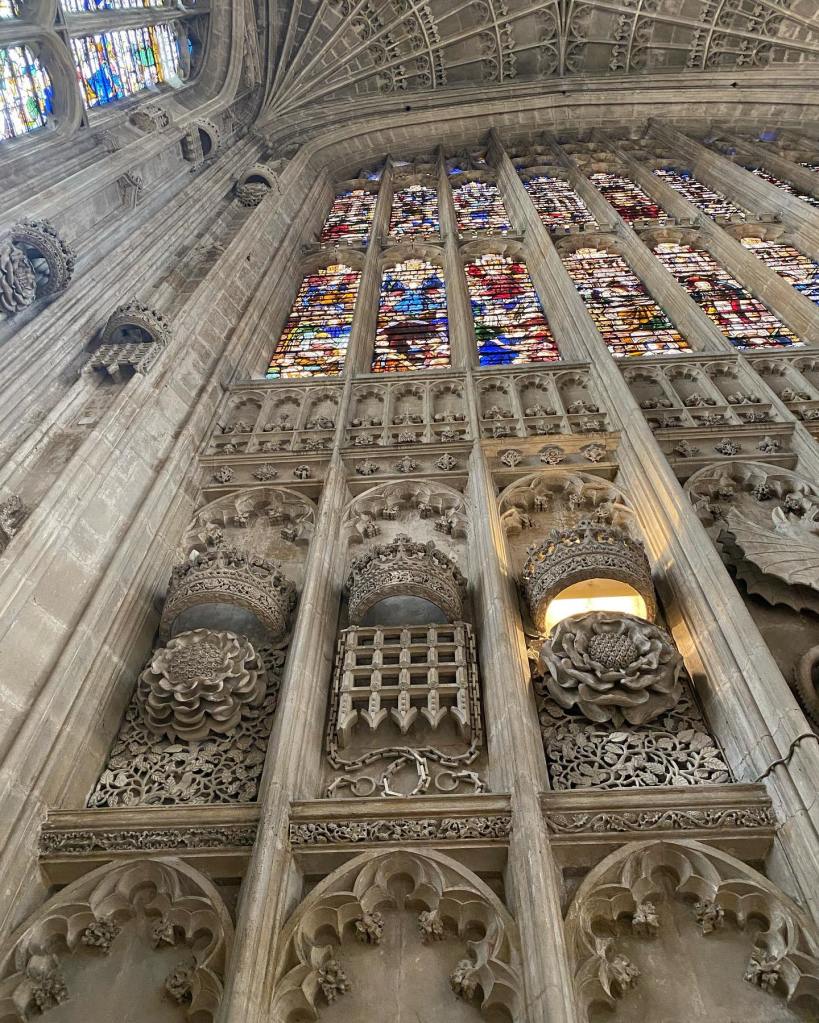
The heraldic scheme remains omnipresent: the crowned Tudor rose, the Beaufort portcullis, the Richmond greyhound, and the Tudor dragon are repeated with almost obsessive regularity. These devices proclaimed the dynasty’s roots in both Yorkist and Lancastrian lines, asserted its descent through Margaret Beaufort, and advertised the stability restored after decades of civil war. Yet heraldry was only one register of meaning.
The chapel’s stained glass, executed between 1515 and 1531, constitutes one of the most ambitious cycles of its age. Each window is organised around paired typologies: Old Testament scenes are juxtaposed with New Testament fulfilments. This exegetical method—reading Hebrew scripture as foreshadowing Christian truth—was conventional in late medieval theology but here acquires a new political charge. Scenes from Genesis, Exodus, and the Prophets are paired with episodes from the life of Christ, presenting salvation history as a continuous, divinely ordered plan.
Within this framework, royal heraldry is interwoven. Margins and tracery lights carry Tudor roses, portcullises, and royal arms, binding the dynasty into the same providential scheme. In effect, just as the Old Testament was fulfilled in the New, so the turmoil of the Wars of the Roses found resolution in the Tudor settlement. The dynasty presented itself as the vessel chosen to bring divine order to a fractured kingdom.
This fusion of scripture and politics is sharpened by the historical context of their completion. The glass was installed under Henry VIII, during the years in which the king’s marital and dynastic anxieties intensified. It is not accidental that windows emphasise genealogies and divine sanction, reinforcing the message that Tudor succession was inscribed into sacred history itself. The visual pairing of prophecy and fulfilment thus doubled as a legitimising allegory for the monarchy.
By the time of its consecration, King’s College Chapel had become something more than the original pious foundation of Henry VI. It was a dynastic theatre in glass and stone, its fan vault and stained cycles announcing both the magnificence of the English monarchy and the providential inevitability of Tudor rule. It remains, even now, one of the most potent survivals of how late medieval and Renaissance art could bind together religion, politics, and propaganda in a single architectural vision.
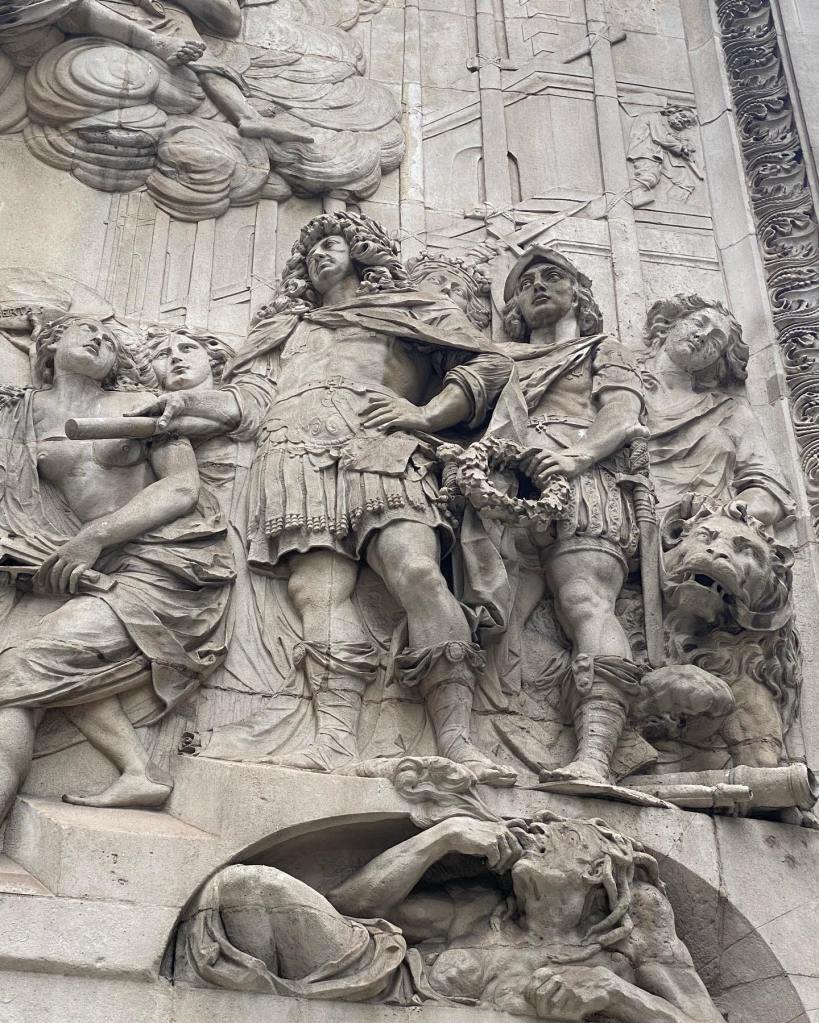
The Monument to the Great Fire of London, bas-relief by Caius Gabriel Cibber (1630–1700), 1671–1677, Portland stone, approximately 3.7 × 2.1 metres, base of the Monument, Fish Street Hill, London
Caius Gabriel Cibber carved the bas-relief at the base of the Monument while technically a prisoner. The Danish-born sculptor, who had trained in Italy and settled in England by the early 1660s, was confined for debt at the time of the commission, and was granted court permission to leave his cell during the day to work on the stone before returning each evening. The arrangement says something pointed about the position of sculptors in Restoration England: Cibber was trusted with one of the most prominent public commissions in the rebuilt City, yet his creditors still had first claim on his person. He was not alone in this precariousness. Artists of considerable reputation routinely depended on the irregular flow of court or civic patronage, and the gap between professional standing and personal solvency could be startlingly wide .
The Monument was designed jointly by Christopher Wren (1632–1723) and Robert Hooke (1635–1703), with construction beginning in 1671 on the site of St Margaret, New Fish Street, the first church destroyed in the fire, and completed by 1677. The First Rebuilding Act of 1669 had stipulated that a column of brass or stone should be erected on or near the spot where the fire began, ‘the better to preserve the memory of this dreadful visitation.’ What form the column should take was long debated. Hooke’s surviving drawings show several proposals: a plain obelisk, a column decorated with tongues of flame, and the fluted Doric column eventually chosen. The crowning element proved more contentious still. Wren initially favoured a statue of a phoenix with outstretched wings rising from the ashes. As the column neared completion, he shifted to proposing either a fifteen-foot statue of Charles II or a sword-wielding female figure representing a triumphant London. Charles himself declined the honour, apparently wishing not to be associated too directly with the catastrophe, and preferred a simpler copper-gilded ball with flames. In the end it was Hooke’s design of a flaming gilt-bronze urn that was adopted. The column stands 202 feet tall, a measurement corresponding exactly to its distance from Thomas Farriner’s bakery on Pudding Lane where the fire had broken out. Wren and Hooke also intended it to function as a scientific instrument: a central shaft served as a zenith telescope for astronomical observations, with an underground laboratory beneath the base for the experimenter’s use, though traffic vibrations from Fish Street Hill ultimately made the conditions unsuitable for precise work;
Cibber’s relief, mounted on the west-facing pedestal panel, was intended to supply the structure with an allegorical account of the Great Fire of 1666 and the City’s recovery. It is a large and densely populated composition, and its rhetorical ambitions deserve scrutiny, because the story it tells is selective in ways that served specific political interests.
The left side of the panel presents London in the immediate aftermath of the fire. The City is personified as a grieving woman seated among broken masonry, her posture borrowed from classical mourning figures familiar through antique sarcophagi and Renaissance prints. The heraldic dragon of the City of London crouches beside her, its protective role inverted into a sign of desolation. Above, the figures of Father Time and Mercury preside: Time, lifting the City towards recovery, and Mercury, patron of commerce, alluding to the mercantile wealth on which London’s reconstruction would actually depend. At her feet a beehive denotes Industry, through which, the allegory implies, the greatest difficulties may be overcome. The iconographic vocabulary here draws heavily on Cesare Ripa’s (c.1555–1622) Iconologia, first published in Rome in 1593 and widely available in illustrated northern European editions by the mid-seventeenth century. Ripa’s system of personification, in which abstract concepts and civic virtues were given human form accompanied by identifying attributes, had become standard equipment for public sculpture and decorative programmes across Europe.
The right half of the relief shifts register. Charles II (1630–1685) appears in the guise of a Roman emperor, laurel-crowned and elevated above the scene, directing the reconstruction with an outstretched arm. The pose is borrowed from imperial triumphal reliefs, particularly those of Trajan (53–117 AD) and Marcus Aurelius (121–180 AD), which were well known to seventeenth-century artists through engraved reproductions. Around the king stand personifications of Architecture, Liberty, Imagination, Justice, and Fortitude, again derived from Ripa’s compendium, each made to appear as though the recovery of London proceeded from the monarch’s personal qualities rather than from the far messier collaborative effort that actually rebuilt the City. The Corporation of London, private investment, and parliamentary legislation did the heavy practical work of reconstruction. The relief tactfully omits all of this.
James, Duke of York (1633–1701), the king’s brother and the future James II, stands behind Charles holding a laurel wreath, cast in the role of a victorious general for his documented efforts during the fire itself. Below, the figure of Envy, blowing flames from her mouth, writhes in defeat, while above the composition Plenty, with her cornucopia, and Peace, bearing a palm branch, preside over the scene with conventional emblems of restored order.
What Cibber produced, then, is a carefully constructed piece of political theatre in stone. The fire, which had exposed the vulnerabilities of monarchy, civic administration, and urban infrastructure alike, is reframed as an occasion for royal authority to assert itself as the agent of renewal. The classical apparatus of the relief, its emperors, its allegorical women, its defeated vices, works to absorb a civic catastrophe into a monarchical myth. It is worth asking whether the relief convinced anyone at the time, or whether its real function was simply to be there, monumental and unanswerable, on the most prominent commemorative structure in the City. Cibber’s carving is a skilled piece of Restoration sculpture, but it is also a piece of political memory-making, and the two are not easily separated.
The Monument’s inscriptions tell their own contentious story, and one that extends well beyond Cibber’s relief. The Latin texts on the north, south, and east faces of the pedestal were originally conceived as factual accounts of the fire, its destruction, and the rebuilding. But in 1680, the Court of Common Council ordered that an additional inscription be fixed to the column, declaring that ‘the City of London was burnt and consumed with fire by the treachery and malice of the Papists.’ The following year the words were duly cut into the stone. The late 1670s had seen the Popish Plot crisis, a fabricated Catholic conspiracy to assassinate Charles II promoted by Titus Oates (1649–1705), which had whipped up anti-Catholic hysteria across England and led to the execution of over thirty people, including the Irish Archbishop Oliver Plunkett (1625–1681). The Exclusion Crisis ran in parallel, as Parliament debated whether to bar the Catholic Duke of York from the succession. In this atmosphere, the Monument became a vehicle for sectarian accusation. The inscription gave official, lapidary permanence to a rumour that had circulated since the fire itself, despite the absence of any credible evidence of Catholic arson.
The scapegoating had begun much earlier. In the immediate aftermath of the fire, foreigners, particularly the French and the Dutch, were attacked in the streets. A Frenchman was murdered when his tennis balls were mistaken for firebombs. Robert Hubert (c.1640–1666), a watchmaker’s son from Rouen, was arrested and confessed to having thrown a fire grenade through an open window of Farriner’s bakery, claiming to be an agent of the Pope. His account shifted repeatedly: he first said he had started a fire in Westminster, a district the flames never reached, then changed his story to fit the known facts. The bakery itself had no window of the kind he described. His own acquaintances testified that he was a Huguenot, a French Protestant, not a Catholic at all. The captain of the ship on which Hubert had sailed from Sweden later confirmed he had not even arrived in England until two days after the fire began. Neither the judges nor the jury believed him guilty. One contemporary account described him as ‘a poor distracted wretch, weary of his life, and chose to part with it in this way’ (Tinniswood, 2003, p. 214). He was hanged at Tyburn on 27 October 1666 regardless, and as his body was being transferred to the Barber-Surgeons for dissection, the crowd tore it apart. In 1667, the fire was officially attributed to natural causes, but the political usefulness of Catholic guilt proved more durable than the facts.
The anti-Catholic inscription on the Monument survived, with brief interruptions, for a century and a half. It was covered over during the reign of James II, who was himself Catholic, but reinstated after the Glorious Revolution of 1688 brought William III (1650–1702) and Mary II (1662–1694) to the throne. Alexander Pope (1688–1744), himself a Catholic, responded with a couplet that has clung to the Monument ever since: ‘Where London’s column, pointing at the skies, / Like a tall bully, lifts the head, and lies’ (Pope, 1733, Epistle iii, l. 339). The inscription was finally removed in 1830, following Catholic Emancipation and a campaign led by the City Solicitor Charles Pearson (1793–1862). Peter Hinds has characterised the Monument as a ‘civic palimpsest,’ its successive additions and erasures recording not the fire itself but the shifting political uses to which its memory was put (Hinds, 2012).
The Monument, in the end, commemorates rather less than it claims and rather more than it intends. Cibber’s relief presents a fiction of royal-led recovery; the inscriptions, at various points in their history, presented a fiction of Catholic guilt. Both served immediate political needs and both have been, in different ways, dismantled by time and scholarship. What remains is the column itself, a remarkable piece of seventeenth-century engineering and public art, and a reminder that commemorative monuments are seldom innocent witnesses to the events they describe.
The Monument to the Great Fire of London, bas-relief by Caius Gabriel Cibber (1630–1700), 1671–1677, Portland stone, approximately 3.7 × 2.1 metres, base of the Monument, Fish Street Hill, London The Monument to the Great Fire of London, bas-relief by Caius Gabriel Cibber (1630–1700), 1671–1677, Portland stone, approximately 3.7 × 2.1 metres, base of the Monument, Fish Street Hill, London
References
Faber, H.F. (1926) Caius Gabriel Cibber, 1630–1700. Oxford: Clarendon Press
Haskell, F. and Penny, N. (1981) Taste and the Antique: The Lure of Classical Sculpture, 1500–1900. New Haven and London: Yale University Press
Hinds, P. (2012) ‘The Horrid Popish Plot’: Roger L’Estrange and the Circulation of Political Discourse in Late Seventeenth-Century London. Oxford: Oxford University Press
Jardine, L. (2003) The Curious Life of Robert Hooke: The Man Who Measured London. London: HarperCollins
Kenyon, J.P. (1972) The Popish Plot. London: Heinemann
Maser, E.A. (ed.) (1971) Cesare Ripa: Baroque and Rococo Pictorial Imagery. The 1758–60 Hertel Edition of Ripa’s Iconologia. New York: Dover Publications
Reddaway, T.F. (1940) The Rebuilding of London after the Great Fire. London: Jonathan Cape
Tinniswood, A. (2003) By Permission of Heaven: The Story of the Great Fire of London. London: Jonathan Cape
Welch, C. (1893) History of the Monument, with Some Account of the Great Fire of London. London: City Press
Whinney, M. (1964) Sculpture in Britain 1530–1830. Harmondsworth: Penguin Books
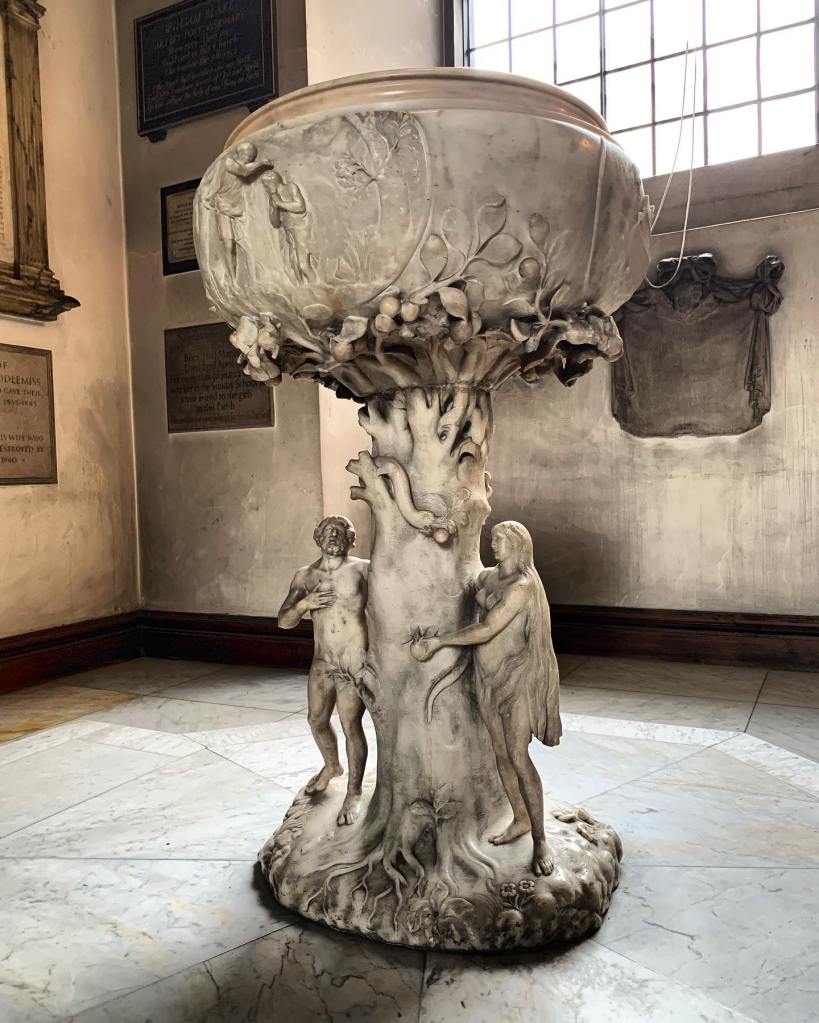
Workshop of Grinling Gibbons (1648–1721)? A white marble baptismal font stands in St James’s Piccadilly, London.
A white marble baptismal font stands in St James’s Piccadilly, remarkable for the richness of its carving. At the base Adam and Eve flank the Tree of Knowledge, around which coils the serpent. The bowl above is divided into three narrative panels: the Baptism of Christ, St Philip baptising the Eunuch of Candace, and the animals entering Noah’s Ark. The original gilded cover, once adorned with angels, has long been lost, probably to theft.
The font, dated 1686, belongs firmly to the flowering of English decorative sculpture in the Restoration period. Its attribution has long been debated. The virtuosity of the carving naturally suggests Grinling Gibbons (1648–1721), whose workshop in the 1680s was producing work on a scale unprecedented in England. Yet the sheer number of followers who adopted his manner, and the collaborative nature of his practice, prevent any conclusive assignment either to Gibbons himself or to his circle.
Though best remembered for his cascades of limewood foliage, Gibbons was also active in stone and marble, particularly in church monuments. His career, spanning five monarchs from Charles II to George I, reveals a master capable of adjusting his style to shifting tastes while retaining a distinctive language of ornament. His early training remains uncertain—perhaps among the ship-carvers of Rotterdam, perhaps under Artus Quellinus (1609–1668), the leading sculptor of the Netherlands—but the breadth of his legacy in Britain is beyond question. Even in cases where attribution falters, the font at St James’s testifies to the reach of his style and the ambition of late seventeenth-century English church furnishing.
Peter Lely (1618–1680), Barbara Villiers, Duchess of Cleveland (1640–1709), with her son Charles FitzRoy (1662–1730), as the Virgin and Child, c.1664. Oil on canvas, 124.7 × 102 cm. The National Portrait Gallery, London
Peter Lely (1618–1680), Barbara Villiers, Duchess of Cleveland (1640–1709), with her son Charles FitzRoy (1662–1730), as the Virgin and Child, c.1664. Oil on canvas, 124.7 × 102 cm. The National Portrait Gallery, London
Barbara Villiers, Duchess of Cleveland, was at the centre of Charles II’s court from the king’s return in 1660. As his mistress, she bore him five children, all later legitimised, and for many years she controlled access to the king, shaping political fortunes through her patronage.
Lely’s portrait of her, painted around 1664, is one of the boldest images of the Restoration. Villiers is cast as the Virgin Mary, holding her young son Charles FitzRoy in the role of the Christ Child. What might, in another context, have been a devotional scene becomes here an audacious conflation of sacred imagery with the politics of dynasty and desire. The effect is unsettling: a king’s mistress steps into the place of the Madonna, and the illegitimate child assumes the attributes of the Saviour.
Villiers was Lely’s most frequent subject, her beauty providing him with endless variations, and his paintings in turn making her the face of the new court. This portrait exemplifies the portrait historié, a genre that blurred the lines between history, allegory, and likeness, though here the fiction carries a sharper edge.
Her life remained turbulent. She fought bitterly with Queen Catherine of Braganza, quarrelled with Frances Stuart, and endured the king’s shifting affections before losing her position to Louise de Kérouaille. Known for her extravagance and entanglements with younger lovers, she died in 1709 aged sixty-eight.