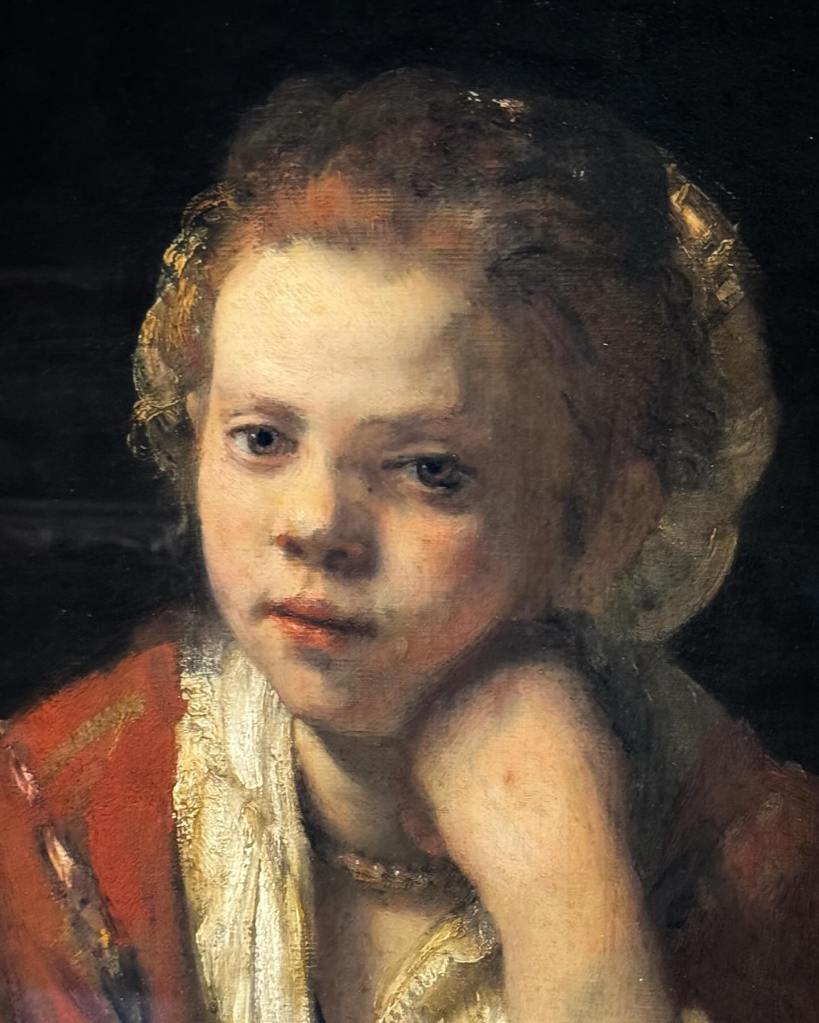
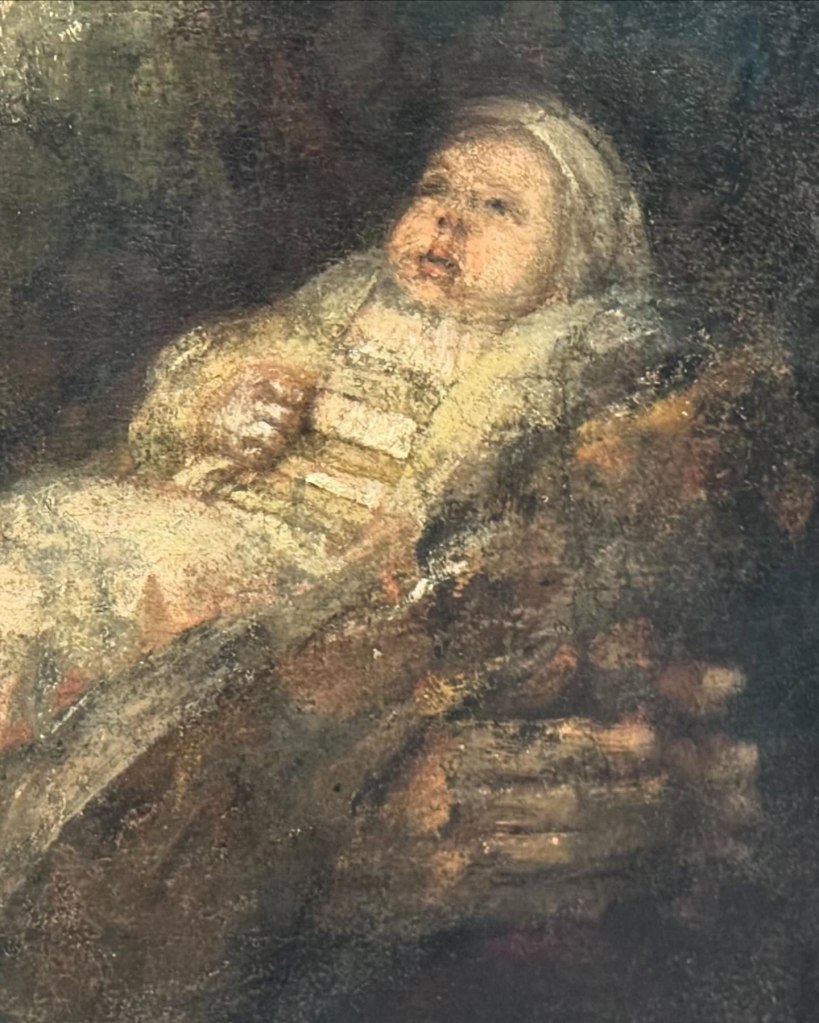
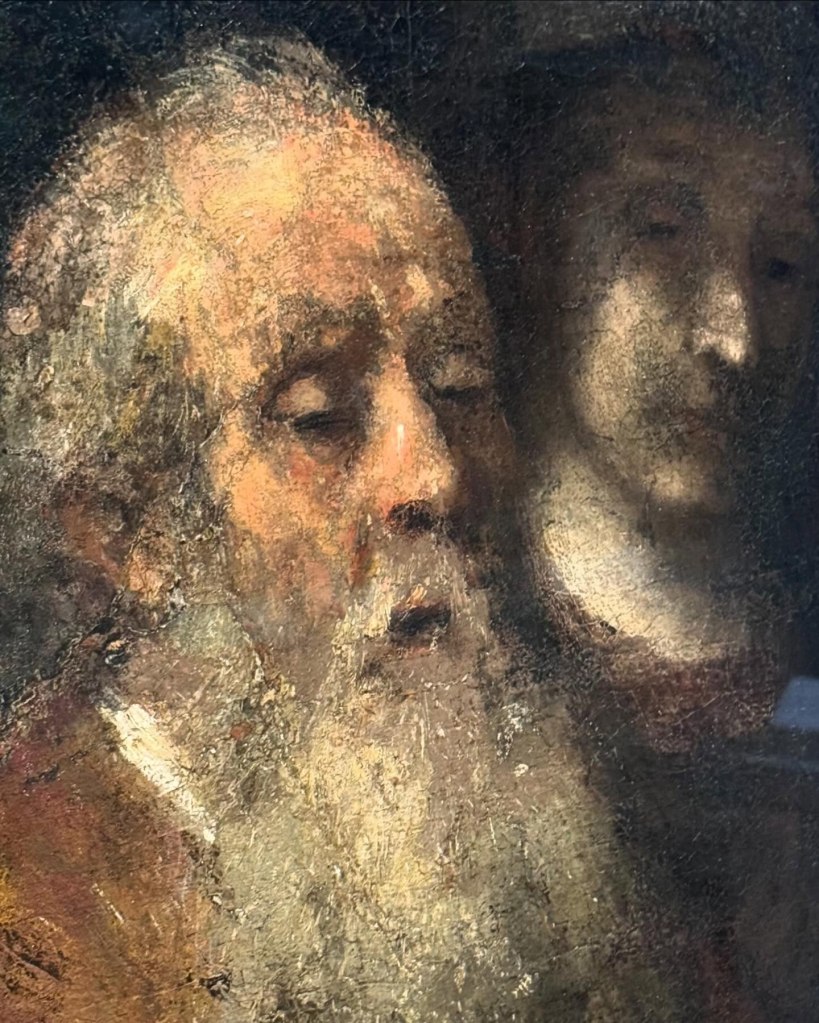
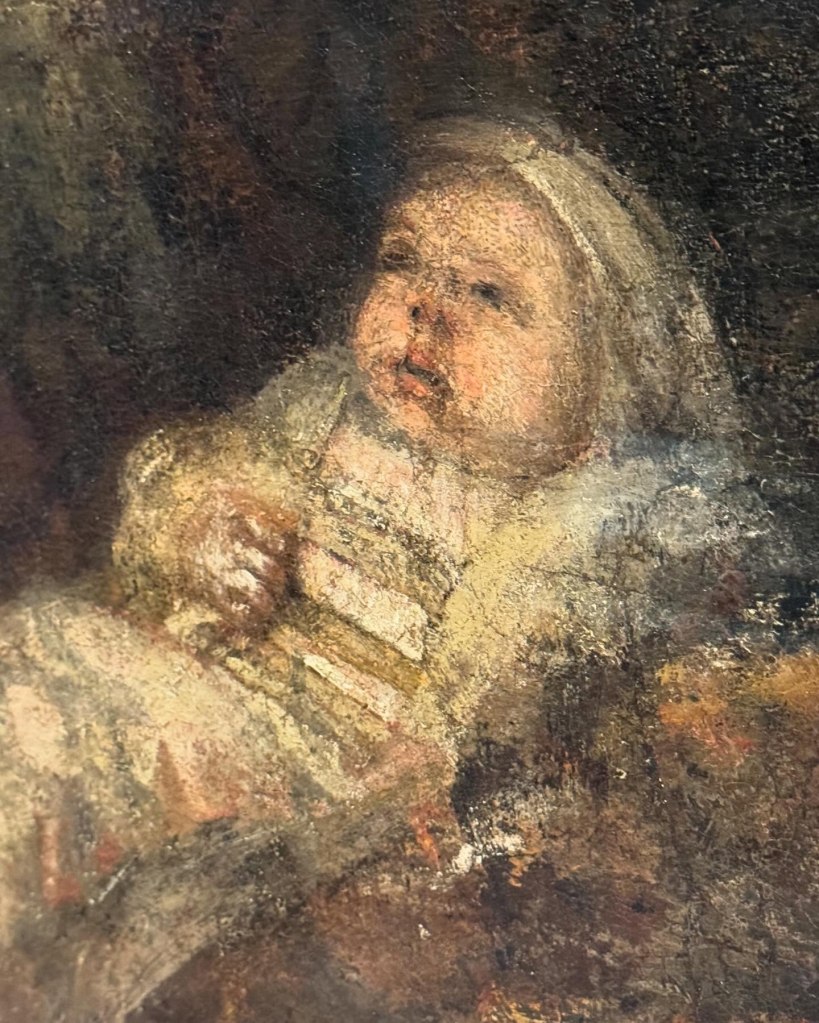
Willem Drost (1633–1659), Ruth and Naomi, Oil on canvas, 89 x 71 cm, Ashmolean Museum, Oxford
Willem Drost (1633–1659), Ruth and Naomi, Oil on canvas, 89 x 71 cm, Ashmolean Museum, Oxford
For much of its history this canvas was thought to be the work of Carel Fabritius (1622–1654), one of Rembrandt’s most brilliant pupils. The attribution only shifted in the twentieth century, after careful stylistic comparison suggested Willem Drost (1633–1659) as the painter. In the 1960s scholars confirmed this view, pointing to the close parallels with Drost’s small but distinctive body of work and to a preparatory sketch now in the Kunsthalle, Bremen, long attributed to Gerbrand van den Eeckhout (1621–1674) but convincingly linked to Drost. The reassessment not only clarified the authorship of the Ashmolean picture but also expanded the fragile outline of a career cut short at the age of twenty-six.
The subject comes from the opening chapter of the Book of Ruth. Naomi, bereaved of her husband and sons, prepares to return from Moab to her native Judah. Ruth, her Moabite daughter-in-law, refuses to part from her and utters the pledge that defines the story: ‘Where you go, I will go; where you lodge, I will lodge; your people shall be my people, and your God my God’ (Ruth 1:16–17). Drost seizes on this moment of choice and devotion, shaping it as an intimate exchange between two women. The picture is restrained in setting but charged in gesture and expression, emphasising fidelity, compassion, and the strength of matriarchal bonds.
The story of Ruth carried layered meanings in seventeenth-century Amsterdam. Within Christian exegesis it was often read as part of a providential chain leading to Christ, since Ruth, a foreigner by birth, became the great-grandmother of King David. In Jewish tradition, by contrast, the focus lay on Ruth’s personal decision: her acceptance of the Jewish faith as a free act of conviction, not compulsion. That difference of interpretation reflects the richness of the subject. In Drost’s painting, stripped of overt theological signs, the emphasis falls above all on human choice, endurance, and loyalty — themes that gave the biblical episode a wide resonance in the city’s diverse religious culture.
Willem Drost (1633–1659), Ruth and Naomi, (fragment with Naomi ) Oil on canvas, 89 x 71 cm, Ashmolean Museum, Oxfor Willem Drost (1633–1659), Ruth and Naomi, (fragment with Ruth), Oil on canvas, 89 x 71 cm, Ashmolean Museum, Oxford
Rembrandt van Rijn (1606–1669), Young girl at a window, 1651, Oil on canvas, 78 × 64 cm, Nationalmuseum, Stockholm
For much of its history, this painting went by a coarser name. Early French inventories catalogued it as La Crasseuse, the slattern or the filthy girl, a title that says rather more about the prejudices of Parisian collectors than about anything Rembrandt put on the canvas. The Nationalmuseum itself still lists it under the Swedish Kökspigan, the kitchen maid, which is at least domestic rather than derogatory, though no less speculative. Rembrandt left no title, no inscription beyond his signature, and no indication of whether the figure was a servant, a model paid by the hour, or someone from his own household. The Nationalmuseum has noted that she is probably too young to be Hendrickje Stoffels (1626–1663), who was twenty-five in 1651 and already living with the artist. If the sitter’s identity was ever known, it has been thoroughly lost.
The painting belongs to 1651, the year after Rembrandt had Geertje Dircx (c. 1610–1656), his former lover and the nursemaid of his son Titus (1641–1668), committed to the Spinhuis in Gouda, a women’s house of correction. Hendrickje had testified against Geertje in the breach-of-promise proceedings. The household on the Breestraat was, to put it mildly, unsettled. Rembrandt had already stopped paying his mortgage. Against this backdrop of domestic disorder and mounting debt, he painted a sequence of half-length female figures, quiet and self-contained, leaning from window-sills or resting on stone ledges. The Stockholm canvas is one of them, and it is among the most inward-looking: a girl in a dull red jacket, her dark hair gathered under a small gold cap, her right arm on the sill, her head inclined against her left hand. She looks out, but at what, or whom, is far from clear.
The figure invites comparison with Rembrandt’s earlier Girl at a Window of 1645 (Dulwich Picture Gallery, London), a painting around which its own mythology has accrued. The French art theorist Roger de Piles (1635–1709), who owned the Dulwich canvas towards the end of the seventeenth century, recorded that Rembrandt had placed it in a window of his house on the Breestraat, where passers-by were said to have mistaken the painted figure for a real servant girl standing motionless. The anecdote is apocryphal: recent scholarship has questioned whether the painting’s dimensions and lighting could have sustained the illusion in an actual window. But the story is telling. De Piles understood the Dulwich painting as a feat of trompe l’oeil, a picture whose energy was directed outward, towards the viewer, daring them to be deceived.
The Stockholm version works in the opposite direction. Its palette is lower in key, its modelling softer, and the brushwork broader in the background, where shadow absorbs almost all detail. The Dulwich girl catches the viewer’s eye with a direct gaze and a gesture of the left hand that seems almost to beckon. The Stockholm girl does nothing of the sort. Her gaze falls somewhere beyond the viewer, or perhaps short of them, and her posture suggests neither invitation nor evasion. If the Dulwich painting is an exercise in seduction, this is something closer to privacy observed. Whether Rembrandt intended the distinction in those terms is impossible to say, but the shift is real: between the two canvases, six years apart, the window-sill motif moves from performance to something like withdrawal.
The idea of figures leaning from windows and niches had deep roots in Dutch and Flemish painting. Gerrit Dou (1613–1675), who had trained under Rembrandt in Leiden during the early 1630s, made the window-sill composition a signature device, surrounding his figures with elaborate stone arches, draped curtains, and carved reliefs painted with exacting precision. For Dou, the sill was a stage for illusionistic display: the viewer was invited to believe that the figure occupied a real architectural space, pressing forward into the room. His pupil Frans van Mieris the Elder (1635–1681) would take the same format further still, treating the niche as a frame-within-a-frame, an exercise in virtuosity for its own sake. Rembrandt had known Dou’s approach from the start, but by 1651 he was doing something quite different with the same device. The ledge in the Stockholm painting carries no carved ornament, no relief, no still-life detail. It is a plain edge, painted with a few strokes, and it does the work of separation rather than illusion. The girl is close enough to touch, but the sill holds her apart. The question is whether that separation is physical or psychological, and the painting, characteristically, refuses to answer.
The canvas was acquired by Count Johan Gabriel Stenbock (1640–1705), probably during his travels in the Netherlands in the 1670s. It passed by inheritance through the Lillie and Sack families before being purchased by King Gustav III of Sweden in 1779, and entered the Nationalmuseum’s collection in the nineteenth century. The Rembrandt Research Project catalogued it as Corpus VI, no. 220, and its autograph status has not been seriously questioned. What has never been resolved, and perhaps cannot be, is the painting’s genre. The Nationalmuseum’s own description places it on the border between portraiture and genre, a category that, for Rembrandt, may have mattered less than it does for art historians. The girl has the particularised features of someone observed from life, but she is given no name, no attribute, and no story. She exists at the boundary, which is also where Rembrandt leaves us: looking across the sill, close enough to recognise a face, too far away to know whose it is.
Rembrandt van Rijn (1606–1669), Young girl at a window, 1651, Oil on canvas, 78 × 64 cm , Nationalmuseum, StockholmRembrandt van Rijn (1606–1669), Young girl at a window, 1651, Oil on canvas, 78 x 64 cm, Nationalmuseum, StockholmRembrandt van Rijn (1606–1669), Young girl at a window, 1651, Oil on canvas, 78 x 64 cm, Nationalmuseum, Stockholm
Schama, S. (1999) Rembrandt’s Eyes. London: Penguin
Van de Wetering, E. (1997) Rembrandt: The Painter at Work. Amsterdam: Amsterdam University Press
Nationalmuseum, Stockholm (n.d.) Flicka i ett fönster, “Kökspigan” [Girl at a Window, “The Kitchen Maid”], Rembrandt Harmensz. van Rijn, 1651. NM 584. Available at: https://collection.nationalmuseum.se/sv/collection/item/17587/ (Accessed: 3 March 2024)
RKD – Netherlands Institute for Art History (n.d.) Rembrandt Harmensz. van Rijn, Girl at a Window (“The Kitchen Maid”), 1651. RKDimages, image no. 41138. Available at: https://rkd.nl/images/41138 (Accessed: 3 March 2024)
Van de Wetering, E. (2017) A Corpus of Rembrandt Paintings VI: Rembrandt’s Paintings Revisited. Dordrecht: Springer
Weststeijn, T. (2008) The Visible World: Samuel van Hoogstraten’s Art Theory and the Legitimation of Painting in the Dutch Golden Age. Amsterdam: Amsterdam University Press
Rembrandt van Rijn (1606–1669), Simeon in the Temple , before October 1669, Oil on canvas, 98.5 × 79.5 cm, National Museum, Stockholm
Rembrandt van Rijn (1606–1669), Simeon in the Temple (fragment), before October 1669, oil on canvas, 98.5 × 79.5 cm, National Museum, Stockholm
On 5 October 1669, the day after Rembrandt died, notary Gerrit Steeman arrived at the small rented house on the Rozengracht in Amsterdam to take stock of what was left. In the entrance hall he counted twenty-two paintings, listed simply as ‘both finished and unfinished’. More unfinished canvases, their number unrecorded, stood in the parlour. The dead painter’s only company during his final days had been his daughter Cornelia (1654–after 1684), not yet fifteen, his sole surviving child by Hendrickje Stoffels (c.1626–1663), who had herself died six years earlier. Hendrickje and Rembrandt had never married, which meant that Cornelia, as their illegitimate daughter, held no legal claim to his belongings. Present at the inventory was also Magdalena van Loo (c.1641–1669), the widow of Rembrandt’s son Titus (1641–1668), who had died barely a year before his father. Magdalena would herself be buried in the Westerkerk just sixteen days later, on 21 October. The notary sealed the rooms, pocketed the keys, and noted that the heirs had not yet decided whether to accept the inheritance, a hesitation that, given Rembrandt’s lifelong pattern of debt and compulsive collecting, was entirely understandable. That hesitation has also robbed us of any certain knowledge of what stood on his easel.
The painting now in Stockholm is almost certainly the canvas described in a sworn notarial document, published by Abraham Bredius (1855–1946) in 1909, in which two Amsterdam painters, Allaert van Everdingen (1621–1675) and his son, the playwright Cornelis van Everdingen (dates uncertain), testified that they had seen Rembrandt at work on a painting of ‘Simeon’ in the months before his death. The same document identifies the patron who had commissioned it: a businessman named Dirck van Cattenburch (1616–1704). The painting was not, then, an unbidden private meditation, as the romantic reading of it prefers, but a paid commission. How far Rembrandt had taken the canvas before he died, and how much of what we now see belongs to his own hand, remain questions that have never been fully settled.
The canvas, fragile and badly deteriorated, nevertheless bears all the marks of his late manner. Its sketch-like surfaces, the stripped-down design, and the sombre, damaged palette reveal an artist working with extreme concentration and economy of means. The composition turns all attention upon Simeon, who cradles the infant Christ in his arms. The figures are reduced to essentials, eliminating the grand architectural settings or surrounding narrative detail familiar in earlier treatments of the Presentation in the Temple. A female figure, partially visible in the background, is generally identified as either the Virgin Mary or the prophetess Anna. She has long troubled scholars. The finish and handling of this figure differ from those of the foreground group, and she may have been added after Rembrandt’s death by an unknown hand working in or near his circle. The problem is further complicated by the painting’s later provenance: it was once owned by Sir Joshua Reynolds (1723–1792), who, as the Gemäldegalerie in Berlin demonstrated in a small exhibition in 2015 devoted to Rembrandt’s Susanna and the Elders (also formerly in Reynolds’s collection), was in the habit of scraping, retouching, and overpaining Rembrandt canvases he considered unfinished or improvable. Whether Reynolds left his mark on the Stockholm painting too remains an open question, and until it is resolved, as Gary Schwartz has argued, all judgements about the level of craftsmanship visible in this canvas must be treated with caution.
The subject, drawn from Luke 2:25–33, had occupied Rembrandt across the full span of his career. His earliest treatment of the theme, Simeon and Anna in the Temple (c.1627–1628, oil on panel, 55.4 × 43.7 cm, Hamburger Kunsthalle), is a small, crowded panel from his Leiden years, packed with figures, architectural detail, and the carefully finished surfaces of a young painter eager to display everything he could do. A few years later, Simeon’s Song of Praise (1631, oil on panel, 60.9 × 47.9 cm, Mauritshuis, The Hague), painted in the year Rembrandt moved to Amsterdam, expands the scene into a vast, shadowy temple interior, the figures dwarfed by soaring columns and deep pools of chiaroscuro. Both paintings are performances of skill, calculated to impress. In 1661, Rembrandt returned to the subject in a small drawing in pen, brush, and brown ink with white bodycolour (12 × 8.9 cm, National Library, The Hague), made as a contribution to the friendship album (album amicorum) of Jacobus Heyblocq (1623–1690), rector of a Latin school in Amsterdam. The composition of the drawing is close to that of the Stockholm painting: Joseph has been dropped, the Virgin moved into the background, and Simeon stands rather than kneels. Interestingly, the Simeon in the painting echoes the pose and position of the Joseph in the drawing, as though Rembrandt transferred the attitude from one figure to another as the composition evolved. In both drawing and painting, the cavernous temple, the priests, the crowds, and the prophetess Anna have all been stripped away. There is no setting, no context. The figures are pushed towards us, spare and unmediated.
According to the evangelist, the Holy Family brought Jesus to the temple in Jerusalem to present him to the Lord and to offer sacrifice, in compliance with the Mosaic law (Leviticus 12:1–8; Exodus 13:2). There they encountered Simeon, a righteous man to whom it had been revealed by the Holy Spirit that he would not die until he had seen the Messiah. In this final version, Rembrandt places the old man at the centre, his eyes nearly closed, his mouth just parting, as if on the verge of uttering the Nunc dimittis: ‘Lord, now lettest thou thy servant depart in peace, according to thy word: for mine eyes have seen thy salvation.’ His expression conveys a deep inner stillness, something beyond relief or joy, closer to the physical sensation of release. The light that falls across the figures is even and diffuse, mysterious rather than dramatic, and this is itself a departure. In the earlier paintings, Rembrandt used directed shafts of light to isolate the Christ child as the brightest point in the composition, following the scriptural metaphor of ‘a light for revelation to the Gentiles’ (Luke 2:32). Here, the light belongs to no single source. It envelops rather than points.
Jonathan Bikker and Gregor Weber, in the catalogue for the exhibition Rembrandt: The Late Works (National Gallery, London, 15 October 2014 – 18 January 2015; Rijksmuseum, Amsterdam, 12 February – 17 May 2015), have argued that Rembrandt’s so-called late style did not emerge from old age or infirmity but was in development from about 1651, when the painter was only forty-five. The concentration, the thick tactile surfaces, the suppression of descriptive detail, the pathos: these belong to the work of a mature artist at the height of his powers, and the common reading of the late paintings as products of decline or withdrawal is, in their view, misleading. The Simeon in the Temple may be the one exception. Here, in the very last canvas, the unfinished surfaces, the lack of definition, and the roughness of execution could well reflect the painter’s failing health rather than deliberate artistic choice, or perhaps both at once, since it is very difficult to separate the two. Is the blurred indistinctness of Simeon’s face an intentional evocation of a life fading, or simply a passage that Rembrandt never lived to resolve? The painting refuses to answer.
As Rembrandt’s final work, its personal resonance is hard to set aside, however much we remind ourselves that it was a commission and not a private act of devotion. A last painting is never only another canvas; it reads as a threshold, a reckoning. Simeon’s readiness for death speaks, inevitably, to the painter’s own situation. After a lifetime of triumphs and calamities, of bankruptcy and bereavement, of a house emptied first of possessions and then of people, Rembrandt was painting a man for whom death was not a catastrophe but a permission. He painted as a man laying down his gift, leaving behind not a commodity for the market but a confession of vocation: art as his reason for being, the sum of his burdens and achievements, the costly price of vision, and the quiet peace with which he finally let it go.
Rembrandt van Rijn (1606–1669), Simeon in the Temple, before October 1669, oil on canvas, 98.5 × 79.5 cm, National Museum, StockholmRembrandt van Rijn (1606–1669), Simeon in the Temple, before October 1669, oil on canvas, 98.5 × 79.5 cm, National Museum, StockholmRembrandt van Rijn (1606–1669), Simeon in the Temple, (fragment) before October 1669, oil on canvas, 98.5 × 79.5 cm, National Museum, Stockholm
References
Bertrand, R. (2001) Étude iconographique et théologique du dernier tableau de Rembrandt, Siméon glorifiant l’enfant Jésus au temple. MA thesis. Université du Québec à Trois-Rivières. Available online at, https://depot-e.uqtr.ca/id/eprint/2716/1/000682150.pdfc(Accessed 3March 2024)
Bikker, J. and Weber, G.J.M. (2014) Rembrandt: The Late Works. Exhibition catalogue. London: National Gallery Company / Amsterdam: Rijksmuseum. Yale University Press.
Perlove, S. and Silver, L. (2009) Rembrandt’s Faith: Church and Temple in the Dutch Golden Age. University Park, PA: Pennsylvania State University Press
Rembrandt (1606-1669), A Young Woman in Profile with a Fan, 1632, Oil on canvas, 72.5 x 54.8 cm, Nationalmuseum, Stockholm
Rembrandt (1606-1669), A Young Woman in Profile with a Fan, 1632, Oil on canvas, 72.5 x 54.8 cm, Nationalmuseum, Stockholm
In June 1628, the Amsterdam collector Joan Huydecoper noted in his records that he had purchased a tronie from a young Leiden painter whose name he initially misspelled as “Warmbrant,” correcting it afterwards to “Rembrant.” The entry is small, almost throwaway, but it tells us something worth pausing over: even before Rembrandt had left Leiden for Amsterdam, before the great portrait commissions and the Anatomy Lesson and the house on the Breestraat, he was already selling tronies. These independent figure studies, depicting no named sitter and answering to no patron, were part of his working life from the start. They were bread-and-butter production, certainly, but they were also something else: a space in which a painter could think aloud, testing what costume, light, and expression could do without the constraint of likeness.
The Young Woman in Profile with a Fan belongs to this category, and it dates from a year of extraordinary activity. Rembrandt arrived in Amsterdam in late 1631 to work from the studio of the art dealer Hendrick Uylenburgh (c.1587–1661), and by 1632 he was producing portraits, biblical subjects, mythological narratives, and tronies at a pace that is difficult to credit. The woman in this painting is shown in strict profile, her face caught in a fall of soft, even light, her cloak trimmed with gold embroidery, a string of pearls threaded through her hair. She holds a fan, a luxury object with associations of courtly refinement and, by the 1630s, increasingly available through the trade networks of the East India Company. Her clothing is not contemporary. The high-necked pleated blouse and heavy cloak recall the fashions of the previous century, a deliberate archaism that lifts the figure out of the present and into something more theatrical.
The profile format itself carries weight. Profile portraiture had deep roots in classical medals and Renaissance commemorative painting, and the format lent its subjects an air of formality and remove. Rembrandt was working with this convention elsewhere in 1632: the Corpus of Rembrandt Paintings notes that the Stockholm picture’s profile composition relates directly to his Portrait of Amalia van Solms (1602–1675), wife of Stadholder Frederik Hendrik (1584–1647), painted in the same year and now in the Musée Jacquemart-André, Paris. But the comparison is instructive precisely because the two works pull in opposite directions. The Amalia portrait fixes a real woman in a format appropriate to her rank. The Stockholm painting uses the same format to create someone who exists nowhere outside the canvas.
And this is where the painting becomes most interesting as evidence of Rembrandt’s studio practice. The woman who sat for this picture was not a patron, but she was a real person, and she appears in several other works from the same year. The Leiden Collection’s catalogue entry for Young Girl in a Gold-Trimmed Cloak (1632) identifies the same model in at least three autograph paintings by Rembrandt, all dated 1632: the Stockholm picture, the Gold-Trimmed Cloak itself, and a Bust of a Young Woman in a Cap in a private Swiss collection. A fourth painting of the same woman, a Bust of a Young Woman now at the University of North Carolina, Chapel Hill, was probably executed by Isaac de Jouderville (c.1612–1648), one of Rembrandt’s studio assistants. More remarkably still, the same model, wearing a nearly identical costume, appears as Europa in Rembrandt’s Abduction of Europa (1632, J. Paul Getty Museum, Los Angeles) and possibly as the central female figure in a disputed Old Testament scene in Ottawa. She was, in other words, not a sitter in any portrait sense but a working model, recycled across genres and formats, her face serving myth one day and tronie the next.
The question of her identity has, predictably, attracted speculation. Over the centuries she has been called Lijsbeth van Rijn (1609–1665), Rembrandt’s younger sister. She has been called Saskia van Uylenburgh (1612–1642), his future wife. The Saskia identification, first proposed by Émile Michel in 1893 and repeated by Kurt Bauch in 1966, is chronologically untenable: Rembrandt and Saskia did not meet until 1633, and Saskia did not leave Friesland for Amsterdam until after their marriage in June 1634. That the name was attached at all is revealing. It tells us less about the painting than about the desires of later connoisseurs who wanted to find private feeling inside images that were never designed to hold it. The tronie, by nature, resists this kind of anchoring. Its subject is type, not individual. The woman with the fan is nobody in particular, and that is the condition on which the painting operates.
There is also the matter of who painted it. The Corpus of Rembrandt Paintings accepted the work as autograph in volume 2, cataloguing it as A49, and reaffirmed this judgment in volume 6. But Christian Tümpel (1937–2009), in his 1986 Rembrandt: Mythos und Methode , catalogued it as A55 and attributed it to Rembrandt’s workshop. Görel Cavalli-Björkman revisited the question in the 2006 Copenhagen exhibition catalogue Rembrandt? The Master and His Workshop. The attribution has not been seriously challenged since the Corpus reconfirmation, but Tümpel’s dissent is worth noting, not least because any claims about Rembrandt’s handling of paint in this picture carry less force if the hand is disputed.
What can be said, whoever held the brush, is that the painting shows a sophisticated understanding of how different textures answer to light. The face is modelled with fine, smooth transitions between illumination and shadow, the skin appearing almost warm. Against this, the gold-trimmed cloak is painted with loaded, confident strokes, the embroidery catching the light in ridges of impasto. The dark fall of fabric behind the figure absorbs light where the face reflects it. This interplay of surfaces, soft against hard, transparent against opaque, is the kind of technical argument that tronies were made to stage. The painting did not need to record a face. It needed to show what painting could do with one.
Rembrandt (1606-1669), A Young Woman in Profile with a Fan, 1632, Oil on canvas, 72.5 x 54.8 cm, Nationalmuseum, Stockholm
References
Bauch, K. (1966) Rembrandt: Gemälde. Berlin: Walter de Gruyter, no. 455
Bruyn, J., Haak, B., Levie, S. H., van Thiel, P. J. J. and van de Wetering, E. (1986) A Corpus of Rembrandt Paintings, vol. 2: 1631–1634. The Hague: Stichting Foundation Rembrandt Research Project, no. A49
Cavalli-Björkman, G. (2006) ‘Young Woman in Profile’, in Rønberg, L. B. and de la Fuente Pedersen, E. (eds.) Rembrandt? The Master and His Workshop. Exh. cat. Copenhagen: Statens Museum for Kunst, p. 180, under no. 6
Hirschfelder, D. (2008) Tronie und Porträt in der niederländischen Malerei des 17. Jahrhunderts [Tronie and portrait in seventeenth-century Netherlandish painting]. Berlin: Gebr. Mann Verlag, pp. 121, 149, 209, 254, 421–422, no. 410
Lloyd Williams, J. (ed.) (2001) Rembrandt’s Women. Exh. cat. Edinburgh: National Gallery of Scotland, no. 19
Michel, É. (1893) Rembrandt, sa vie, son œuvre et son temps. Paris: Librairie Hachette, p. 560
Middelkoop, N. (ed.) (2020) Rembrandt and Amsterdam Portraiture, 1590–1670. Exh. cat. Madrid, fig. 70
Schwartz, G. (2006) The Rembrandt Book. New York: Abrams, p. 50, fig. 71.
Tümpel, C. (1986) Rembrandt: Mythos und Methode [Rembrandt: myth and method]. Antwerp: Mercatorfonds, no. A55 (as Rembrandt workshop)
Van de Wetering, E. et al. (2005) A Corpus of Rembrandt Paintings, vol. 4: Self-Portraits. Dordrecht: Springer, pp. 629, 632, fig. 4 (Corrigenda et addenda)
Van de Wetering, E. (2017) A Corpus of Rembrandt Paintings, vol. 6: Rembrandt’s Paintings Revisited. Dordrecht: Springer, no. 80
Vogelaar, C. and Korevaar, G. (eds.) (2005) Rembrandt’s Mother: Myth and Reality. Exh. cat. Leiden: Museum De Lakenhal. Zwolle: Waanders, under no. 71, pp. 221–224, fig. 157
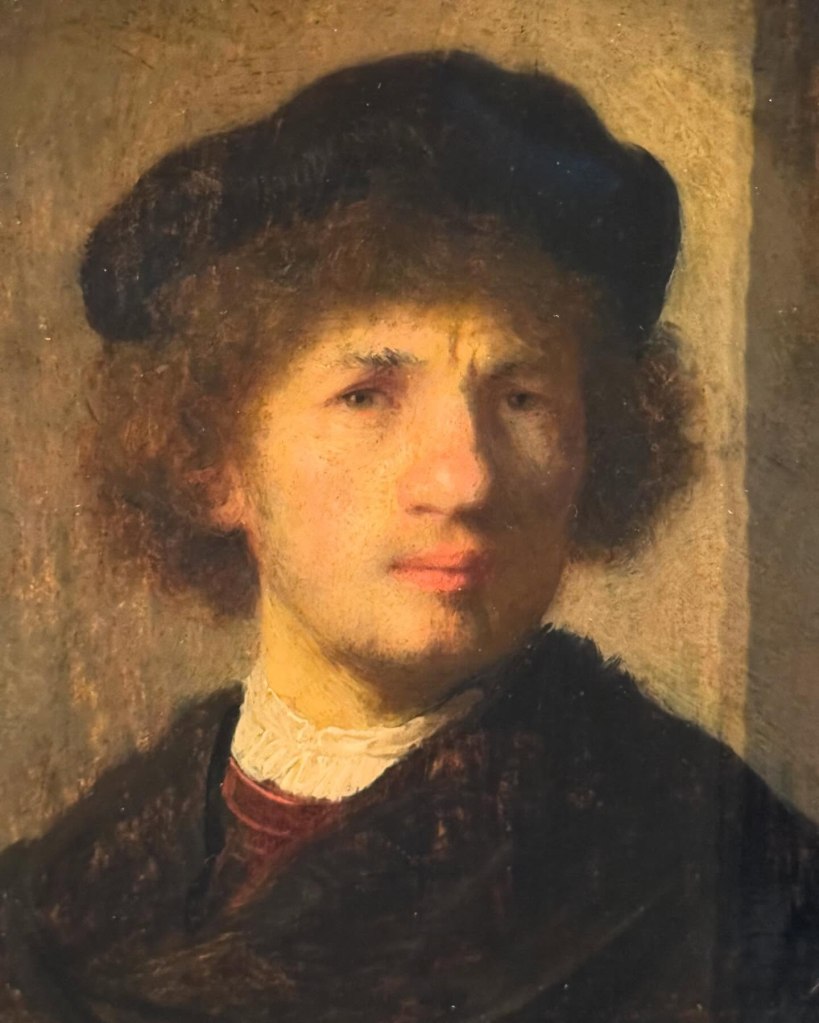
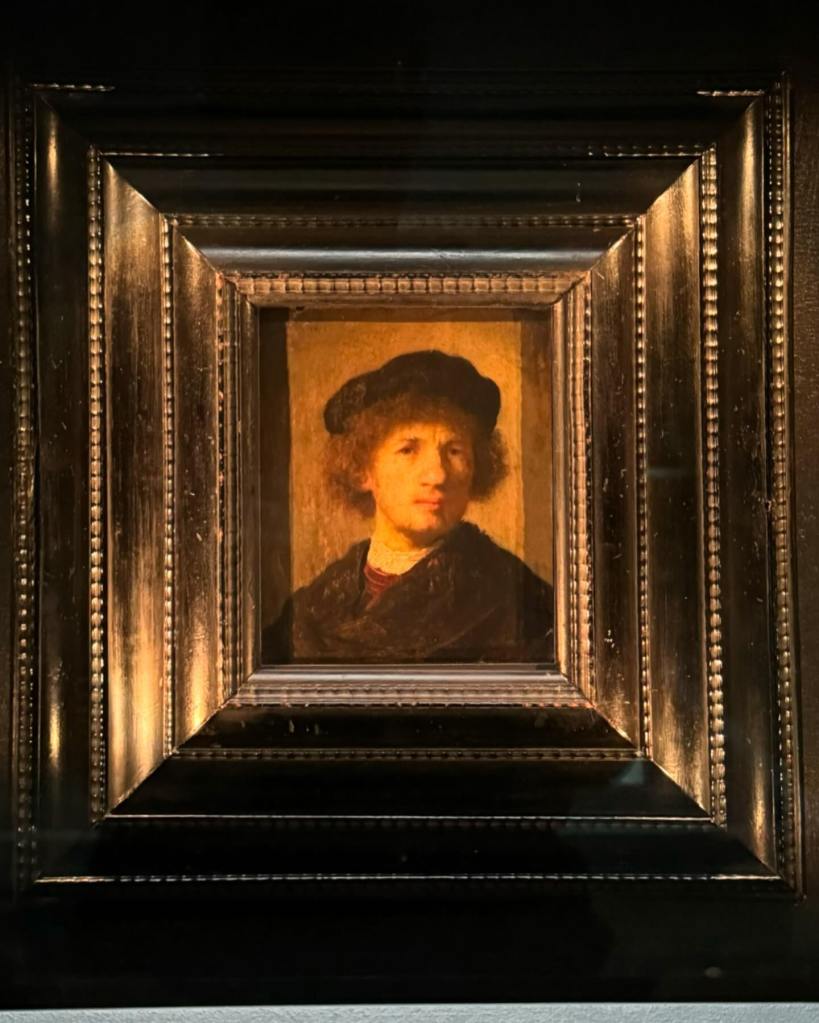
Rembrandt Harmensz. van Rijn (1606 -1669), Self-Portrait, 1630, Oil on copper, 15,5 x 12 cm, Nationalmuseum, Stockholm
Rembrandt Harmensz. van Rijn (1606 -1669), Self-Portrait, 1630, Oil on copper, 15,5 x 12 cm, Nationalmuseum, Stockholm
On 27 April 1630, Harmen Gerritszoon van Rijn (1568–1630), a miller of comfortable means, was buried at the Pieterskerk in Leiden. His ninth child, Rembrandt (1606–1669), was twenty-three, turning twenty-four that July, and still working in the city where he had been born. It is a small fact, easily passed over in the biographical literature, but it belongs to the year of this painting. Somewhere in the months after his father’s death, or perhaps just before it, Rembrandt sat before a mirror with a copper plate no larger than a postcard and painted himself with a concentration that borders on the forensic. He signed it R[HL] 1630, using the Leiden monogram he would abandon two years later when he moved to Amsterdam and began, with a confidence that still startles, to sign with his first name alone.
The circumstances around the painting deserve spelling out. By 1630, Rembrandt had already attracted attention well beyond Leiden. In the autumn or winter of 1628, Constantijn Huygens (1596–1687), secretary to Stadholder Frederik Hendrik and one of the most cultivated men in the Dutch Republic, had travelled from The Hague to visit the studio Rembrandt shared with Jan Lievens (1607–1674). Huygens’s response, set down in a Latin autobiography composed between 1629 and 1631 but not published until 1891, was unguarded. He described the two as “still beardless and, going by their faces, more boys than men,” yet judged that Rembrandt was “superior to Lievens in his sure touch and liveliness of emotions.” Of Rembrandt’s Judas Repentant, Returning the Pieces of Silver (1629, private collection), he wrote that ‘a youth, a Dutchman, a beardless miller’ had surpassed Protogenes, Apelles, and Parrhasius in the ability to “bring together so much in one human figure and express what is universal.” This was extraordinary language from a man not easily impressed, and it was being written at precisely the moment Rembrandt was painting the Stockholm copper. The young man who stares out from this panel was doing so with the knowledge that the stadholder’s secretary considered him the equal of the ancients, that Gerrit Dou (1613–1675) had been his pupil since 1628, and that his father, whose trade Huygens had used to define him, was freshly dead.
The support is copper, overlaid with a base of white lead and then a layer of gold leaf before any paint was applied. The effect is striking: light passes through the thin oil layers and bounces back off the gold ground, producing a warmth and luminosity that a conventional priming could not achieve. It is a technique borrowed from miniature painting and metalwork traditions rather than from the easel painter’s usual repertoire, and it raises a question worth asking. Was this young painter simply experimenting for its own sake, or was he deliberately testing what oil paint could do on a surface more commonly associated with goldsmiths and enamellers? Copper demands a discipline quite different from panel or canvas: the surface is smooth, cold, and unforgiving, and every passage of paint remains visible. There is nowhere to hide imprecision.
The brushwork throughout is fine and controlled, consistent with the precise, layered manner Rembrandt practised during his Leiden years. This is sometimes loosely associated with the fijnschilder tradition, but the chronology needs stating plainly: Dou, whose name is most closely tied to that school, entered Rembrandt’s workshop only in 1628 and developed his hyper-refined technique from what he found there. The delicacy visible in this copper panel is not a borrowing from the fijnschilders; it is closer to the source from which they drew. Ernst van de Wetering, in Volume IV of the Corpus of Rembrandt Paintings (2005), described the costume in this self-portrait (beret and gathered shirt) as corresponding to the stilus mediocris, the middle register of classical rhetorical address, neither grand nor low. That Rembrandt was already calibrating his self-presentation in terms legible to an educated audience, at an age when most painters were still completing their training, is telling.
Van de Wetering’s technical studies identify five works by Rembrandt on copper supports, three of which use a gold leaf ground: this self-portrait, An Old Woman at Prayer (Residenzgalerie, Salzburg), and The Laughing Soldier (Mauritshuis, The Hague). All three date from 1630 and are similar in format and scale. The number is small enough to suggest deliberate trials rather than settled practice, and Rembrandt appears to have abandoned the support entirely after his move to Amsterdam in 1631. Whether he found copper too limiting for the larger formats he increasingly favoured, or simply lost interest in a technique that yielded diminishing returns at greater scale, remains open.
The painting’s attribution, however, has its own instructive history. In the first volume of the Corpus (1982), the Rembrandt Research Project classified it as a B-number, meaning Rembrandt’s authorship could be neither confirmed nor rejected. This was not because anyone had found positive evidence of another hand. The difficulty, rather, lay in the RRP’s own working model under Josua Bruyn (1923–2011), which assumed that Rembrandt’s handling would remain broadly uniform within any given period. Because the three gilded copper paintings differ noticeably from one another in execution, despite sharing the same unusual support and the same date, two of the three (this self-portrait and The Laughing Soldier) fell outside what the team was prepared to accept as Rembrandtesque at that moment. It was only when van de Wetering took sole editorship for Volume IV (2005) that the earlier reservations were overridden and the painting was given unequivocally to Rembrandt. The reversal tells us as much about the evolution of connoisseurial method as it does about the object itself: a painting can be by Rembrandt for three and a half centuries, then not quite by Rembrandt for twenty-three years, and then by Rembrandt again, without a single atom of its surface changing. One might ask whether the problem was ever with the painting at all, or whether it lay with a methodology that expected a twenty-four-year-old experimenting on copper to paint like a twenty-four-year-old working on oak.
The provenance is respectable and runs through a sequence of informed Dutch and French collections. The earliest documented owner is Elias van der Hoeven of Rotterdam, from whose collection it passed at city auction in 1768 to Johan van der Marck Aegidiusz. It subsequently moved through the hands of a Mr Fouquet, Comte Duchâtel in Paris, and Comtesse Henri Delaborde, before reaching the great Dutch collector and scholar Frits Lugt (1884–1970) in The Hague. Lugt’s involvement carries weight: as the compiler of Les Marques de Collections de Dessins et d’Estampes [The Marks of Collections of Drawings and Prints] and a connoisseur of formidable range, his ownership places the painting within a tradition of serious Dutch collecting stretching back to the seventeenth century itself. The work later passed to a private collection in Vienna and was donated to the Nationalmuseum in 1956 by Nationalmusei Vänner, the museum’s friends’ association, to coincide with a major Rembrandt exhibition.
The modern chapter of its story is less decorous. On 22 December 2000, five minutes before closing time, three armed men entered the Nationalmuseum carrying a submachine gun and two handguns. Car bombs had been detonated at nearby hotels as a diversion, and nails scattered on surrounding roads to disable police vehicles. The thieves seized this painting along with two works by Pierre-Auguste Renoir (1841–1919) and escaped by motorboat along the waterfront. It was the first armed robbery in the museum’s two-hundred-year history. The Rembrandt vanished for nearly five years, circulating through a criminal underworld that plainly had no idea what to do with it, before Danish police recovered it undamaged and still in its original frame in September 2005. It was returned to the Nationalmuseum of Sweden just days before the opening of a major Dutch Golden Age exhibition. There is something faintly absurd, and perhaps fitting, about a painting no larger than a postcard causing this much trouble. But then, a twenty-four-year-old Rembrandt was already proving capable of that.
What survives in this portrait is something the later Rembrandt rarely allowed: a surface where every passage of paint is accountable, where nothing is buried under impasto or shadow, and where the young painter’s hand is almost uncomfortably exposed. The face that looks back is serious, concentrated, and perhaps just recently bereaved. It is not the face of the Amsterdam master who would paint the Night Watch twelve years later. It is the face of a miller’s son who had left Leiden only once, briefly, to train with Pieter Lastman in Amsterdam, and had come straight back. He had just buried his father, and he was painting himself over gold.
Rembrandt Harmensz. van Rijn (1606 -1669), Self-Portrait, 1630, Oil on copper, 15,5 x 12 cm, Nationalmuseum, Stockholm
References
Bredius, A. (1969) Rembrandt: The Complete Edition of the Paintings. Revised by H. Gerson. London: Phaidon
Bruyn, J., Haak, B., Levie, S.H., van Thiel, P.J.J., and van de Wetering, E. (1982) A Corpus of Rembrandt Paintings, vol. I: 1625–1631. The Hague, Boston, and London: Martinus Nijhoff
Chapman, H.P. (1990) Rembrandt’s Self-Portraits: A Study in Seventeenth-Century Identity. Princeton: Princeton University Press
Kan, A.H. (1946) De jeugd van Constantijn Huygens door hemzelf beschreven [The Youth of Constantijn Huygens Described by Himself]. Rotterdam: A.D. Donker
Scallen, C.B. (2004) Rembrandt, Reputation, and the Practice of Connoisseurship. Amsterdam: Amsterdam University Press
Schnackenburg, B. (2016) Jan Lievens: Friend and Rival of the Young Rembrandt, with a Catalogue Raisonné of his Early Leiden Works 1623–1632. Petersberg: Michael Imhof Verlag
Van de Wetering, E. (ed.) (2005) A Corpus of Rembrandt Paintings, vol. IV: The Self-Portraits. Dordrecht: Springer
Van de Wetering, E. (2009) Rembrandt: The Painter at Work. Revised edn. Amsterdam: Amsterdam University Press
Vogelaar, C. et al. (1991) Rembrandt en Lievens in Leiden: ‘Een jong en edel schildersduo’ [Rembrandt and Lievens in Leiden: ‘A Young and Noble Pair of Painters’]. Exh. cat. Leiden: Stedelijk Museum De Lakenhal
Wheelock, A.K. et al. (2008) Jan Lievens: A Dutch Master Rediscovered. Exh. cat. Washington: National Gallery of Art
Bomford, D., Brown, C., and Roy, A. (2006) Art in the Making: Rembrandt. New edn. London: National Gallery Company
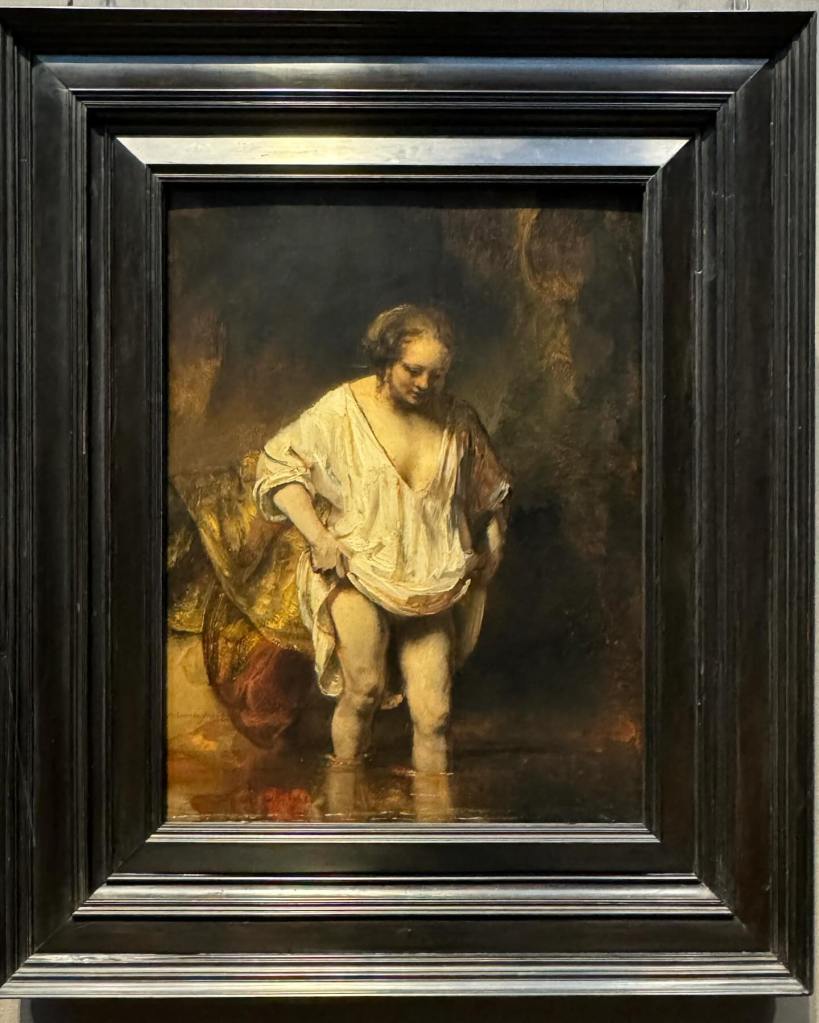
Rembrandt van Rijn (1606 – 1669), A Woman bathing in a Stream, 1654, Oil on oak, 61.8 × 47 cm, The National Gallery, London
Rembrandt van Rijn (1606 – 1669), A Woman bathing in a Stream, 1654, Oil on oak, 61.8 × 47 cm, The National Gallery, London
The painting’s earlier provenance is not documented. It was almost certainly the lot sold at the Blackwood sale of 18-19 March 1756, where it was described as ‘A Woman going into the Water holding her Coats pretty high, and laughing at what she sees reflected.’ Before that, it was possibly the picture listed in the Andrew Hay sale of May 1739 as, simply, ‘A Woman going into a Bath.’ These early descriptions deserve attention, not because they are especially eloquent, but because of what they do not say. There is no Hendrickje. No Callisto. No mythological apparatus of any kind. The eighteenth-century cataloguer saw a woman wading into water and described what was in front of him. The identification of the model, the decoding of the subject, the biographical backstory: all of that came later, and it is worth asking what changed in the way people look at pictures between 1756 and the present day.
The painting has appeared in every major catalogue raisonné of Rembrandt’s work. John Smith (1781-1855) listed it as No. 165 in his A Catalogue Raisonné of the Works of the Most Eminent Dutch, Flemish and French Painters (1829-1842). Wilhelm von Bode (1845-1929) and Cornelis Hofstede de Groot (1863-1930) gave it No. 353 in their complete edition (1897-1906); Hofstede de Groot subsequently catalogued it as No. 306 in his own expanded ten-volume raisonné (1907-1928). Abraham Bredius (1855-1946) assigned it No. 437 in 1935, retained by Horst Gerson (1907-1978) in the revised third edition of 1969. Kurt Bauch (1897-1975) listed it as No. 278. Christian Tümpel (1937-2009) gave it No. 122. In each case, the title remained broadly descriptive: a woman, a stream, a bath. Neil MacLaren’s (1909-1988) catalogue of the National Gallery’s Dutch School, revised and expanded by Christopher Brown in 1991, introduced a quiet but significant addition: the parenthetical question mark after Hendrickje Stoffels’s name. A Woman Bathing in a Stream (Hendrickje Stoffels?). That question mark is, in its way, one of the most carefully weighed interventions in the painting’s entire literature.
Then, in 2011, Ernst van de Wetering (1938-2021) published Volume V of A Corpus of Rembrandt Paintings, the ongoing project of the Rembrandt Research Project. He gave the painting its longest and most committed title: A woman wading in a pond (Callisto in the wilderness), catalogued as V 19 and discussed across sixteen pages (pp. 519-534). Volume VI subsequently listed it as No. 229. Volker Manuth catalogued it as No. 325; Jeroen Giltaij as No. 473. What is striking about the trajectory from Smith’s plain listing in 1836 to Van de Wetering’s retitling in 2011 is the steady accretion of meaning laid onto a picture that, by its very nature, resists it. The eighteenth-century auctioneer described what he saw. Van de Wetering decided what the picture was about. Whether that represents progress in understanding or a loss of something else, a willingness to sit with uncertainty, is a question that goes well beyond this single panel.
The identification of the figure as Callisto was first proposed by Jan Leja in 1996, in an article published in Simiolus. Leja argued that the woman’s shift, pulled above her knees but emphatically not removed, aligned with the Ovidian story of Callisto as retold in seventeenth-century Dutch sources rather than in Ovid’s own Metamorphoses. Karel van Mander (1548-1606), in his commentary on the Metamorphoses appended to the Schilder-boeck [Book of Painters] (1603-1604), described how Callisto, expelled from Diana’s retinue after her pregnancy was discovered (the result of Jupiter’s assault, not her own doing), ‘for some time kept herself secretly in the wilderness.’ This detail has no counterpart in Ovid. Leja proposed that Rembrandt’s painting depicts exactly that moment: Callisto alone and exiled, wading through water, her pregnancy still concealed. Lyckle de Vries arrived independently at the same reading in 2006, and Van de Wetering adopted it for the Corpus. Bart Cornelis, Curator of Dutch and Flemish Paintings at the National Gallery, has endorsed this interpretation publicly. Other scholars have proposed Susanna at her bath, though the absence of the voyeuristic elders (present in Rembrandt’s 1647 Berlin Susanna and the Elders) makes this harder to sustain. The suggestion that the figure is Diana herself, the goddess of the hunt, does not appear to have serious scholarly support: Diana is part of the Callisto story, but the identification proposed in the literature is with Callisto, not with the goddess who punishes her. Still others have drawn a connection with Bathsheba, since Rembrandt’s great Bathsheba at Her Bath (Musée du Louvre, Paris) was painted in the same year and the two women share a physical type: wide-hipped, auburn-haired, with high round foreheads. But MacLaren’s catalogue entry noted that the panel’s small size and oak support might suggest a preparatory sketch for a larger history painting, though no such painting is known, and Rembrandt, unlike Rubens, did not typically produce preliminary oil sketches for larger projects.
The biographical parallel with Hendrickje Stoffels (c. 1626-1663) is widely discussed. In July 1654, Hendrickje was summoned before the Council of the Reformed Church in Amsterdam and admonished for living with Rembrandt, in the church records’ phrase, ‘like a whore’ (in hoererije), and was banned from the celebration of the Lord’s Supper. Their daughter Cornelia was baptised on 30 October of that year. Hendrickje would have been about twenty-eight. The alignment with Callisto’s story is, as several scholars have acknowledged, difficult to ignore: both women punished by an institution for a pregnancy they did not choose entirely on their own terms, both exiled from a community. But how far should this kind of reading be pushed? Is the painting a private allegory, addressed to those who knew the household and would recognise the parallel? Or is the biographical reading simply the one that modern audiences find most satisfying, because it gives us a human story, and human stories, especially those involving shame and intimacy and institutional cruelty, are easier to care about than problems of iconography?
This is a question that the literature tends to raise and then quietly set aside. There is a powerful appetite, in Rembrandt studies and beyond, for the artist’s life to illuminate the artist’s work, and the appetite is strongest when the life involves suffering, scandal, or financial ruin. Simon Schama’s Rembrandt’s Eyes (1999) is the most fully realised expression of this tendency, and Paul Crenshaw’s Rembrandt’s Bankruptcy (2006) traces the economic and social dimensions of the painter’s decline. But is the biographical approach the only way into a picture like this, or even the best one? The 1756 Blackwood cataloguer managed to look at the painting without knowing or caring who the woman was, and his description, which notices her holding up her clothes and laughing at her reflection, is in some respects more attentive to what is actually on the panel than much of what has been written since. He saw paint, not narrative. Whether that represents a failure of interpretation or a different, perhaps more honest, mode of looking is not a question with a settled answer.
Michael Zell, in a substantial article published in the Journal of Historians of Netherlandish Art (2024), has argued that the painting’s resistance to classification is itself the subject. Zell reads the picture as a deliberate experiment with the borders between a genre scene and a history painting, between a life study and a finished composition, and suggests that Rembrandt used the figure’s ambiguity to challenge the hierarchies of artistic categorisation that structured Dutch art theory in the writings of Van Mander and Samuel van Hoogstraten (1627-1678). The painting is signed and dated, which confirms it was complete to Rembrandt’s satisfaction, and yet it retains the loose, energetic brushwork of an informal sketch. Zell draws a parallel with the wash drawing A Young Woman Sleeping (c. 1654, British Museum), one of Rembrandt’s few drawings executed entirely with the brush. Christian Tümpel’s (1937-2009) concept of Herauslösung, the isolation of a single figure from a recognisable biblical or classical scene, has also been applied to the painting, and Zell notes that the pose has been connected to the ancient mulier impudica, a figure-type of a woman lifting her covering to expose herself. The Rembrandt Research Project’s own characterisation is plain enough: “Although at first sight this well preserved work may appear sketchily executed, it is a very subtle painting, epitomising Rembrandt’s artistic and pictorial genius. Its authenticity has never been questioned.”
Perhaps what draws people back to this painting, year after year, has less to do with Hendrickje’s biography or Callisto’s exile than with something harder to put into words: the directness with which the paint meets the eye, the sense of a figure caught in a moment so particular and so unguarded that it feels almost intrusive to look. But then, looking is what the painting asks for. It is signed, dated, and finished. Rembrandt wanted it seen. The question is whether we see what he put there, or what we bring.
Rembrandt van Rijn (1606 – 1669), A Woman bathing in a Stream, 1654, Oil on oak, 61.8 × 47 cm, The National Gallery, London
References
Bomford, D., Kirby, J., Roy, A., Rüger, A. and White, R. (2006) Rembrandt. London: National Gallery Company; New Haven: Yale University Press
Bredius, A. (1935) Rembrandt: The Complete Edition of the Paintings. Vienna: Phaidon
Bredius, A., revised by Gerson, H. (1969) Rembrandt: The Complete Edition of the Paintings. 3rd edn. London: Phaidon
Crenshaw, P. (2006) Rembrandt’s Bankruptcy: The Artist, His Patrons, and the Art Market in Seventeenth-Century Netherlands. Cambridge: Cambridge University Press
Hofstede de Groot, C. (1907-1928) Catalogue Raisonné of the Works of the Most Eminent Dutch Painters of the Seventeenth Century. 10 vols. London, Stuttgart and Paris
Leja, J. (1996) ‘Rembrandt’s “Woman Bathing in a Stream”‘, Simiolus: Netherlands Quarterly for the History of Art, 24(4), pp. 320-327.
MacLaren, N., revised and expanded by Brown, C. (1991) National Gallery Catalogues: The Dutch School, 1600-1900. London: National Gallery Publications
Schama, S. (1999) Rembrandt’s Eyes. New York: Alfred A. Knopf
Sluijter, E.J. (2006) Rembrandt and the Female Nude. Amsterdam: Amsterdam University Press
Smith, J. (1829-1842) A Catalogue Raisonné of the Works of the Most Eminent Dutch, Flemish and French Painters. 9 vols. London
Van de Wetering, E. (2011) ‘Rembrandt — A woman wading in a pond (Callisto in the wilderness)’, in A Corpus of Rembrandt Paintings. Vol. 5. Stichting Foundation Rembrandt Research Project. Dordrecht: Springer, pp. 519-534
RKD – Netherlands Institute for Art History (n.d.) Rembrandt van Rijn, A Woman Bathing in a Stream (Hendrickje Stoffels?), 1654. RKDimages, image no. 59022. Available at: https://rkd.nl/en/explore/images/59022 (Accessed: 14 January 2024)
Rembrandt van Rijn (1606-1669), Portrait of Jacob de Gheyn III, 1632, Oil on panel, 29.9 x 24.9 cm, Dulwich Gallery, London
Rembrandt van Rijn (1606-1669), Portrait of Jacob de Gheyn III, 1632, Oil on panel, 29.9 x 24.9 cm, Dulwich Gallery, London
Painted in 1632, shortly after Rembrandt’s move from Leiden to Amsterdam, this portrait shows Jacob de Gheyn III, engraver and son of the court artist Jacob de Gheyn II. Although only modest in size, the panel demonstrates Rembrandt’s precision of observation: the crisp folds of the ruff, the soft modelling of flesh under light, and the controlled transition from illuminated face to shadow. Such qualities established Rembrandt as a portraitist who could fuse realism with intensity, offering a more searching image than that of his rivals.
The work is closely related to a companion portrait of Maurits Huygens, now in the Kunsthalle, Hamburg. The two men were close friends, and their commissions were brokered by Constantijn Huygens, Maurits’s brother, secretary to the Stadtholder and one of Rembrandt’s earliest and most influential patrons. Though not conceived as pendants, the portraits were bound by the friends’ pact that on the death of one, the survivor would keep both. De Gheyn’s death in 1641 fulfilled this agreement: his portrait passed to Huygens and later to his family, where the two remained together until 1786, when the pair was finally separated.
The scale and intimacy of these works reflect Rembrandt’s strategy in the early 1630s. Rather than compete directly with the established Amsterdam masters who excelled in large full-length portraits for civic patrons, Rembrandt focused on small panels that drew the eye into subtle detail and searching light. Such portraits demonstrated his ability to capture not only likeness but also the presence of the sitter within a confined space.
This approach contrasts with the monumental works he would soon undertake, beginning with the Anatomy Lesson of Dr Nicolaes Tulp (1632, Mauritshuis) and culminating in the great civic guards’ portraits such as the Night Watch (1642, Rijksmuseum). In these, Rembrandt expanded the principles already evident here—the dramatic interplay of light, the sense of immediacy, and the psychological engagement with his sitters—onto a collective stage. The modest scale of De Gheyn’s portrait thus foreshadows the qualities that would define Rembrandt’s larger ambitions, where intimacy and monumentality were fused into new forms of civic and historical imagery.
Jacob de Gheyn pursued a career as an engraver, while the Huygens brothers became central figures in Dutch politics and culture. Their circle provided Rembrandt with access to the Stadtholder’s court and with commissions that anchored his position in Amsterdam.
Jacob de Gheyn pursued a career as an engraver, , while the Huygens brothers occupied pivotal positions in Dutch intellectual and political life. Through them Rembrandt secured access to the Stadtholder’s court and to a network of patrons whose support shaped his rise in the 1630s. The Portrait of Jacob de Gheyn III thus stands at the intersection of friendship, patronage, and artistic experimentation, encapsulating the moment when Rembrandt transformed the conventions of Dutch portraiture into instruments of intimacy and distinction.
Rembrandt van Rijn (1606-1669), Portrait of Jacob de Gheyn III, 1632, Oil on panel, 29.9 x 24.9 cm, Dulwich Gallery, London
Rembrandt Harmensz. van Rijn (1606–1669), Self-Portrait in a Heavy Fur Cap, 1631, Etching, Laid paper, Plate & Sheet 63 × 58 mm, Christie’s London, The Sam Josefowitz Collection Sale, 7 December 2023
Rembrandt Harmensz. van Rijn (1606–1669), Self-Portrait in a Heavy Fur Cap, 1631, Etching, Laid paper, Plate & Sheet 63 × 58 mm, Christie’s London, The Sam Josefowitz Collection Sale, 7 December 2023
While many of Rembrandt’s etched self-images have been classified as tronnies—studies of physiognomy, character, or expression—his self-portraits operate on a more complex level. They are at once exercises in technique, explorations of identity, and experiments in which the artist casts himself in different guises: scholar, gentleman, bohemian, soldier, or prophet. These shifting roles reflect both his private study and his public ambition, projecting an image of versatility that matched his ceaseless technical invention.
In his Leiden years, he relied on his own face as an accessible and responsive model, often practising expressions before a mirror and translating them directly to copper. The high cost of copper meant that he frequently worked several heads onto a single plate before cutting it down, which explains the minute scale of many of these early prints, including the present example.
Here, Rembrandt portrays himself as a thoughtful young man with an intent, searching gaze. The heavy fur cap partly conceals his famously untamed curls, and scholars have suggested that he first etched the hair and later added the cap—an intervention that changes not only the composition but also the social register of the figure. This layering reflects his ongoing process of self-fashioning: the self-portrait becomes not a fixed likeness, but a mutable experiment in artistic and personal identity.
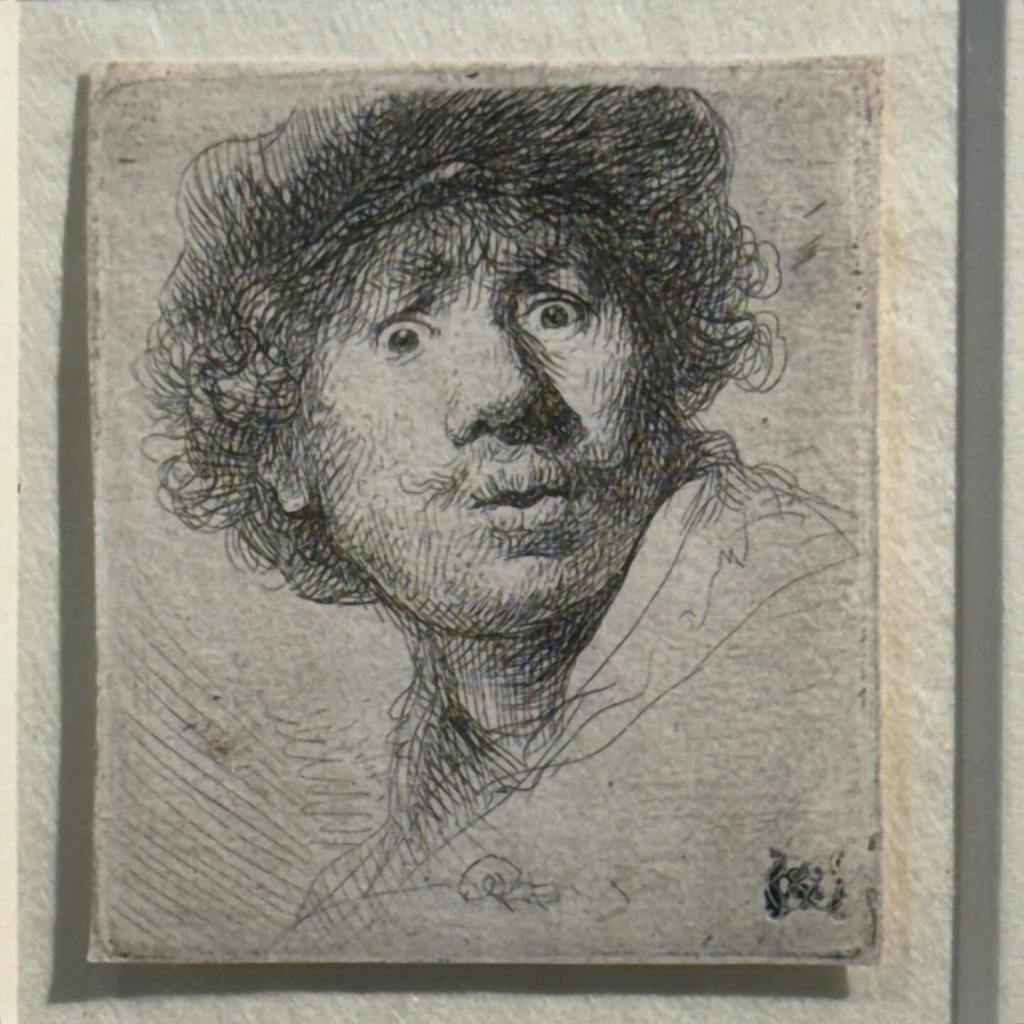
Rembrandt Harmensz. van Rijn (1606-1669), Self-Portrait in a Cap, Wide-Eyed and Open-Mouthed, 1631, Etching and Drypoint technique, Laid paper from the Second final state, Sheet 52 x 45 mm, The Sam Josefowitz Collection Sale, 7 December 2023
Rembrandt Harmensz. van Rijn (1606-1669), Self-Portrait in a Cap, Wide-Eyed and Open-Mouthed, 1631, Etching and Drypoint technique, Laid paper from the Second final state, Sheet 52 x 45 mm, The Sam Josefowitz Collection Sale, 7 December 2023
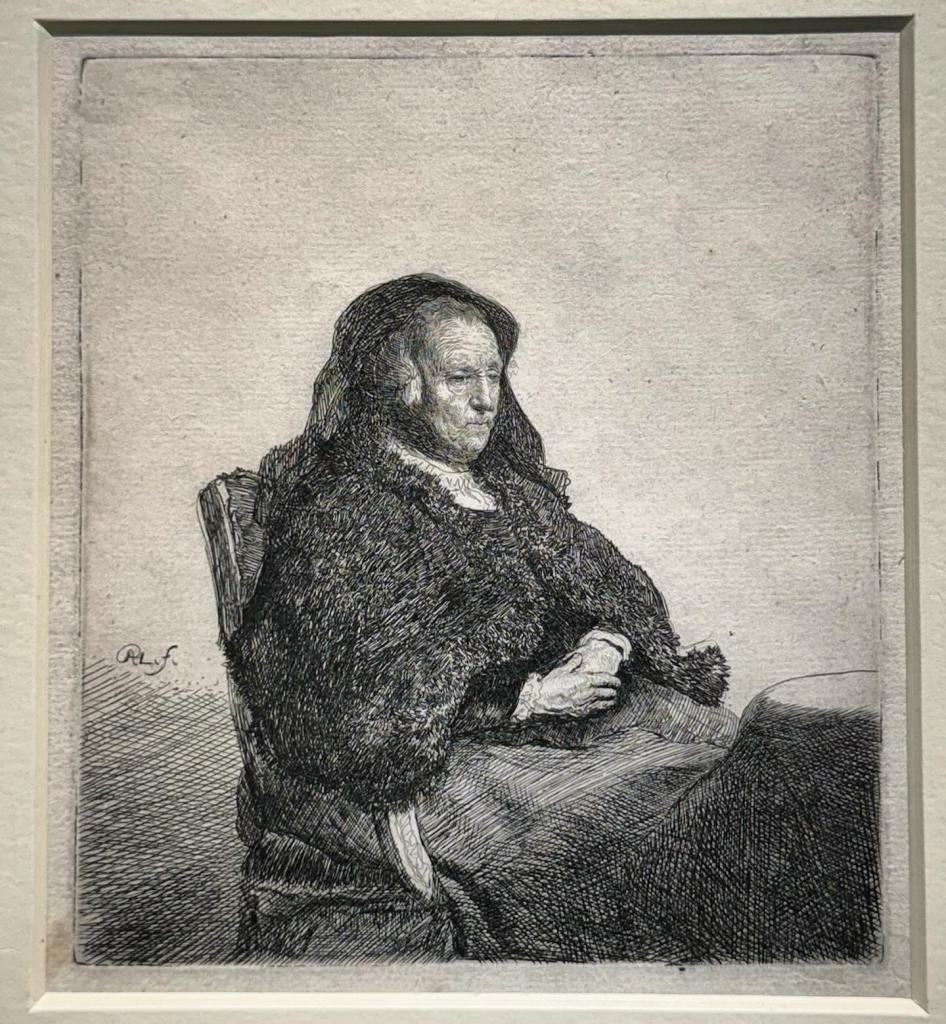
Rembrandt Harmensz. van Rijn (1606–1669), The Artist’s Mother Seated at a Table, Looking Right: Three Quarter Length, c.1631, Etching, Laid paper from the Second state (of three), Plate 149 × 131 mm, Sheet 172 × 150 mm, The Sam Josefowitz Collection Sale, 7 December 2023
This portrait of Rembrandt’s mother, Neeltgen Willemsdochter van Zuytbrouck (1568–1640), occupies an intriguing place in the scholarly discussion of the Rembrandt family. In the 19th century, there was a tendency to identify many of Rembrandt’s sitters as members of his family, often in a romanticising spirit, including works assumed to represent his mother. Current academic consensus, however, interprets this etching less as a literal portrait than as part of the tronie tradition, where the identity of the sitter matters less than the exploration of age, expression, and character.
Rembrandt frequently employed his mother as a model during his early years in Leiden, with around thirty works associated with this theme. Although he himself never identified these works explicitly as portraits of her, the title became attached later. The strong likelihood of her presence in them is generally accepted, based on both the repetition of her features and the respect with which she is portrayed.
It has also been argued that these depictions of the elderly woman move beyond mere study, taking on an allegorical dimension in which old age embodies virtues such as moderation, wisdom, steadfast faith, and fortitude in the face of death. In this way, the image participates in a long-standing tradition of associating the visible marks of ageing with moral exempla, offering viewers not simply an intimate likeness but a reflection on the passage of time and the human condition.