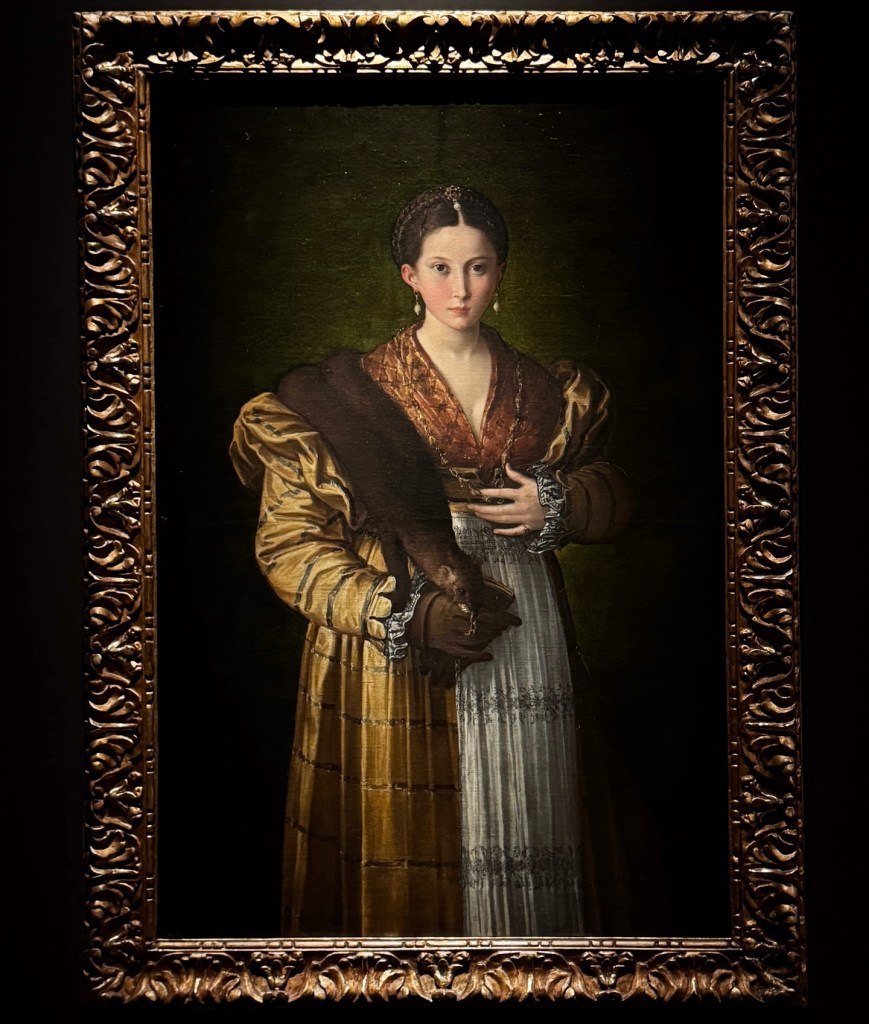
Parmigianino (1503–1540), Antea, c.1531–34, Oil on canvas,. 136 x 86 cm, Museo di Capodimonte, Naples
Parmigianino (1503–1540), Antea, c.1531–34, Oil on canvas,. 136 x 86 cm, Museo di Capodimonte, Naples
The fact that this painting survives at all is remarkable.It had been moved to the Monte Cassino monastery for protection during the war, but when the Hermann Göring Division occupied the area, the work was seized along with other holdings from the Museo di Capodimonte and taken first to Berlin, then deeper into occupied territory, ending up in the Altaussee salt mines near Salzburg. There it sat in a network of tunnels alongside thousands of looted works, the Ghent Altarpiece and Michelangelo’s Bruges Madonna among them, while the local Gauleiter tried to have the whole cache destroyed. It was recovered by Allied forces in the summer of 1945 and eventually returned to Naples. The Monte Cassino monastery had been flattened by Allied bombing in February 1944, and a great deal that had been stored there was lost.
The name ‘Antea’ is part of the painting’s mythology. It was first attached to the portrait in 1671 by the writer Giacomo Barri, who claimed the sitter was a celebrated Roman courtesan and the artist’s lover. There is no evidence for either claim, and for its first hundred and thirty-five years the picture was known simply as Ritratto di giovane donna. But the story stuck, and it is telling that it did. From the Baroque period onwards, people liked to furnish Renaissance portraits with romantic backstories, and Parmigianino’s picture, with its frankly confrontational gaze and its air of unresolved intimacy, practically invited that kind of invention. The various candidates proposed since then (the artist’s daughter, a servant, the Parmese noblewoman Pellegrina Rossi di San Secondo, a woman named Antea Smeraldi found in local baptismal records) only confirm how powerfully the painting generates the feeling that this must be a real person, someone whose name ought to be recoverable.
Whether it is recoverable is another question. An influential reading of Parmigianino’s female figures has placed them within the Renaissance discourse of ideal beauty and the Petrarchan literary tradition, where the sitter’s individual identity mattered far less than her conformity to a set of visual and poetic conventions (Cropper, 1976). The oval face, the blonde hair, the composed expression: these are the features of Petrarch’s Laura translated into paint, filtered through the treatise literature on beauty that circulated in sixteenth-century Italy. On this reading, asking who she ‘really’ was may be the wrong question altogether. The portrait belongs to a genre in which beauty and virtue are the subject, and the woman who embodies them need not have existed at all.
And yet the painting resists sitting comfortably in that category. The near full-length standing format was unusual for female portraits of this period. The body is broad-shouldered and ample, the proportions deliberately exaggerated in the Mannerist manner, but the face has a directness that feels like observation rather than formula. Her clothing mixes luxury with specificity: the gold satin dress with its silver bands, the blackwork embroidery on her apron and cuffs, the marten fur draped over one shoulder, the gold chain and brooch. These are not generic markers of wealth. The white apron, or zinale, was traditionally worn by brides in northern Italy as a sign of virginity, which, if that reading holds, would narrow the possibilities considerably. It has been suggested by scholars that several of the accessories she wears, the marten fur, the chain, the ring, the earrings, were of a kind conventionally given as courtship gifts, and that a woman shown wearing them would have been understood as having accepted a lover’s advances. Parmigianino seems to have been aware of these codes and to have used them with purpose, even if we cannot now say exactly what that purpose was.
Parmigianino appears to have used this same face, or something very close to it, in other works, including his unfinished Madonna of the Long Neck. If the same model sat for both a devotional image and a portrait loaded with erotic suggestion, then the boundary between observed person and invented type was one Parmigianino was happy to blur. That may be the most honest conclusion available: that the painting sits on the line between portraiture and ideal, between a woman who might have walked into the studio and one who was assembled from conventions, desires, and paint.
Parmigianino (1503–1540), Antea, c.1531–34, Oil on canvas,. 136 x 86 cm, Museo di Capodimonte, Naples
References
Cropper, E. (1976) ‘On Beautiful Women, Parmigianino, Petrarchismo, and the Vernacular Style’, The Art Bulletin, 58(3), pp. 374–394.Available at, https://www.jstor.org/stable/i354283 ( Accessed 19 December 2024)
Cropper, E. (1986) ‘The Beauty of Woman: Problems in the Rhetoric of Renaissance Portraiture’, in Ferguson, M.W., Quilligan, M. and Vickers, N. (eds.) Rewriting the Renaissance: The Discourses of Sexual Difference in Early Modern Europe. Chicago: Chicago University Press, pp. 175–190.
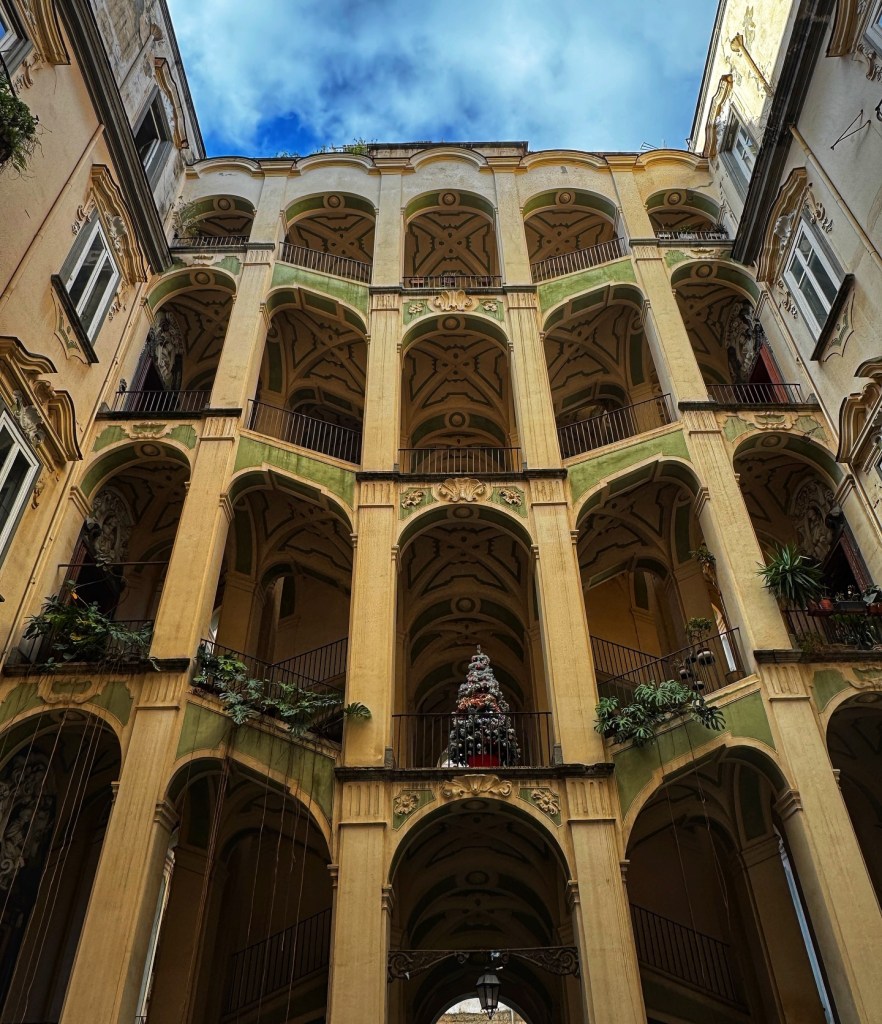
Palazzo dello Spagnolo, in the Rione Sanità area of Naples, was constructed in 1738 at the request of Nicola Moscati, the Marquis of Poppano. The architectural design is attributed to Ferdinando Sanfelice (1675–1748), a prominent figure in Neapolitan Baroque architecture. The palace is renowned for its distinctive ‘ali di falco’ double-ramped staircase, which dominates the central courtyard. This staircase exemplifies Sanfelice’s innovative approach, seamlessly blending functionality with artistic expression. Its sweeping curves and symmetrical design create a sense of fluidity and motion, while the open structure allows natural light to enhance the Baroque emphasis on dynamism. The interior was richly adorned with Rococo stucco work by Aniello Prezioso, based on designs by Francesco Attanasio in 1742, further enriching the palace’s aesthetic appeal.
Palazzo dello Spagnolo, Naples
The conception of the staircase as a central architectural element has deep historical roots. During the Renaissance, monumental staircases symbolised power and elegance. This tradition evolved further in the Baroque era, where architects such as Francesco Borromini reimagined staircases as dramatic and expressive elements that defined a building’s spatial identity.
Sanfelice drew on these traditions while adapting them to the cultural and architectural context of 18th-century Naples. In the Palazzo dello Spagnolo, the staircase is not merely a transitional element but a statement of the palazzo’s entire architectural philosophy. It transforms the courtyard into a vibrant, theatrical space, reflecting Sanfelice’s skill in blending functionality with aesthetic sophistication.
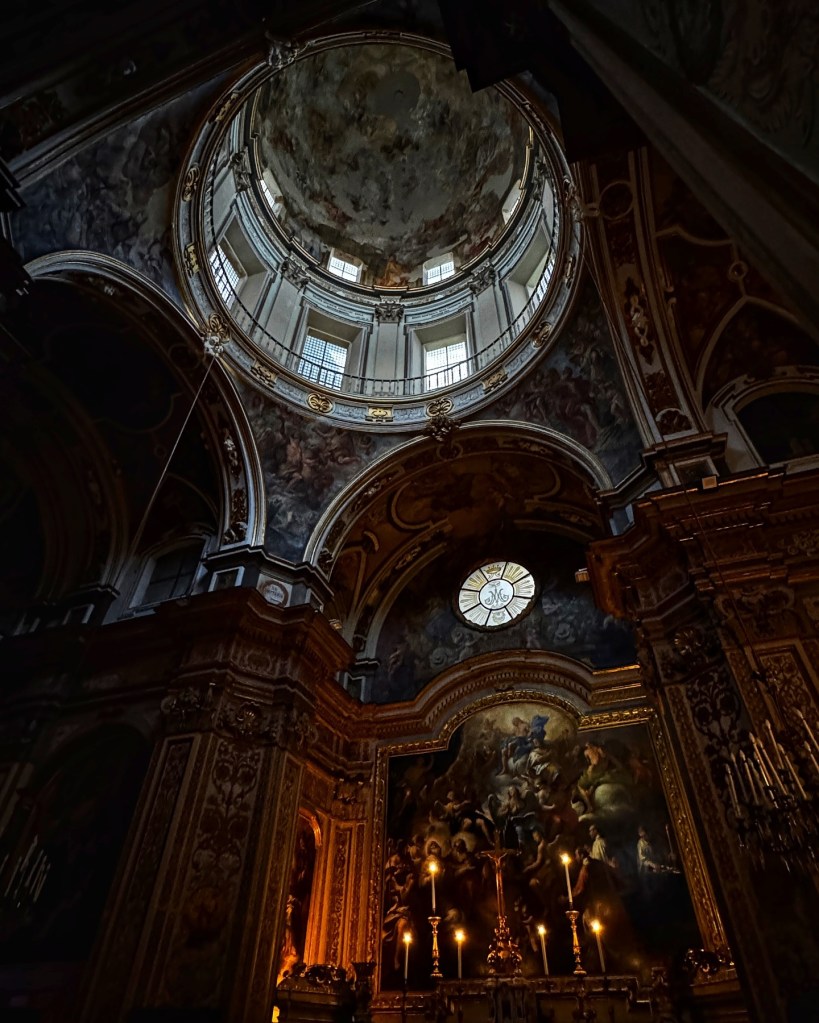
Chiesa di San Nicola alla Carità (Church of Saint Nicholas of Myra), Naples
The plague that swept Naples in 1656 killed around half the city’s population, including almost all of the Pii Operai congregation who had been tending the sick, and the architect they had hired nine years earlier to build their new church on Via Toledo. Onofrio Antonio Gisolfi (died 1656) had been chief royal engineer to the Kingdom of Naples, a serious if not celebrated figure, succeeding Bartolomeo Picchiatti (1571–1643) in that role and occupied with the Regi Lagni reclamation works and the Palazzo Reale alongside his ecclesiastical commissions. He had begun work on the church in 1647. By the time he died, the left aisle and the hypogeum (the underground burial chamber) had been built. The painter Bernardo Cavallino (1616–1656), one of the most refined Neapolitan colourists of his generation, also died in the contagion, and his body was placed in that same hypogeum.
The site sat dormant for twelve years. Work resumed on 18 March 1668 under Cosimo Fanzago (1591–1678), who modified the earlier scheme, and the church was finally blessed on 5 July 1682 under the patronage of Cardinal Diego Innico Caracciolo di Martina. There is an irony worth noting here: in 1645, while Gisolfi was briefly absent from Naples, Fanzago had attempted to take his post as chief royal engineer. The commission of the man he had once tried to displace passed, by way of the plague, into his hands.
The Pii Operai themselves are often confused with the Theatines, and it is a confusion that travels easily into popular guidebooks. The two orders are entirely distinct. The Theatines were founded in 1524 by St Cajetan (1480–1547) and Gian Pietro Carafa (1476–1559), the future Pope Paul IV. The Pii Operai (formally the Congregation of Pious Workers, in Latin Congregatio Piorum Operariorum) were founded in Naples around 1600 by a different Carafa: Carlo Carafa (1561–1633), of a junior branch of the Neapolitan noble family, who had been educated at the Jesuit college in Nola, had been forced out of the Society of Jesus by ill health, and then spent more than a decade as a soldier before returning to religious life in his thirties. His pastoral work attached itself to the most exposed parts of Neapolitan society: the inmates of the Ospedale degli Incurabili, the dying and the condemned (through the Compagnia dei Bianchi), reformed prostitutes (for whom he founded a conservatorio in 1602), and from around 1605 the rural villages around the city. Pontifical recognition came in 1606, formal approval as the Pii Operai followed in 1621 under Pope Gregory XV.
The funding of the church carries its own legend. According to the tradition the congregation preserved, a beggar whom they had been nursing for a long time died in their care, and the rags in which he had been wrapped were found to contain six thousand ducats. A second donation of six thousand ducats followed from another patient, Giovan Battista Burgo, in similar gratitude. Whether the beggar story is exact or polished in the retelling, the property on Via Toledo was bought in 1647 with that capital, and Gisolfi began work. The relics of St Nicholas of Bari, specifically a phalanx of the saint’s index finger, were translated from Scala in the Amalfi peninsula when the new church was blessed, and gave it its dedication.
What the visitor sees today is essentially eighteenth-century decoration within a seventeenth-century shell. The architecture is sober, a Latin-cross plan with three aisles, in keeping with Counter-Reformation preaching practice rather than the more inventive geometries that Fanzago and his peers were testing in other Neapolitan commissions. The interior matters because of what was done to its surfaces over the following century, by three painters in succession.
The principal campaign was Francesco Solimena’s (1657–1747). Between 1696 and 1701, Solimena, then in his late thirties and rising into the position he would hold for the next fifty years as the dominant figure in Neapolitan painting, frescoed the vault of the central nave with three scenes from the Life of St Nicholas: the Birth of the Saint, the Liberation, and the Abduction of the Boy Basilio. The lateral spandrels near the windows hold figures of the Apostles and the Virtues. He added two large transept altarpieces, the Sermon of St John the Baptist and the Sermon of St Paul (both 1697), and painted lunettes on the counter-façade. A protracted dispute with the Pii Operai (resolved only in 1708) led him to abandon the worksite for some years, although he later returned to design the lower order of the façade, begun in 1723 and finished only in 1776 by Salvatore Gandolfo, who completed the upper order to his own design. The two marble angels above the central portal were begun by Francesco Pagano in 1725 and completed by Paolo Persico in 1775; the bronze bust of St Nicholas between them is by Bartolomeo Granucci.
The apse and dome were finished by two painters who together represent the next generation. Paolo De Matteis (1662–1728), the favourite pupil of Luca Giordano (1634–1705) and Solimena’s principal rival, frescoed the vault of the apse, the wall above the choir and the pendentives of the dome between 1700 and 1702, and in 1707 added the large canvas of the Death of St Nicholas behind the high altar together with the lateral apse paintings. The fresco of St Nicholas Driving Demons from a Tree above the entrance was completed in 1712. Francesco De Mura (1696–1782), Solimena’s principal follower in the next generation, frescoed the dome itself (the Healing of the Sick by St Nicholas and the Paradise) and contributed the Visitation, the Nativity, the Doctors of the Church and several individual saints. The high altar itself, an inlaid polychrome marble construction, was designed by Mario Gioffredo (1718–1785), the architect later given the epithet ‘the Neapolitan Vitruvius’, and executed by Antonio Troccola in 1743.
The altarpiece behind the high altar, Paolo De Matteis’s Transito di San Nicola [the Passing, or Death, of St Nicholas], was painted in 1707, and its commission cannot be separated from the breakdown that had just occurred between the Pii Operai and Francesco Solimena. The order had quarrelled with Solimena badly enough that he had abandoned the worksite, in a rupture only patched up in 1708, and they needed a painter capable of finishing the apse with credibility. De Matteis (1662–1728) was the obvious successor. He was Solimena’s principal rival in the city, the pupil whom the historiographer Luigi Lanzi (1732–1810) would later describe as Luca Giordano’s (1634–1705) best, and he had already worked inside the building between 1700 and 1702, on the apse vault, the wall above the choir and the pendentives of the dome. He was, in other words, neither a stranger to the site nor an unknown quantity to the order. There was also a particular circumstantial advantage. Between 1702 and 1705, De Matteis had been at the French court, invited by Victor-Marie, Comte d’Estrées (1660–1737), where he worked for Louis the Grand Dauphin (1661–1711), for the financier Antoine Crozat (1655–1738) and for the Marquis de Clérambault, decorating Crozat’s hôtel particulier on the Place Vendôme. Both Giordano and Solimena had declined invitations to Paris; De Matteis went, becoming the first Neapolitan of his generation to take a major foreign court commission and setting a precedent that would later be followed by the Venetian painters Sebastiano Ricci (1659–1734), Rosalba Carriera (1675–1757) and Giovanni Antonio Pellegrini (1675–1741). By the time the Pii Operai needed him back in Naples for the Transito, he had returned with a European visibility that no Neapolitan painter of his generation could match. Born in Piano Vetrale in the Cilento hills in 1662, trained first under Francesco di Maria (1623–1690) (a small but telling biographical overlap, since di Maria had also been Solimena’s early teacher) and then in Giordano’s studio, he was by temperament more cosmopolitan than the Neapolitan school usually permits, working subsequently in Rome for Popes Clement XI, Clement XII and Benedict XIII, and in Genoa, at Monte Cassino, and at Bisceglie. The Transito itself is a deliberately legible piece of work, a death-bed scene of the bishop of Myra organised on a clear axis, painted in the warm diffused light he had taken from Giordano and softened with the classicising restraint he absorbed from the Roman example of Carlo Maratta (1625–1713). It reads quickly, which mattered in a church whose congregation was the urban poor whom the order served. The choice of subject is also intelligent for the setting: the Transito of St Nicholas is the moment when the patron of givers becomes the recipient of attention, a reversal that cannot have been lost on a congregation whose founding act of mercy had been the nursing of dying paupers. As for De Matteis’s place in the Neapolitan school, his reputation has been hard to fix because his first biographer, Bernardo de’ Dominici (1683–1759), was openly hostile to him, presenting him as vain and over-productive. It is worth pausing on this. De’ Dominici was himself a pupil of Solimena, which means that the canonical account of Neapolitan painting that was inherited was effectively written from the studio of De Matteis’s principal rival; one might reasonably ask how much of De Matteis’s two-hundred-year eclipse was earned and how much was simply the consequence of being on the losing side of an in-house quarrel. It was Livio Pestilli’s monograph of 2013 that finally set out the case for the defence, arguing that what de’ Dominici read as facility was in fact a genuine responsiveness to patrons’ iconographic programmes, sustained at a high technical level across an unusually wide geography. De Matteis is most naturally understood as the painter who carried Giordano’s manner forward at the moment Solimena was pulling Neapolitan painting in the opposite direction, towards the older example of Mattia Preti (1613–1699) and the darker drama of Giovanni Lanfranco (1582–1647). The Transito in San Nicola alla Carità is one of the points where that divergence is visible inside a single building: Solimena’s nave above, the rivalrous pupil of his rival below.
Some popular guides in English still credit Luca Giordano with an altarpiece in the church, often described as a St Nicholas Distributing Alms of 1695. The high altar canvas is firmly attributed to De Matteis. What does exist is a Guardian Angel altarpiece in the third left chapel by Giovan Battista Lama (1673–c. 1748), a pupil of Giordano, which may be the source of the confusion in tourist literature. The attribution of stucco work to Dionisio Lazzari (1617–1689) often repeated in guides is likewise absent from the standard catalogues of Lazzari’s documented Neapolitan commissions; the stucco of the presbytery was in fact executed by Pietro Scarola under Solimena’s direction.
Two later burials still anchor the building’s history. Cavallino’s grave has never been located precisely within the hypogeum, which is fitting for a painter only one of whose surviving works is dated and most of whose chronology has had to be reconstructed from style alone. The body of Carlo Carafa, the founder of the order, was translated here from San Giorgio Maggiore in 1969, three centuries after his death. The painter killed by the plague and the founder whose congregation was almost extinguished by it now lie under the same roof, beneath ceilings neither of them lived to see.
Chiesa di San Nicola alla Carità (Church of Saint Nicholas of Myra), NaplesPaolo De Matteis (1662–1728), Death of St Nicholas, Chiesa di San Nicola alla Carità (Church of Saint Nicholas of Myra), NaplesPaolo De Matteis (1662–1728), Death of St Nicholas, Chiesa di San Nicola alla Carità (Church of Saint Nicholas of Myra), NaplesChiesa di San Nicola alla Carità (Church of Saint Nicholas of Myra), Naples
References
Barker, S. (2007) ‘Art, Architecture and the Roman Plague of 1656–1657’, in I. Fosi (ed.) La peste a Roma (1656–57) [The Plague at Rome (1656–57)]. Rome: Università Roma Tre-Croma, pp. 243–262. Available at :https://www.academia.edu/7620955/Art_Architecture_and_the_Roman_Plague_of_1656 (Accessed 16 December 2024)
Blunt, A. (1975) Neapolitan Baroque and Rococo Architecture. London: A. Zwemmer.
Galante, G.A. (1985) Guida sacra della città di Napoli [Sacred Guide to the City of Naples]. Edited by N. Spinosa. Naples: Società Editrice Napoletana
Hansen, M.S. (2024) ‘Trinitarian Theology, Neapolitan Painting: Paolo De Matteis, Francesco Solimena, and Sebastiano Conca’, Zeitschrift für Kunstgeschichte [Journal of Art History], 87(2), pp. 234–261. Available at: https://doi.org/10.1515/zkg-2024-2005. (Accessed 16 December 2024)
Hills, H. (2004) Invisible City: The Architecture of Devotion in Seventeenth-Century Neapolitan Convents. Oxford: Oxford University Press.
Hills, H. (2016) The Matter of Miracles: Neapolitan Baroque Architecture and Sanctity. Manchester: Manchester University Press.
Marshall, C.R. (2016) Baroque Naples and the Industry of Painting: The World in the Workbench. New Haven: Yale University Press.
Mormando, F. and Worcester, T. (eds.) (2007) Piety and Plague: From Byzantium to the Baroque. Kirksville, MO: Truman State University Press
Percy, A. and Mahon, D. (1984) Bernardo Cavallino of Naples, 1616–1656. Exhibition catalogue. Cleveland: Cleveland Museum of Art
Pestilli, L. (2013) Paolo de Matteis: Neapolitan Painting and Cultural History in Baroque Europe. Farnham: Ashgate
Sallmann, J.-N., Carmichael, A.G., Alfani, G. et al. (2012) ‘Plague Epidemic in the Kingdom of Naples, 1656–1658’, Emerging Infectious Diseases, 18(1), pp. 186–188. Available at: https://doi.org/10.3201/eid1801.110597. (Accessed 16 December 2024)
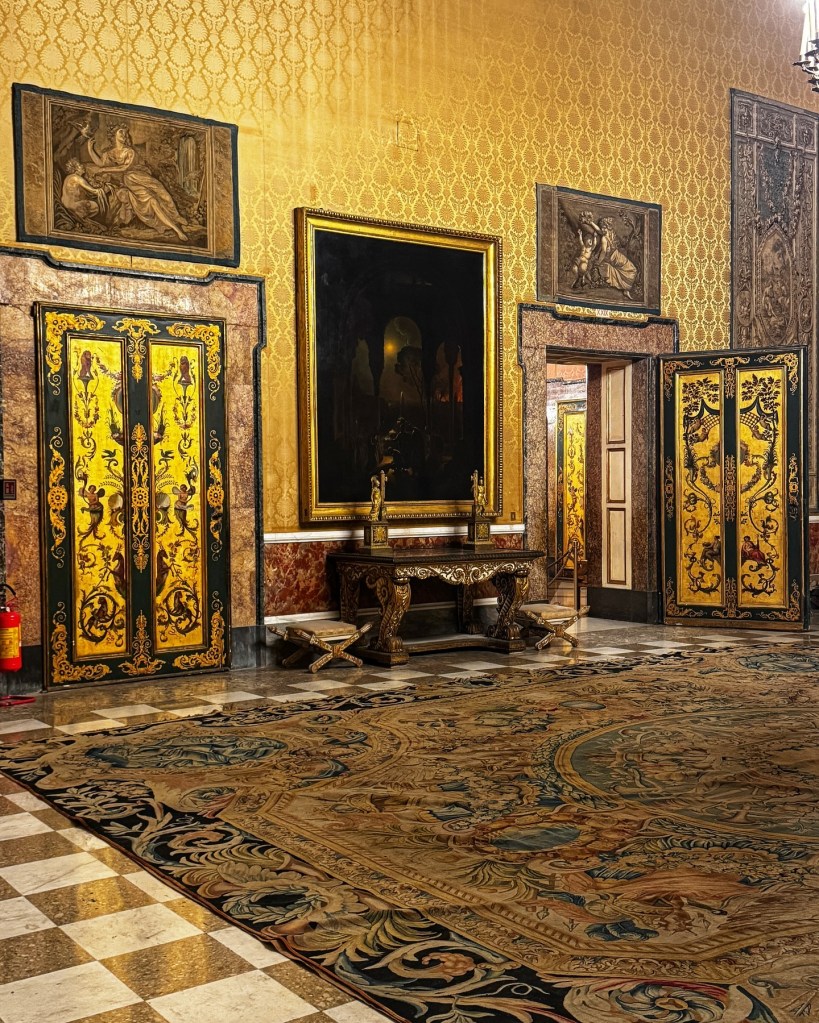
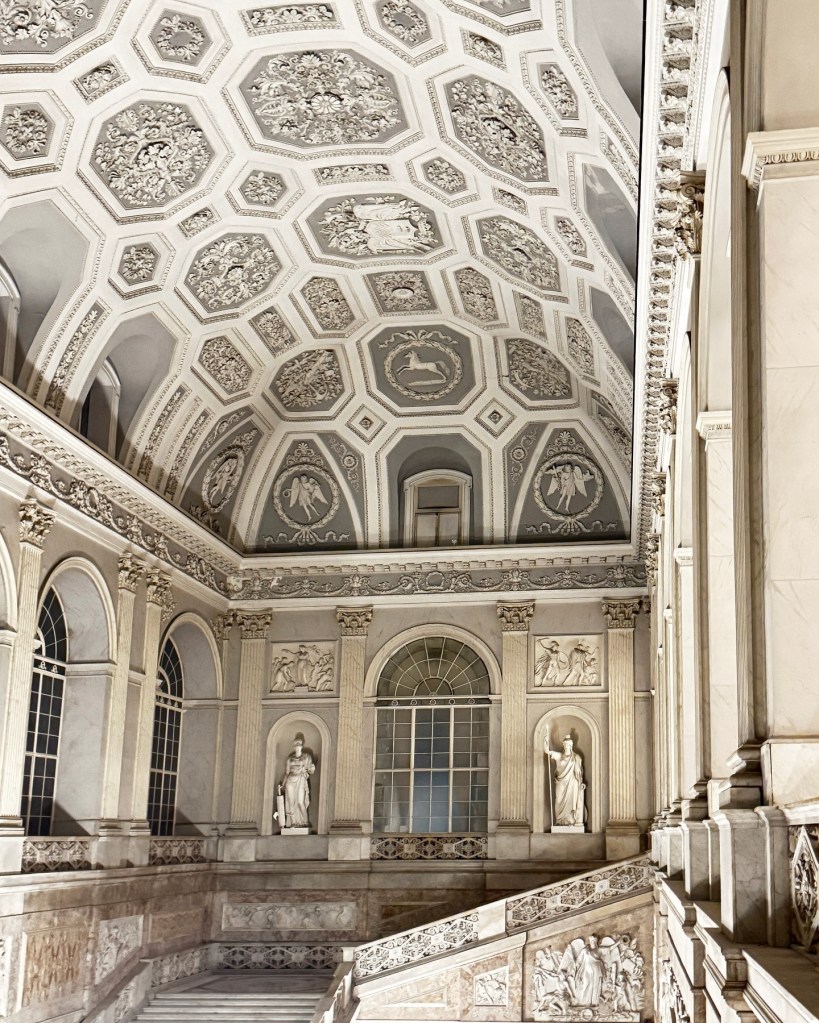
The Royal Palace of Naples stands as a remarkable testament to a layered architectural heritage. The fusion of late Renaissance, Baroque, and Neoclassical styles, shaped by the Spanish Habsburgs, Austrian Habsburgs, and Bourbon monarchs, reflects both the finest achievements of past generations and the evolving tastes of successive rulers.
Palazzo Reale di Napoli
The Royal Palace of Naples, commissioned in 1600 by the Spanish viceroy Fernando Ruiz de Castro, was designed by Domenico Fontana (1543–1607) in the late Renaissance style. Fontana’s design emphasised symmetry, classical proportions, and monumental elegance.
In the mid-17th century, under the rule of the Spanish viceroys, Francesco Antonio Picchiatti (1619–1694) expanded the palace, incorporating Baroque features. His contributions included the grand staircase and the Palatine Chapel, where dramatic spatial effects and intricate decoration exemplified the opulence of the Baroque period.
After the War of the Spanish Succession (1701–1714), the Kingdom of Naples came under the rule of the Austrian Habsburgs and, later, the Bourbon dynasty in 1734 with the accession of Charles VII of Naples (later Charles III of Spain). Under Bourbon rule, the palace became a royal residence. Following a fire in 1837, Gaetano Genovese (1795–1875) oversaw renovations that introduced many Neoclassical elements. His work included porticos, balanced façades, and simplified ornamentation, reflecting the taste of 19th-century Bourbon monarchs.
The Palatine Chapel (Cappella Reale) was closely associated with prominent composers who served as maestros di cappella, including Diego Ortiz (c. 1510–c. 1570), Giovanni de Macque (c. 1548–1614), Giovanni Maria Trabaci (c. 1575–1647), Alessandro Scarlatti (1660–1725), and Giovanni Paisiello (1740–1816). These composers reflect the chapel’s importance as a centre of sacred music.
The Palatine Chapel (Cappella Palatina or Cappella Reale dell’Assunta), Royal Palace of Naples. Designed by Francesco Antonio Picchiatti (1600–1670), begun c. 1643–1644, consecrated 1646, later decorated by Jusepe de Ribera (1591–1652), Giovanni Lanfranco (1582–1647), Charles Mellin (1597–1649), Giacomo del Pò (1654–1726), Domenico Morelli (1823–1901), and Giuseppe Cammarano (1766–1850); high altar by Dionisio Lazzari (1617–1689, executed 1674). Palazzo Reale di Napoli Palazzo Reale di Napoli Palazzo Reale di Napoli Palazzo Reale di Napoli Palazzo Reale di Napoli
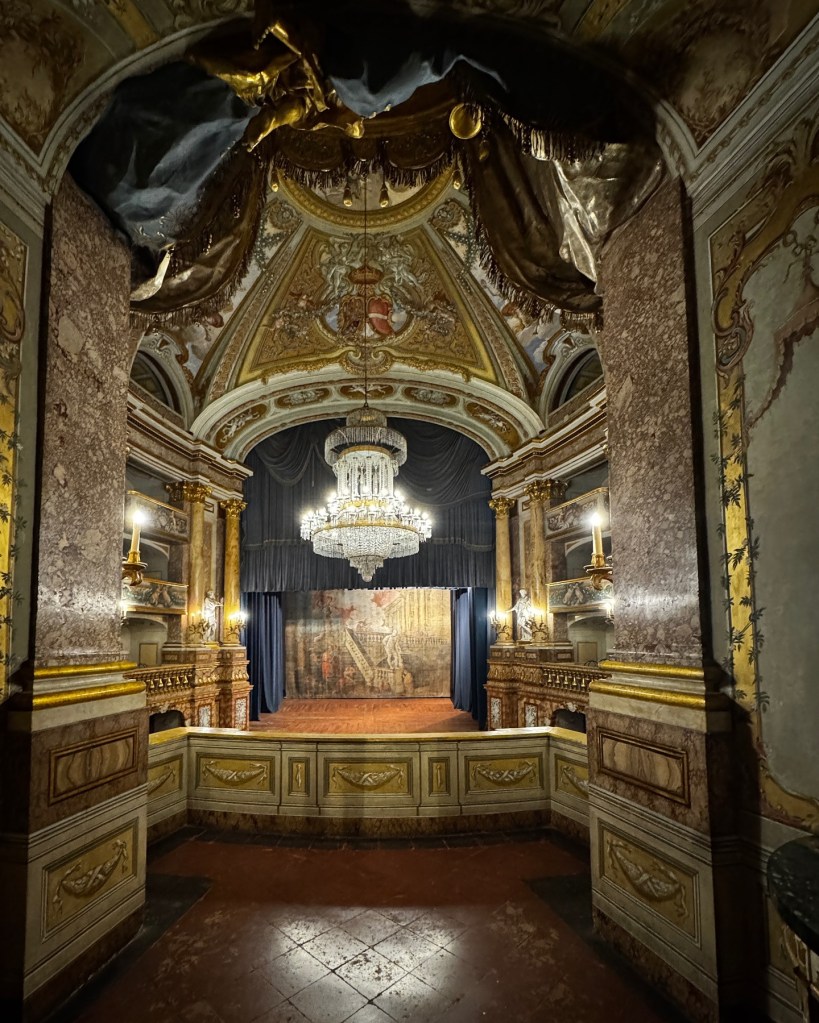
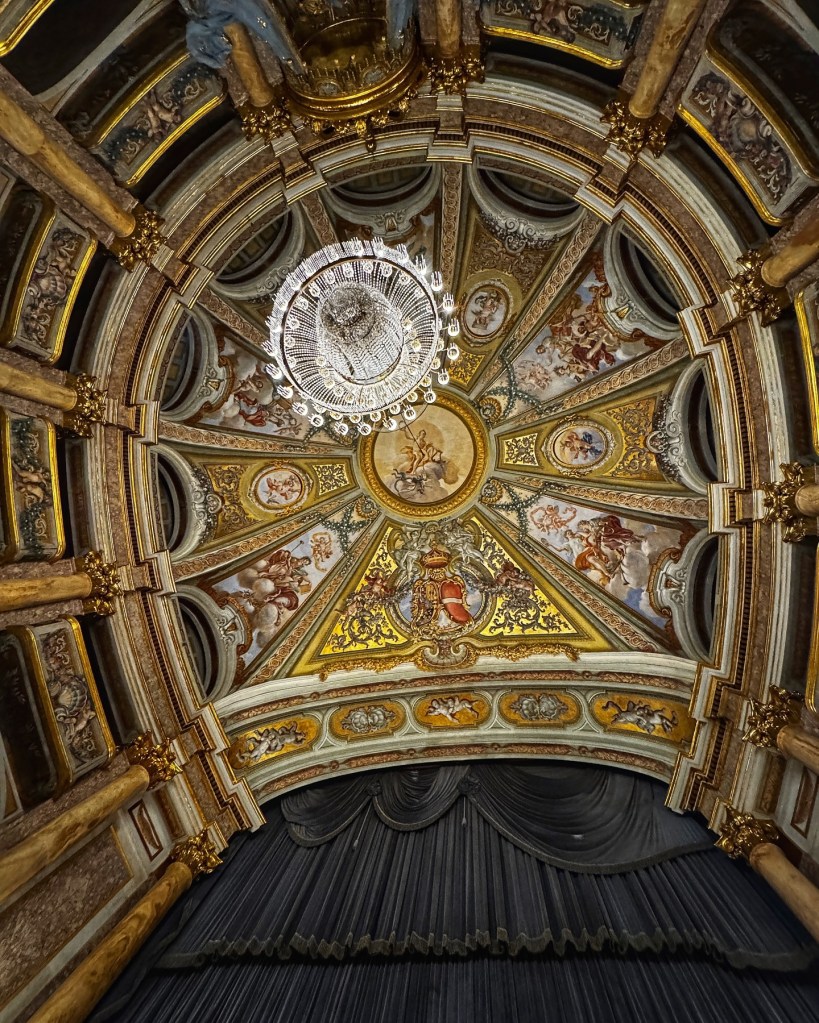
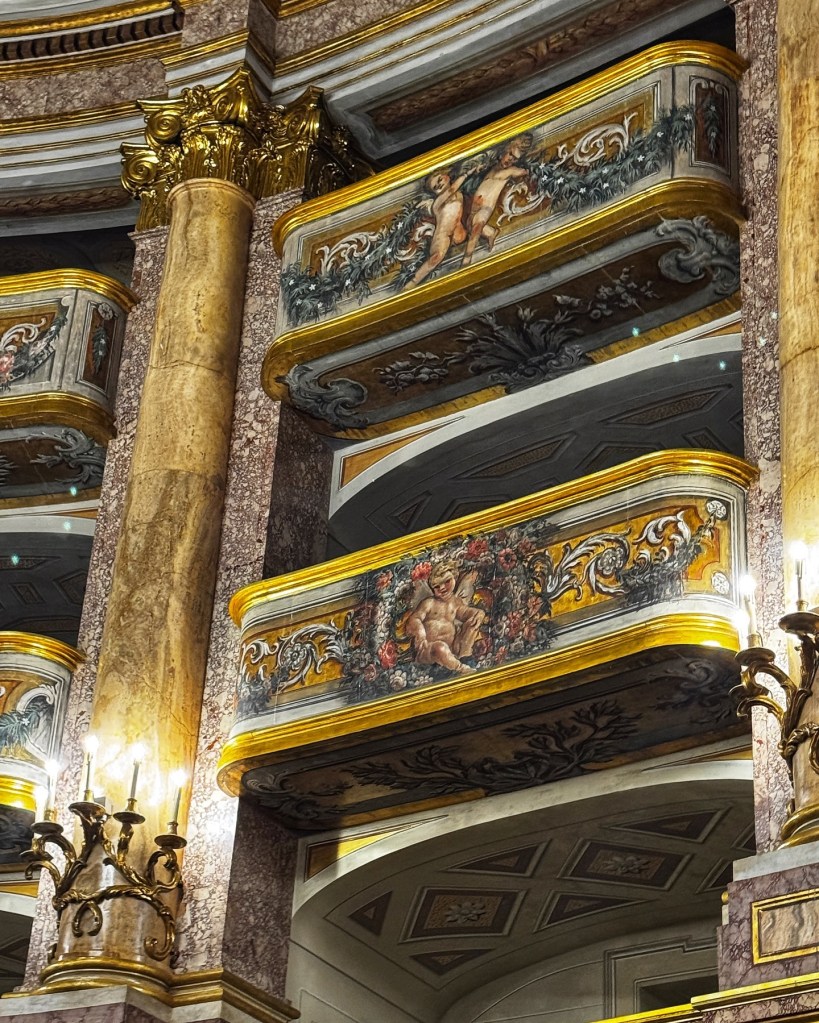
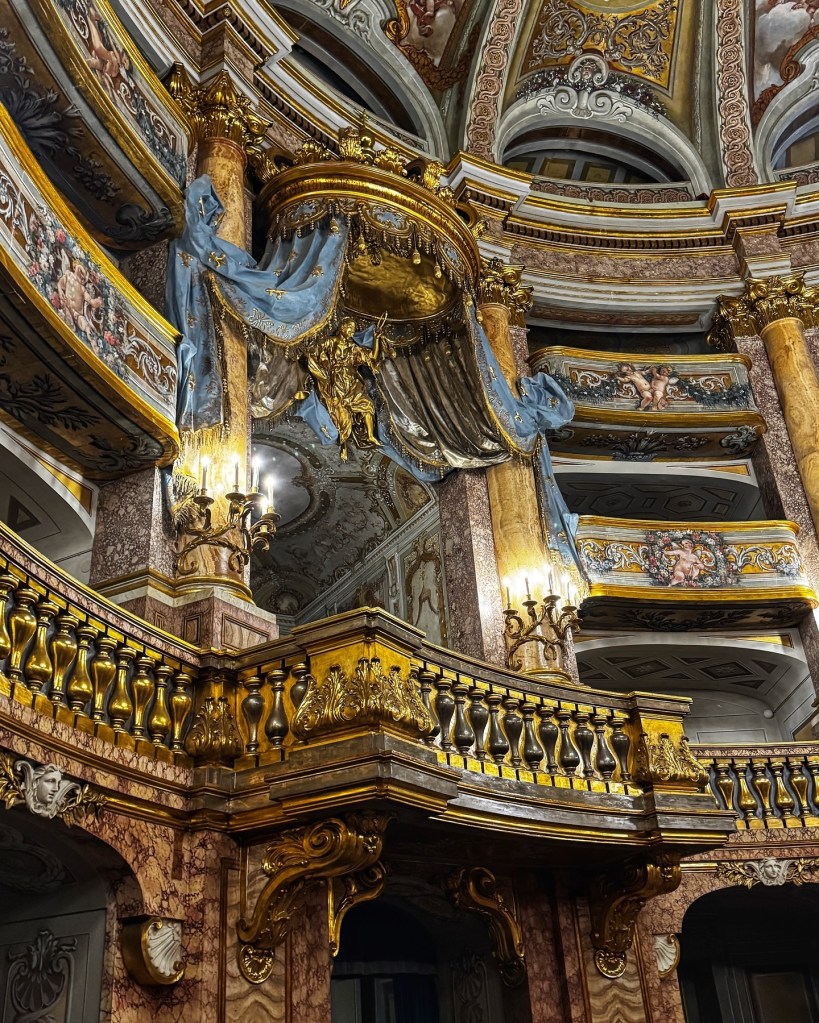
The Court Theatre of the Royal Palace of Caserta remains one of the most authentic examples of 18th-century theatre design. It is among the few parts of the palace completed under Luigi Vanvitelli’s (1700–1773) direct supervision, retaining its original architectural and decorative elements. The theatre was completed in 1768 and inaugurated during the Carnival season of that year by the young royal couple, Ferdinand IV (1751–1825) and Maria Carolina d’Asburgo-Lorena (1752–1814), in the presence of the Neapolitan aristocracy.
The Court Theatre is a smaller-scale replica of the Teatro San Carlo in Naples, designed by Giovanni Antonio Medrano (1703–1760) and Angelo Carasale (1685–1759). These theatres revolutionised 18th-century architecture by introducing the horseshoe-shaped auditorium, which became the global standard for theatres. This innovation addressed multiple needs: it reflected social hierarchy, enhanced acoustics and visibility, and allowed for the concealment of stage machinery.
The building rises to the height of the palace’s first two floors and contains 41 boxes arranged across five rows, including a prominent Royal Box. The Royal Box, spanning three rows, is crowned with a papier-mâché canopy featuring a large crown supported by Fame blowing a trumpet.
The theatre’s interior showcases exceptional artistic craftsmanship. In the 18th century, Gaetano Magri adorned the balconies with cherubs, floral wreaths, and shells, alternating designs to maintain visual harmony. Gennaro Amodio and Pietro Ferdecchini created the plasterwork and gilded stucco frames, while Gaetano Navarro, Nicola Cilento, and Francesco Bonfantini crafted the paper-mâché columns and statues of Orpheus and Amphion, which flank the proscenium. The balconies are supported by alabaster columns set on stone bases from Atripalda.
The ceiling, frescoed by Crescenzo La Gamba, features a central piece titled ‘Apollo Crushing the Python’, an allegory symbolising King Ferdinand’s triumph over vice and evil. Surrounding this central image are depictions of the nine muses, while medallions on the ceiling represent the classical four elements: earth, wind, fire, and water.
The Court Theatre of the Royal Palace of Caserta.The Court Theatre of the Royal Palace of Caserta.The Court Theatre of the Royal Palace of Caserta.The Court Theatre of the Royal Palace of Caserta.
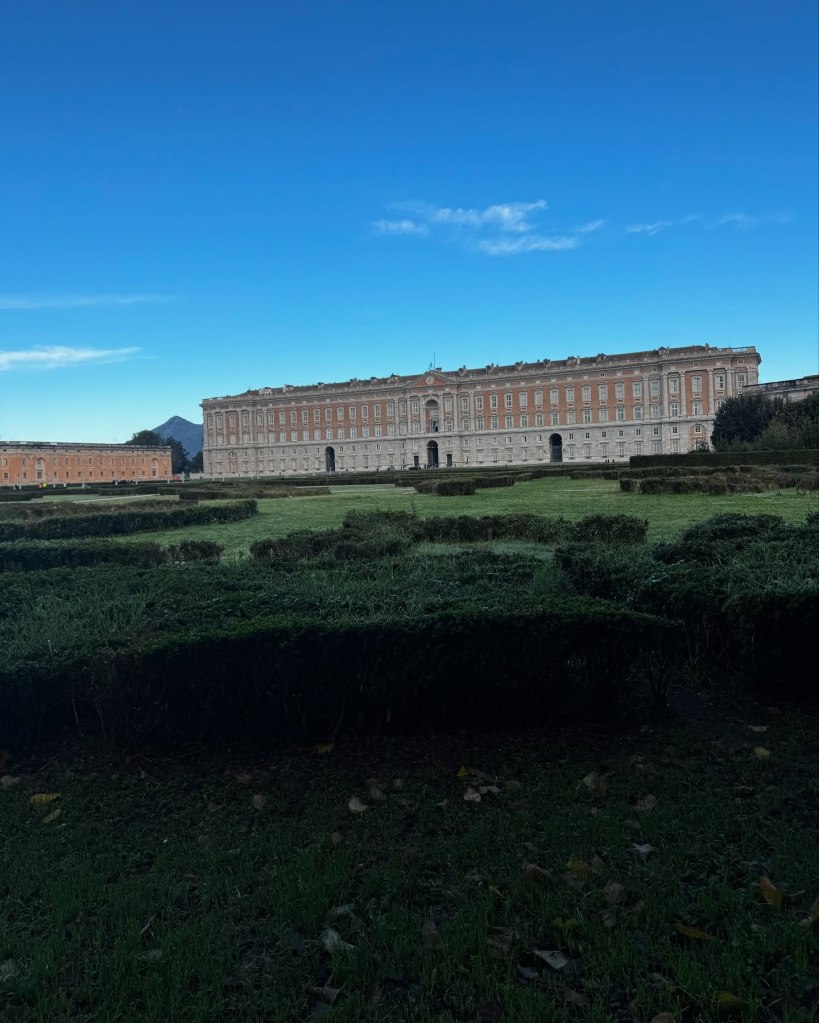
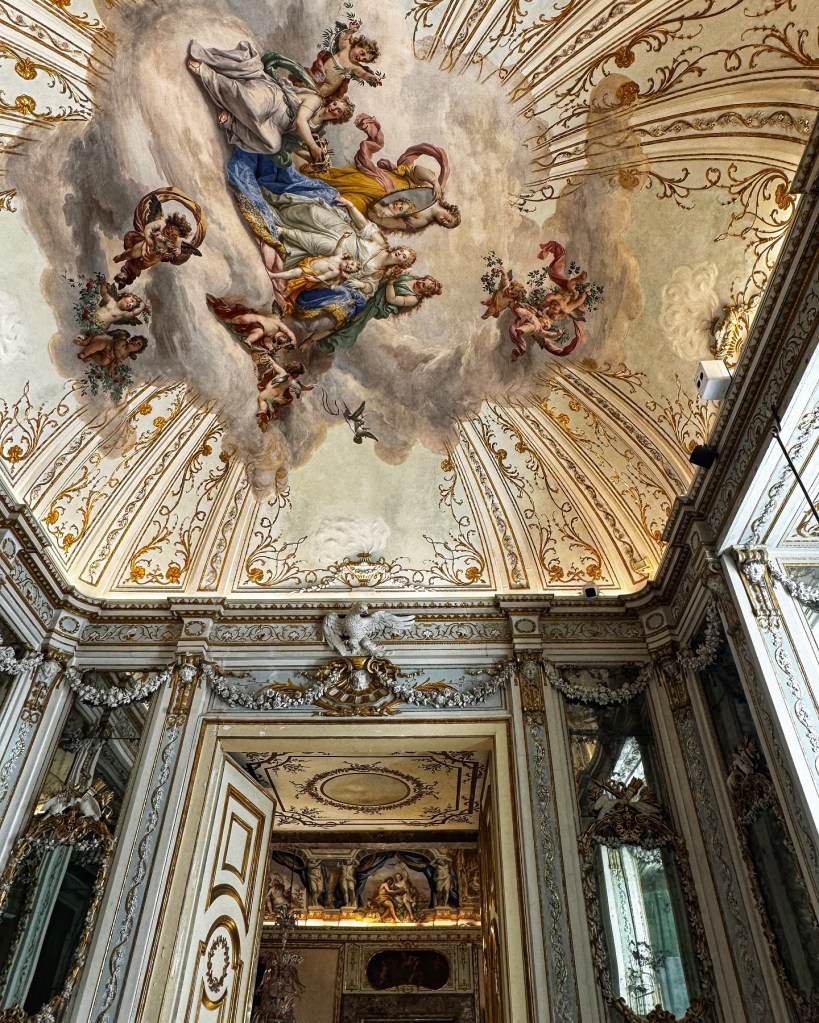
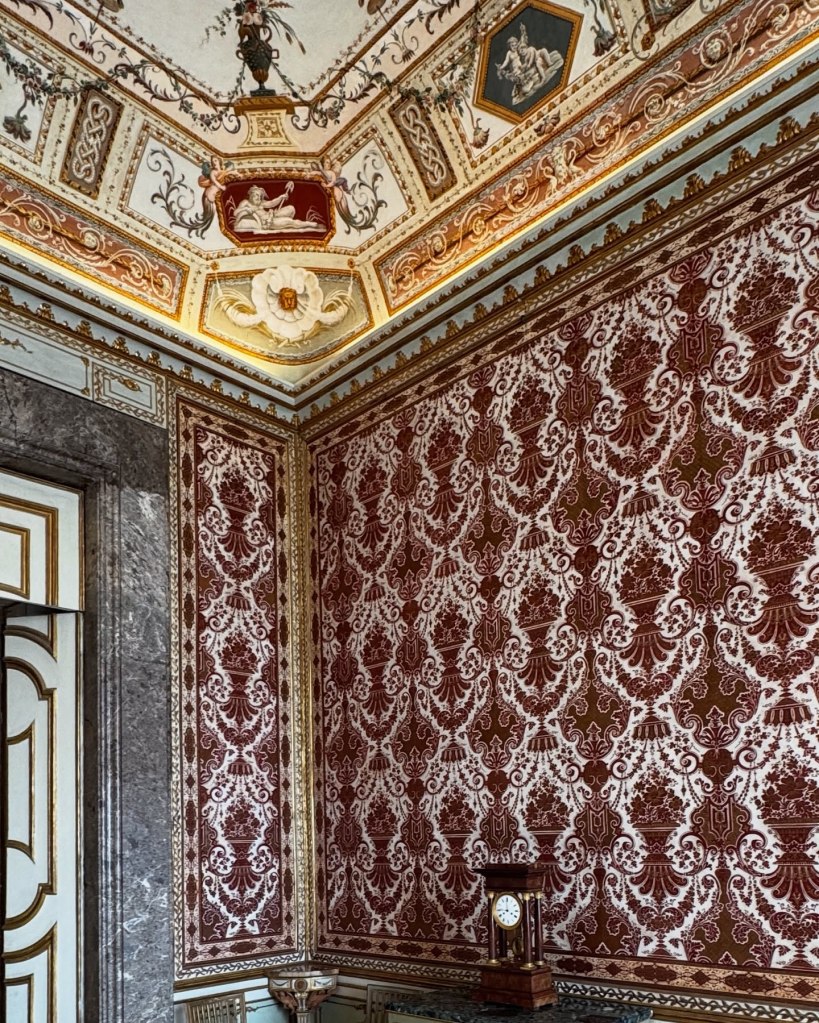
The Royal Palace of Caserta, commissioned in 1752 by Charles VII of Naples (1716–1788) and designed by Luigi Vanvitelli (1700–1773), was one of the most ambitious building projects of the eighteenth century. Charles wanted a residence that could stand beside Versailles, and Vanvitelli gave him one that answered to the tastes of its own moment: heavy with Baroque ornament in places, lighter and more playful in others, and increasingly attentive to the stripped-back formality that would come to define Neoclassicism. The interiors are perhaps the strongest argument for the building’s importance. Vanvitelli and the painters, stuccatori, and craftsmen who worked under him produced rooms of real technical finesse, many of them informed by what was then being pulled from the ground at Pompeii and Herculaneum, sites that lay practically on the doorstep.
The Bourbon court’s interest in these excavations is legible everywhere in the decoration. Classical motifs, meanders, acanthus scrolls, mythological scenes, recur throughout, but they are handled freely rather than copied, adapted to modern colour schemes and spatial arrangements that owe as much to eighteenth-century fashion as to antiquity. One might ask how far the designers at Caserta were conscious of setting a precedent; what is clear is that the solutions they arrived at were noticed and taken up at courts across Europe. The rooms themselves remain extraordinary, dense with surface incident, carefully ordered, and surprisingly varied in mood from one to the next.
The Royal Palace of CasertaThe Royal Palace of CasertaThe Royal Palace of CasertaThe Royal Palace of CasertaThe Royal Palace of CasertaThe Royal Palace of CasertaThe Royal Palace of Caserta
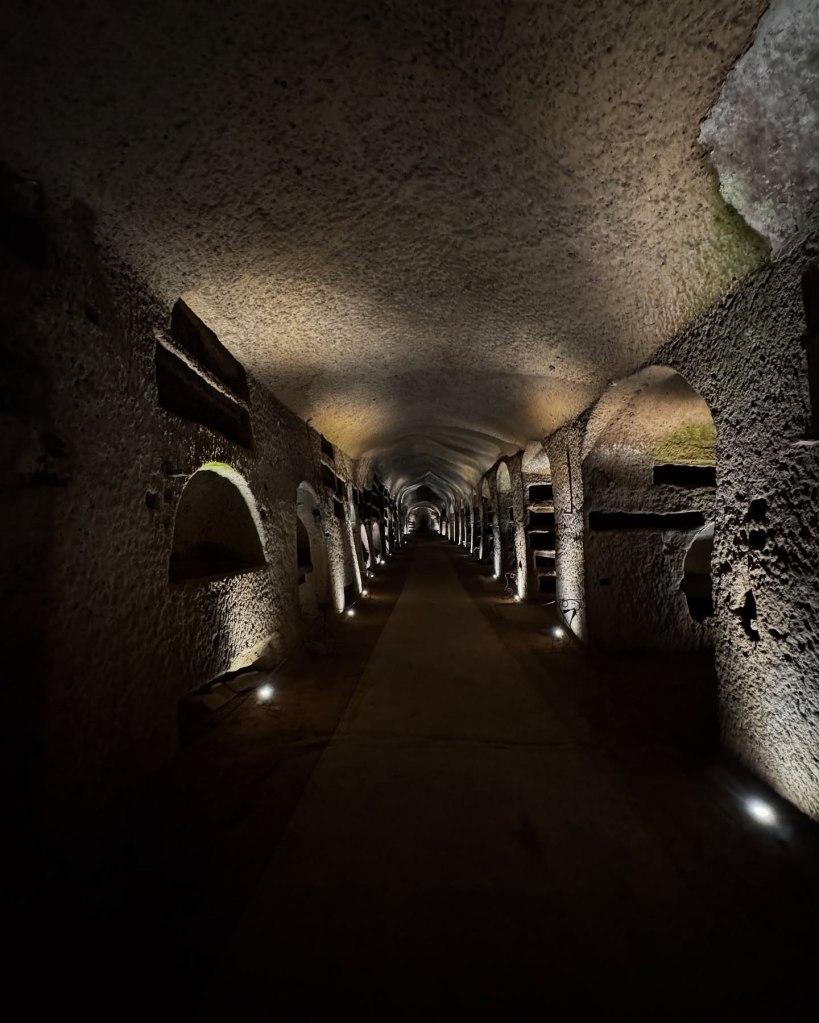
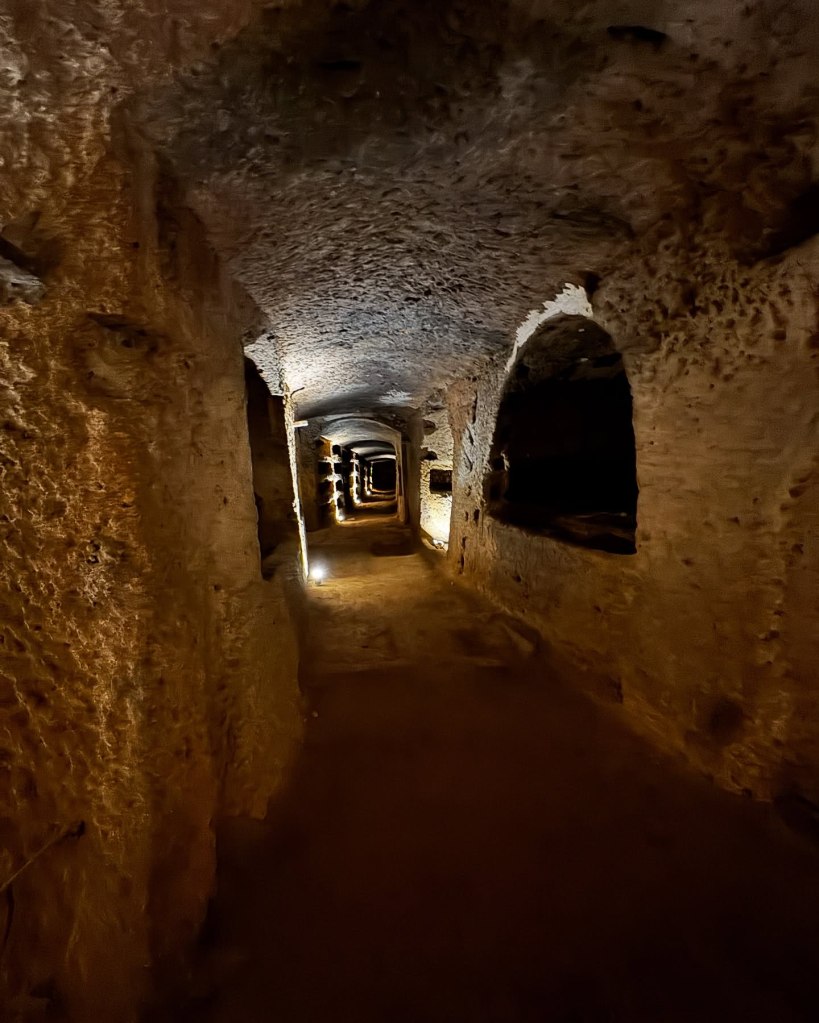
The tufa beneath Naples holds some of the earliest painted evidence of Christian worship anywhere in the Mediterranean. Cut into the rock during the third and fourth centuries, the Catacombs of San Gennaro record a congregation still finding the images through which its faith might be expressed. Christ appears as shepherd, the shared meal carries Eucharistic meaning, and Jonah emerges from the whale as a promise of resurrection.
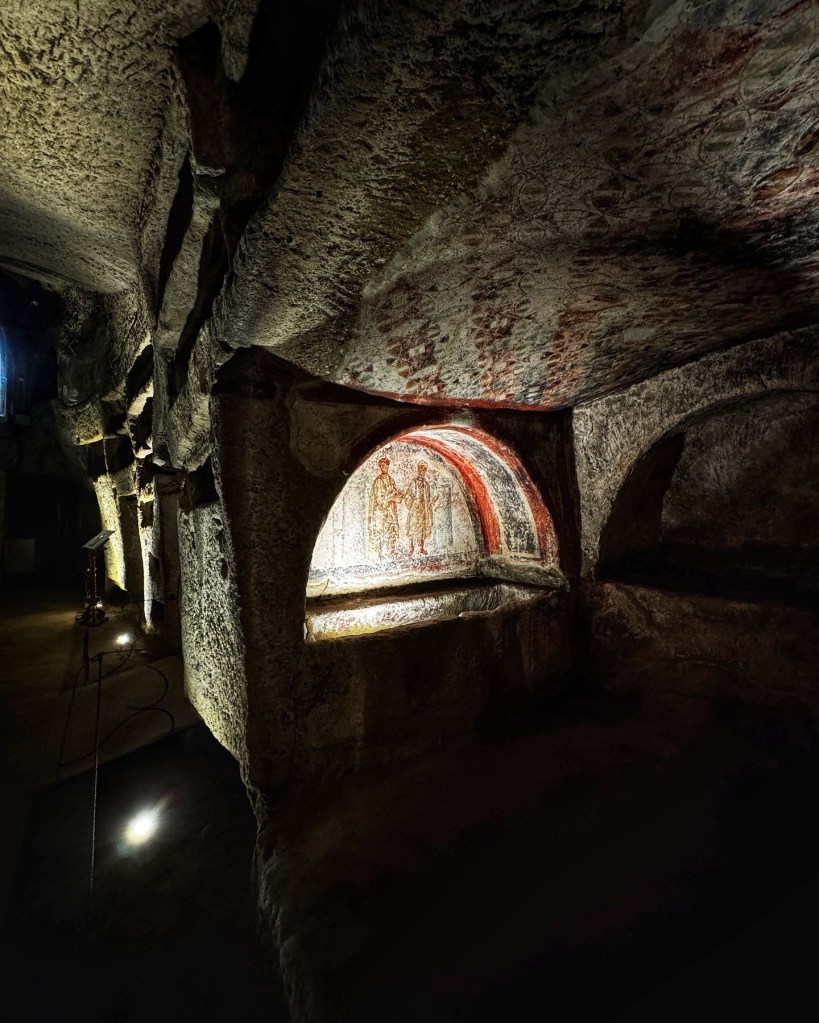
The painters borrowed freely from the Roman funerary art around them — pastoral scenes, banqueting motifs, figures of rescue and deliverance — and turned each towards purposes that Roman patrons had never imagined. What gives the decoration its particular character is this tension between familiar visual conventions and the new demands being placed on them. The underground setting matters, too. These images were made for the dead and for those who grieved over them, and this lends the whole programme an intimacy quite different from the monumental church cycles that followed. There is something unresolved about them, a quality the more confident decorative schemes of later centuries would largely leave behind.
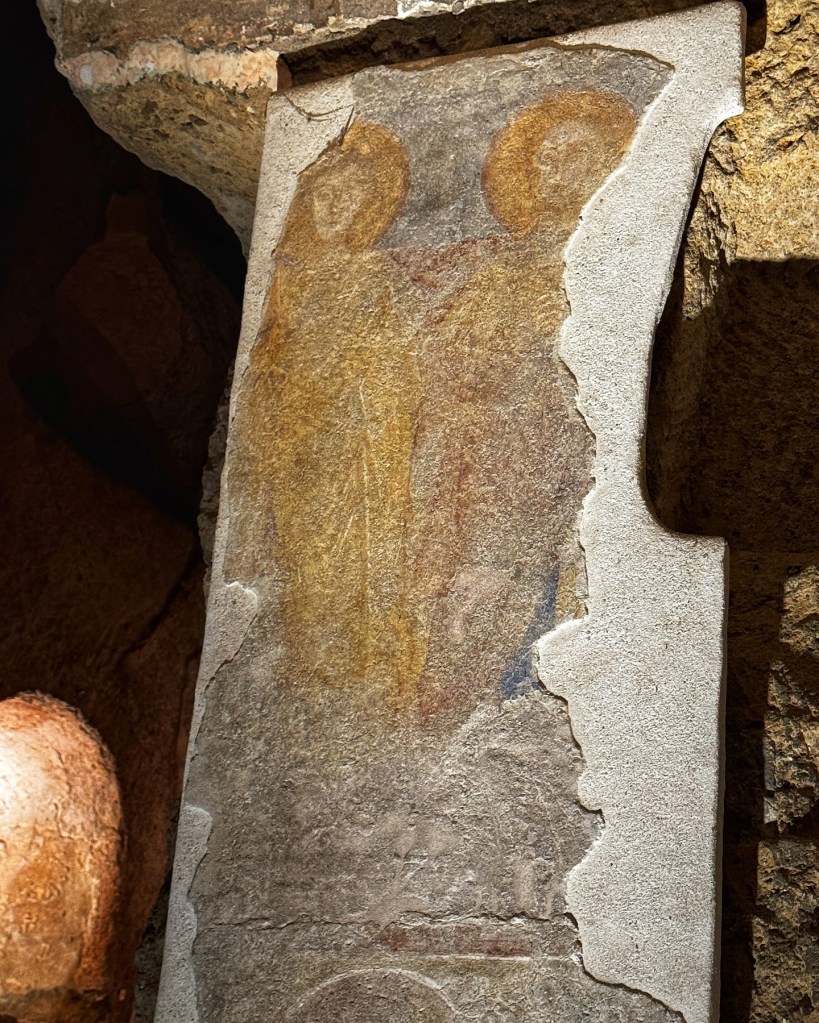
The earliest surviving frescoes, dating from the fifth and sixth centuries, work with a limited range of motifs, though each is used with care. Figures such as Bitalia and Cerula stand in the orant pose, arms raised in prayer, a gesture borrowed from Roman funerary tradition and given a new purpose: the soul’s direct address to God. Laurel wreaths, candles, and the image of Christ as Good Shepherd all come from the same inherited store, each one quietly adjusted in meaning without losing its older visual familiarity.
The fresco of Theotecnus and his family shows what this spare visual language could hold. The laurel wreath reads as divine reward, the lit candles as Christ’s guiding presence, and the composition as a whole carries the expected message of resurrection and salvation. But what sets it apart is a detail no formula demanded: the inclusion of the couple’s two-year-old daughter Nonnosa, identified by name and age in the accompanying inscription alongside her parents Theotecnus and Ilaritas. The specificity is arresting. For these mourners, grief and doctrinal hope were not separate categories.
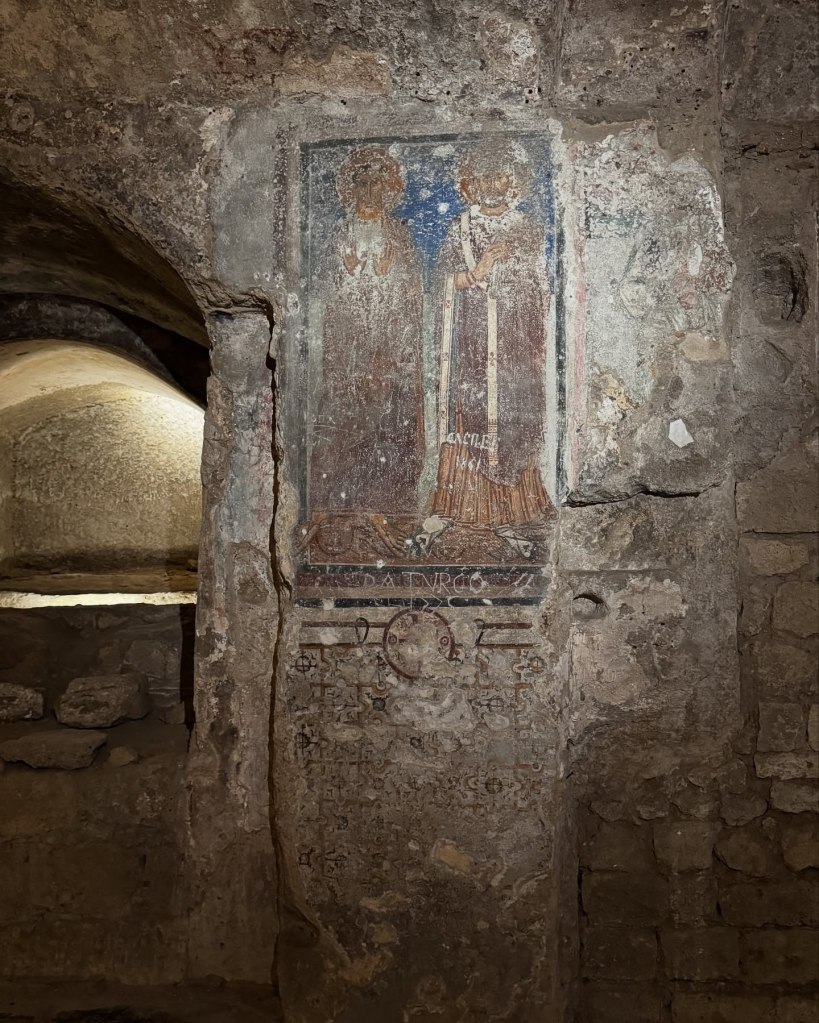
As Christianity gained institutional authority in the centuries that followed, the decoration of the catacombs changed accordingly. The burial chambers were eventually converted into a basilica, and the frescoes of this later period show a different kind of ambition. Saints, bishops, and martyrs appear with gold haloes and considerable technical skill, the imagery now serving the emerging cult of sainthood as much as the older needs of private mourning. The intimate, personal register of the earlier works gives way to something more formal and more public, less concerned with the named individual than with the collective authority of the Church.
The Catacombs of San Gennaro in Naples The Catacombs of San Gennaro in Naples The Catacombs of San Gennaro in Naples The Catacombs of San Gennaro in Naples The Catacombs of San Gennaro in Naples The Catacombs of San Gennaro in Naples The Catacombs of San Gennaro in Naples The Catacombs of San Gennaro in Naples The Catacombs of San Gennaro in Naples The Catacombs of San Gennaro in Naples The Catacombs of San Gennaro in Naples The Catacombs of San Gennaro in Naples The Catacombs of San Gennaro in Naples
Bisconti, F. (2018) ‘The Art of the Catacombs’, in Caraher, W.R., Davis, T.W. and Pettegrew, D.K. (eds.) The Oxford Handbook of Early Christian Archaeology. Oxford: Oxford University Press, pp. 210–230. Available at: https://www.academia.edu/38138891 (Accessed: 15 December 2024)
Blanchard, P. (2013) Blue Guide Southern Italy. London: Blue Guides
Spier, J. (ed.) (2007) Picturing the Bible: The Earliest Christian Art. New Haven: Yale University Press
Schibille, N., Neri, E., Ebanista, C., Ammar, M.R. and Bisconti, F. (2018) ‘Something old, something new: the late antique mosaics from the catacomb of San Gennaro (Naples)’, Journal of Archaeological Science: Reports, 20, pp. 411–422. Available at: https://www.sciencedirect.com/science/article/pii/S2352409X18301366 (Accessed: 15 December 2024)
Tusa Massaro, L. (2013) ‘Devotion and Memory: Episcopal Portraits in the Catacombs of San Gennaro in Naples’, Academia.edu. Available at: https://www.academia.edu/3461028 (Accessed: 15 December 2024)